Posts

THE STARK EFFECT
The Stark Effect describes how external electric fields shift or split atomic an...

ZEEMAN EFFECT
The Zeeman Effect describes how weak magnetic fields split atomic spectral lines...

Zeeman Effect and Paschen Back Effect
The Zeeman and Paschen-Back effects describe how magnetic fields split atomic sp...

HUNDS RULE
Hund’s Rule explains how electrons fill degenerate orbitals—occupying them singl...

Alkali Type Spectra and Equivalent Electrons in Physics
Alkali-type spectra arise from atoms with a single outer electron—like Li, Na, a...
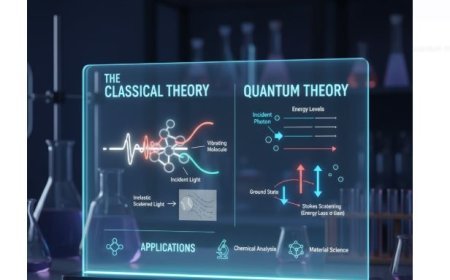
The Raman Effect: Classical and Quantum Theories
Explore the Raman Effect—an inelastic light-scattering phenomenon discovered by ...

Pauli's Exclusion Principle and Its Physical Significan...
Discover Pauli’s Exclusion Principle and how it shapes atomic structure, electro...

Lande's "g" Factor, LS-JJ Coupling Schemes
Learn how Lande’s g-factor defines atomic magnetic moments and why LS and JJ cou...
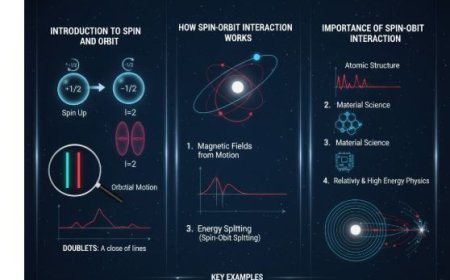
Spin-Orbit Interaction
Spin–orbit interaction describes how an electron’s intrinsic spin couples with i...
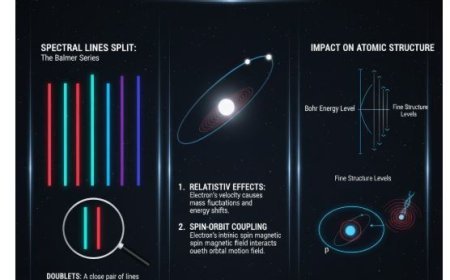
THE HYDROGEN ATOM
Discover how fine structure in the hydrogen atom arises from relativistic effect...

The Vector Model of the Atom and Its Quantum Numbers
Learn how the vector model explains atomic structure through quantized angular m...

Stern-Gerlach Experiment
Learn how the Stern–Gerlach experiment proved quantized angular momentum and ele...

ESR Spectrometers and Hyperfine Structure
Electron Spin Resonance (ESR) detects unpaired electrons using a microwave sourc...
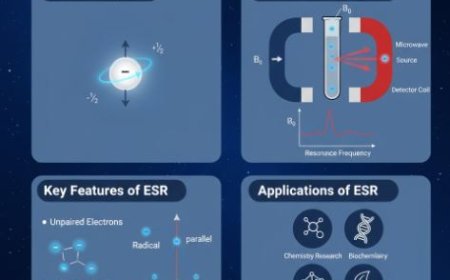
Electron Spin Resonance
Learn how Electron Spin Resonance (ESR/EPR) detects unpaired electrons using mag...

Instrumentation for NMR: Extra Techniques
Discover NMR instrumentation and extra techniques like MRI, DNMR, solid-state, a...

Bloch Equations, Dipolar Interactions, and Chemical Shifts
Learn how Bloch equations, dipolar interactions, and chemical shifts shape NMR a...