














TWIN LAWS IN CRYSTALS
Twin Laws are the crystallographic rules that govern the formation and orientation of twin crystals. Every twin crystal follows a definite geometric relationship known as a twin law, helping mineralogists understand crystal symmetry, classify different types of twinning, identify minerals, and interpret crystal growth and geological processes.
Twin Laws in Crystals
Introduction
- Twin Laws are among the most important concepts in crystallography because they explain how twin crystals are formed and how individual crystal segments are related to one another. When two or more crystal individuals grow together in a definite and symmetrical arrangement, the relationship between those crystal individuals is controlled by a specific crystallographic rule known as a Twin Law.
- Every twin crystal follows a particular twin law that determines the orientation of its crystal parts. Without these laws, crystal twinning would appear random and impossible to classify. Twin laws provide a scientific basis for understanding twinning and help mineralogists identify different types of twin crystals.
- Twin laws are important not only for mineral identification but also for studying crystal growth, crystal symmetry, geological processes, and crystal structure. Many minerals possess characteristic twin laws that serve as valuable diagnostic features.
What are Twin Laws?
- Twin Laws are crystallographic rules that define the geometrical relationship between two or more twin crystal individuals.
- These laws specify how one crystal individual is related to another through a symmetry operation.
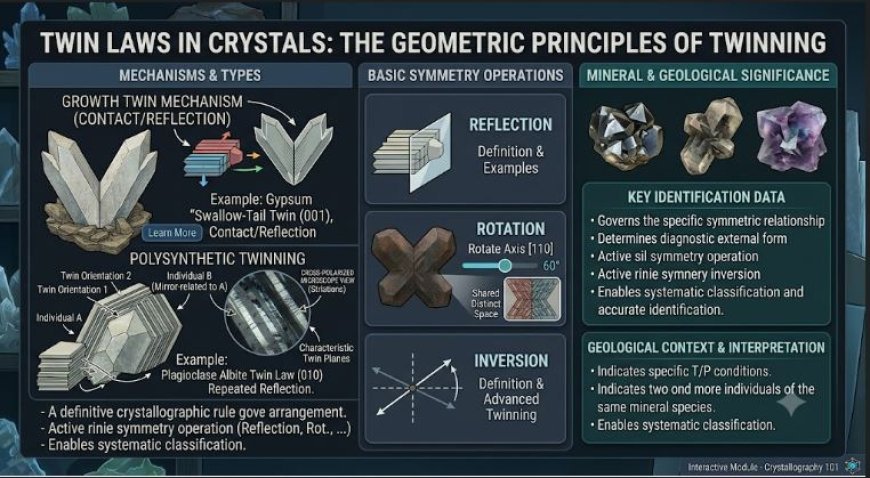
- The relationship may involve reflection across a plane, rotation around an axis, or inversion through a point.
- Twin laws determine the orientation of crystal individuals within a twin crystal.
- Each type of twinning follows a specific twin law.
Definition of Twin Law
- A Twin Law may be defined as the crystallographic rule that describes the symmetry relationship between twin individuals in a twinned crystal.
- It specifies the twin plane, twin axis, or twin center responsible for the twin arrangement.
- The twin law serves as the foundation for classifying and understanding all forms of crystal twinning.
Importance of Twin Laws
- Twin laws provide a systematic method for studying crystal twinning.
- They help identify minerals based on characteristic twin relationships.
- They explain the geometrical arrangement of twin crystals.
- They assist in understanding crystal growth mechanisms.
- They provide information about geological conditions during mineral formation.
- They play an important role in crystallographic classification.
Basic Principles of Twin Laws
- Twin laws are based on crystallographic symmetry.
- The twin relationship must follow a definite geometrical rule.
- Twin individuals belong to the same mineral species.
- The crystal individuals possess identical chemical composition.
- The difference between twin individuals lies only in their orientation.
- The orientation relationship remains constant throughout the twin structure.
Elements Associated with Twin Laws
Twin Plane
- The Twin Plane is an imaginary crystallographic plane that relates twin individuals as mirror images.
- It is one of the most common elements used in twin laws.
- Many contact twins are controlled by a twin plane.
- The twin plane often serves as the boundary between crystal individuals.
Twin Axis
- The Twin Axis is an imaginary line around which one crystal individual is rotated relative to another.
- Rotation through a specific angle produces the twin relationship.
- Many penetration twins are described using a twin axis.
Twin Center
- The Twin Center is a point through which inversion relates the twin individuals.
- This type of relationship is less common but still important in crystallography.
Composition Plane
- The Composition Plane is the actual surface separating the twin individuals.
- It often coincides with the twin plane but not always.
Types of Twin Laws
Reflection Twin Law
- In this type, the twin individuals are related by reflection across a twin plane.
- One crystal appears as the mirror image of the other.
- Reflection twin laws are common in contact twins.
- The twin plane serves as the symmetry element controlling the relationship.
Rotation Twin Law
- Here, the twin individuals are related by rotation around a twin axis.
- One crystal is rotated through a specific angle relative to the other.
- Rotation twin laws are common in penetration twins.
- The rotational relationship creates distinctive crystal shapes.
Inversion Twin Law
- In this type, twin individuals are related by inversion through a twin center.
- Every point in one crystal corresponds to an equivalent point in the other crystal.
- Although less common, inversion twins are important in advanced crystallography.
How Twin Laws are Expressed
- Twin laws are generally expressed using crystallographic planes or directions.
- The notation indicates the crystallographic element responsible for the twin relationship.
- For example, a twin plane may be represented by a specific crystallographic index.
- Twin axes are similarly described using crystallographic directions.
- This standardized notation allows scientists worldwide to describe twin relationships accurately.
Common Twin Laws in Minerals
Albite Twin Law
- The Albite Twin Law is one of the most important twin laws in mineralogy.
- It is commonly observed in plagioclase feldspar.
- The twin relationship produces repeated twin lamellae.
- This law is responsible for the characteristic striations seen in plagioclase feldspars.
- Albite twinning is an important diagnostic feature used in mineral identification.
Carlsbad Twin Law
- The Carlsbad Twin Law is commonly found in orthoclase feldspar.
- The twin relationship is controlled by rotation around a crystallographic axis.
- Carlsbad twins usually consist of two crystal individuals.
- This law produces characteristic twin crystals commonly observed in granitic rocks.
Baveno Twin Law
- The Baveno Twin Law occurs mainly in feldspar minerals.
- It produces contact twins with a distinctive crystal arrangement.
- Baveno twinning is commonly used to identify orthoclase feldspar.
Manebach Twin Law
- The Manebach Twin Law is another important feldspar twin law.
- It produces characteristic contact twin structures.
- The resulting crystal forms are often symmetrical and easily recognizable.
Spinel Twin Law
- The Spinel Twin Law is characteristic of minerals belonging to the spinel group.
- It commonly produces penetration twins.
- This law serves as an important example of rotational twinning.
Twin Laws and Different Types of Twins
Simple Twins
- Simple twins generally follow a single twin law.
- The relationship involves only two crystal individuals.
Contact Twins
- Contact twins commonly follow reflection twin laws.
- The twin plane serves as the boundary between crystal individuals.
Interpenetration Twins
- Interpenetration twins often follow rotation twin laws.
- Crystal individuals grow through one another according to a specific orientation relationship.
Polysynthetic Twins
- Polysynthetic twins involve repeated application of the same twin law.
- Multiple twin lamellae develop according to a single crystallographic rule.
Role of Twin Laws in Mineral Identification
- Twin laws are valuable tools for identifying minerals.
- Many minerals possess characteristic twin relationships.
- The presence of a particular twin law often confirms mineral identity.
- Feldspar minerals are commonly identified using their twin laws.
- Twin laws help distinguish minerals that otherwise appear similar.
Geological Significance of Twin Laws
- Twin laws preserve information about crystal growth conditions.
- They help geologists understand mineral formation processes.
- Certain twin laws indicate specific temperature and pressure conditions.
- Deformation twins reveal evidence of tectonic activity.
- Transformation twins record structural changes within minerals.
Applications of Twin Law Studies
- Mineral identification
- Petrographic analysis
- Structural geology
- Crystallographic research
- Materials science
- Gemstone investigations
- Metamorphic studies
- Crystal growth research
Advantages of Understanding Twin Laws
- Improves mineral identification accuracy.
- Helps classify crystal twins systematically.
- Enhances understanding of crystal symmetry.
- Supports crystallographic research.
- Provides information about geological history.
- Assists in advanced mineralogical studies.
Twin Laws and Crystal Symmetry
- Twin laws are closely related to crystal symmetry.
- They describe symmetry operations that are not normally present in the individual crystal.
- The twin structure often exhibits apparent symmetry greater than that of the single crystal.
- Studying twin laws helps crystallographers understand the relationship between symmetry and crystal growth.
Importance of Twin Laws in Crystallography
- Twin Laws form the theoretical foundation of crystal twinning studies.
- They explain how twin crystals develop and why specific twin arrangements occur.
- Understanding twin laws allows scientists to classify twins accurately and interpret crystal growth processes.
- These laws play a major role in mineral identification, crystallographic analysis, and geological investigations.
- Twin laws also help researchers understand crystal deformation, metamorphism, and structural transformations.
- Because twinning occurs in a large number of minerals, knowledge of twin laws is essential for students of geology, mineralogy, crystallography, petrology, and materials science.
- The study of twin laws provides a complete understanding of crystal twinning and serves as a bridge between crystal growth, crystal symmetry, and crystal structure.
- Due to their scientific importance and practical applications, Twin Laws remain one of the most fundamental topics in crystallography and mineralogical research.
What's Your Reaction?