













Forms of Crystals in the Tetragonal System
The Tetragonal Crystal System produces characteristic crystal forms such as tetragonal prisms, pyramids, dipyramids, and ditetragonal forms due to its four-fold symmetry. Learn about their morphology, symmetry, and mineral examples in crystallography and mineralogy.
Forms of Crystals in the Tetragonal System
Introduction
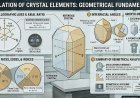
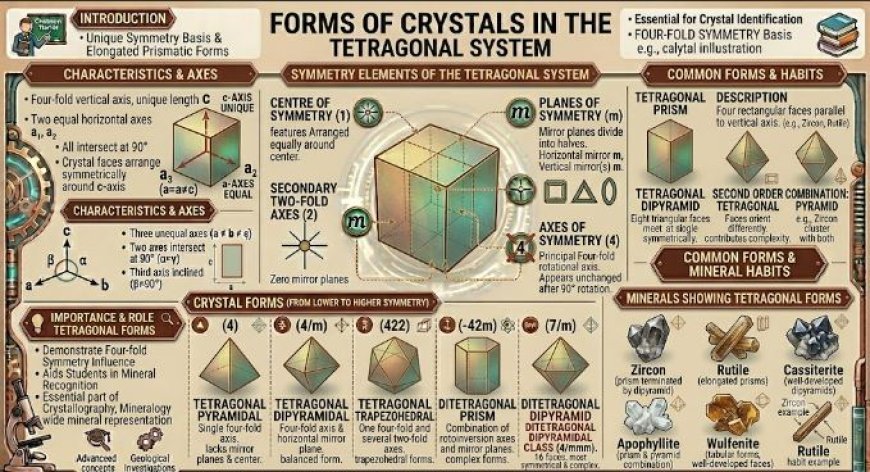
- The Tetragonal Crystal System is one of the seven crystal systems recognized in crystallography. It is characterized by three crystallographic axes where the two horizontal axes are equal in length and the vertical axis differs in length. All three axes intersect at right angles. This arrangement gives rise to a wide range of crystal forms that display four-fold symmetry.
- Crystal forms in the tetragonal system are generally more symmetrical than those of the orthorhombic, monoclinic, and triclinic systems but less symmetrical than those of the cubic system. The study of these crystal forms is important because it helps mineralogists identify minerals and understand the relationship between crystal structure and external shape.
- Minerals such as zircon, rutile, cassiterite, apophyllite, and wulfenite commonly exhibit tetragonal crystal forms. The various crystal forms found in this system demonstrate how symmetry influences crystal growth and morphology.
Characteristics of Tetragonal Crystal Forms
- Crystal forms in the tetragonal system are based on a four-fold axis of symmetry.
- The horizontal crystallographic axes are equal in length, while the vertical axis is unequal.
- All crystallographic axes intersect at 90°.
- Crystal faces are arranged symmetrically around the principal vertical axis.
- Many crystal forms occur as combinations of prisms, pyramids, and dipyramids.
- The crystal forms exhibit a balanced and geometrically regular appearance.
Tetragonal Prism
- The Tetragonal Prism is one of the most common crystal forms in the tetragonal system. It consists of four rectangular faces arranged parallel to the vertical axis. The faces intersect each other at right angles and form a prism with a square cross-section.
- This crystal form develops when crystal growth occurs equally along the horizontal axes while extending vertically. The tetragonal prism often serves as the main body of tetragonal crystals and may combine with pyramidal forms at its ends.
- Minerals such as zircon and rutile commonly develop tetragonal prisms. These crystals often appear elongated due to growth along the vertical axis.
- The tetragonal prism is important because it clearly demonstrates the four-fold symmetry characteristic of the tetragonal system.
First Order Tetragonal Pyramid
- The First Order Tetragonal Pyramid consists of four triangular faces that meet at a common point above or below the crystal. Each face intersects both horizontal axes equally while meeting the vertical axis at a specific angle.
- This form commonly develops at the ends of tetragonal prisms and gives the crystal a pointed appearance. The faces are arranged symmetrically around the four-fold axis, producing a balanced crystal shape.
- First-order pyramids are frequently observed in many tetragonal minerals and often occur in combination with prism forms.
- The development of these pyramids depends on the relative growth rates of different crystal faces during crystal formation.
Second Order Tetragonal Pyramid
- The Second Order Tetragonal Pyramid also consists of four triangular faces, but the orientation of these faces differs from that of the first-order pyramid.
- The faces intersect the crystallographic axes in a different manner, producing a crystal form that appears rotated relative to the first-order pyramid.
- This crystal form contributes additional complexity to tetragonal crystals and may occur alone or in combination with other forms.
- The second-order pyramid plays an important role in understanding crystal symmetry and face orientation within the tetragonal system.
Tetragonal Dipyramid
- The Tetragonal Dipyramid is formed when two identical pyramids are joined base to base. It consists of eight triangular faces arranged symmetrically around the vertical axis.
- This crystal form is one of the most characteristic forms of the tetragonal system and is commonly observed in minerals such as zircon and cassiterite.
- Because of its symmetrical arrangement, the tetragonal dipyramid exhibits excellent geometric balance and often forms well-developed crystal shapes.
- The dipyramidal form reflects the influence of the four-fold rotational axis and demonstrates the high degree of symmetry present in the tetragonal system.
Ditetragonal Prism
- The Ditetragonal Prism is a more complex crystal form than the ordinary tetragonal prism. It consists of eight prism faces arranged around the vertical axis instead of four.
- The additional faces result from modifications of the simple prism and increase the complexity of the crystal shape.
- This form is commonly associated with higher symmetry classes of the tetragonal system and often occurs in combination with dipyramidal forms.
- The ditetragonal prism demonstrates how crystal growth can produce more elaborate forms while maintaining overall symmetry.
Ditetragonal Dipyramid
- The Ditetragonal Dipyramid is one of the most symmetrical and complex crystal forms of the tetragonal system. It consists of sixteen triangular faces arranged symmetrically around the crystal.
- This form belongs to the higher symmetry classes and is particularly associated with the Ditetragonal Dipyramidal Class (4/mmm), which is the normal class of the tetragonal system.
- The crystal form exhibits a high degree of symmetry and often appears as a highly modified dipyramid with numerous faces.
- It represents the maximum development of symmetry possible within the tetragonal system and serves as an important example in crystallographic studies.
Combinations of Tetragonal Crystal Forms
- In nature, crystals rarely occur as perfect examples of a single crystal form. Instead, several forms commonly combine during crystal growth to produce complex crystal shapes.
- A tetragonal crystal may consist of a tetragonal prism combined with a tetragonal dipyramid, producing a crystal that is elongated in the center and pointed at both ends.
- Similarly, first-order and second-order pyramids may develop together on the same crystal, creating intricate geometrical patterns.
- The combination of different crystal forms helps mineralogists identify minerals and understand their growth history.
Minerals Showing Tetragonal Crystal Forms
- Several important minerals exhibit crystal forms belonging to the tetragonal system.
- Zircon commonly develops tetragonal prisms terminated by dipyramids and is one of the best-known tetragonal minerals.
- Rutile frequently forms elongated tetragonal prisms and needle-like crystals.
- Cassiterite, the principal ore of tin, often displays well-developed dipyramidal forms.
- Apophyllite commonly develops prism and pyramid combinations that clearly demonstrate tetragonal symmetry.
- Wulfenite may form tabular tetragonal crystals with well-developed crystal faces.
- These minerals provide excellent examples for studying tetragonal crystal morphology and symmetry.
Importance of Tetragonal Crystal Forms
- The crystal forms of the Tetragonal Crystal System are important because they demonstrate the influence of four-fold symmetry on crystal growth and external appearance.
- Understanding these forms helps students recognize minerals and classify crystals accurately. The study of prisms, pyramids, dipyramids, and ditetragonal forms also provides insight into the relationship between crystal structure and crystal morphology.
- Tetragonal crystal forms are widely used in mineral identification, crystallographic research, and geological investigations. They help explain how symmetry controls the development of crystal faces and contributes to the formation of beautiful natural crystals.
- Because many economically important minerals belong to this system, the study of tetragonal crystal forms remains an essential part of crystallography, mineralogy, and geological sciences.
What's Your Reaction?








ARUL PRASANTH
Arul Prasanth - MSc Geology graduate offering comprehensive study materials in Geology, Physics, and English. With a focus on clarity and effectiveness, I aim to provide students with the tools necessary for academic success.