













Forms of Crystals in the Trigonal System
The Trigonal Crystal System produces characteristic crystal forms such as rhombohedrons, scalenohedrons, trigonal prisms, and trigonal pyramids due to its three-fold symmetry. Learn about their morphology, symmetry, and mineral examples in crystallography and mineralogy.
Forms of Crystals in the Trigonal SystemForms of Crystals in the Trigonal System
Introduction
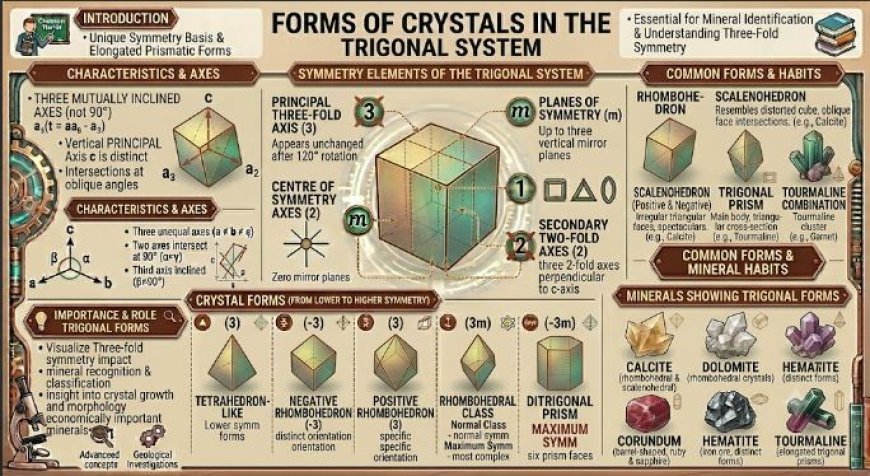
- The Trigonal Crystal System is one of the seven crystal systems recognized in crystallography. Although it is closely related to the hexagonal system, it is distinguished by the presence of a three-fold rotational axis of symmetry. This symmetry causes crystals to repeat their appearance every 120° rotation around the principal axis.
- The trigonal system contains several unique crystal forms that are not found in other crystal systems. These forms often exhibit striking geometric shapes and are commonly observed in minerals such as calcite, corundum, hematite, tourmaline, and dolomite.
- The study of trigonal crystal forms is essential for understanding crystal symmetry, mineral classification, and crystal morphology. These forms also provide valuable information about crystal growth conditions and the internal arrangement of atoms within minerals.
Characteristics of Trigonal Crystal Forms
- Crystal forms in the trigonal system are based on a three-fold rotational axis.
- The crystal repeats its appearance after a rotation of 120°.
- Crystal forms commonly develop as rhombohedrons, scalenohedrons, prisms, and pyramids.
- The system exhibits moderate symmetry compared to cubic and hexagonal systems.
- Crystal faces are arranged symmetrically around the vertical axis.
- Many forms display distinctive angular relationships that help in mineral identification.
- Trigonal crystal forms often occur in combination, producing complex and attractive crystal habits.
Rhombohedron
- The Rhombohedron is the most characteristic crystal form of the trigonal system. It consists of six rhomb-shaped faces arranged symmetrically around the crystal.
- Although it resembles a cube in some respects, the angles between its faces are not 90°. Instead, the faces meet at oblique angles, giving the crystal a distinctive appearance.
- Rhombohedrons may occur as positive or negative forms depending on the orientation of the crystal faces.
- Minerals such as calcite and dolomite commonly develop rhombohedral crystal forms.
- This crystal form is extremely important in mineralogy because it serves as one of the most reliable indicators of trigonal symmetry.
Positive Rhombohedron
- A Positive Rhombohedron is a rhombohedral form whose faces intersect the crystallographic axes in a specific orientation.
- The arrangement of faces follows the symmetry requirements of the trigonal system and produces a crystal form that is slightly different from the negative rhombohedron.
- Positive rhombohedrons often occur in combination with other crystal forms and contribute to the diversity of crystal habits observed in trigonal minerals.
Negative Rhombohedron
- A Negative Rhombohedron is similar in shape to the positive rhombohedron but differs in the orientation of its faces.
- The distinction between positive and negative rhombohedrons is important in crystallographic studies because it helps identify crystal symmetry and crystal class.
- Many trigonal minerals may exhibit both positive and negative rhombohedral forms on the same crystal.
Scalenohedron
- The Scalenohedron is one of the most distinctive crystal forms in the trigonal system.
- It consists of twelve scalene triangular faces arranged symmetrically around the crystal.
- The crystal resembles two pyramids joined together, but the faces are irregular triangles rather than equilateral triangles.
- Minerals such as calcite commonly develop scalenohedral forms and may display spectacular crystal shapes.
- The scalenohedron is important because it demonstrates how complex crystal forms can arise from trigonal symmetry.
Trigonal Prism
- The Trigonal Prism consists of three rectangular faces arranged parallel to the vertical axis.
- These faces form a prism with a triangular cross-section.
- Trigonal prisms often serve as the main body of crystals and may be terminated by pyramidal or rhombohedral forms.
- Minerals such as tourmaline frequently develop trigonal prismatic crystals that are elongated along the vertical axis.
- This crystal form clearly demonstrates the influence of three-fold symmetry on crystal growth.
Trigonal Pyramid
- The Trigonal Pyramid consists of three triangular faces that meet at a common point.
- The faces are arranged symmetrically around the principal axis and produce a pointed crystal shape.
- Trigonal pyramids commonly occur as terminal forms on trigonal prisms.
- They contribute to the development of characteristic crystal habits and help mineralogists identify trigonal minerals.
Ditrigonal Prism
- The Ditrigonal Prism is a modified form of the simple trigonal prism.
- Instead of three prism faces, it contains six prism faces arranged around the crystal.
- The additional faces increase the complexity of the crystal form while preserving overall trigonal symmetry.
- This form commonly occurs in higher-symmetry classes of the trigonal system and is frequently observed in well-developed crystals.
Ditrigonal Pyramid
- The Ditrigonal Pyramid consists of six triangular faces arranged around the crystal.
- It develops when additional crystal faces appear between the faces of a simple trigonal pyramid.
- This form is more symmetrical and complex than the ordinary trigonal pyramid.
- Ditrigonal pyramids often combine with prisms and rhombohedrons to create intricate crystal habits.
Combinations of Trigonal Crystal Forms
- In nature, crystals rarely occur as perfect examples of a single crystal form.
- Instead, multiple forms usually combine during crystal growth.
- A crystal may consist of a trigonal prism combined with a rhombohedron, producing an elongated crystal with inclined terminal faces.
- Similarly, prisms may combine with pyramids, scalenohedrons, or ditrigonal forms.
- These combinations create the wide variety of crystal shapes observed in trigonal minerals.
- Studying these combinations helps mineralogists understand crystal growth conditions and identify minerals accurately.
Minerals Showing Trigonal Crystal Forms
- Several important minerals belong to the trigonal crystal system and display characteristic crystal forms.
- Calcite is one of the most common trigonal minerals and frequently develops rhombohedral and scalenohedral forms.
- Dolomite often forms rhombohedral crystals similar to those of calcite.
- Corundum, including ruby and sapphire varieties, belongs to the trigonal system and commonly develops barrel-shaped crystals.
- Hematite often exhibits trigonal crystal forms and is an important ore of iron.
- Tourmaline develops elongated trigonal prisms and is widely recognized for its distinctive crystal habit.
- These minerals provide excellent examples for studying trigonal symmetry and crystal morphology.
Importance of Trigonal Crystal Forms
- The crystal forms of the Trigonal Crystal System are important because they demonstrate the effects of three-fold symmetry on crystal growth and external appearance.
- Understanding rhombohedrons, scalenohedrons, prisms, and pyramids helps students recognize trigonal minerals and classify crystals correctly.
- These forms play a major role in mineral identification, crystallographic research, and geological investigations.
- The study of trigonal crystal forms also helps explain the relationship between crystal symmetry and crystal morphology.
- Many economically important minerals belong to this system, making their crystal forms valuable in mining, gemstone studies, and mineral exploration.
- Knowledge of trigonal crystal forms provides a strong foundation for advanced studies in crystallography and mineralogy.
- Because of their unique geometry, scientific importance, and natural beauty, trigonal crystal forms remain one of the most fascinating topics in crystal morphology and geological sciences.
What's Your Reaction?








ARUL PRASANTH
Arul Prasanth - MSc Geology graduate offering comprehensive study materials in Geology, Physics, and English. With a focus on clarity and effectiveness, I aim to provide students with the tools necessary for academic success.