












INSTRUMENTS USED FOR CRYSTAL GROWTH
Instruments used for crystal growth provide controlled conditions such as temperature, pressure, humidity, and chemical composition required for crystal formation. These instruments help scientists grow high-quality crystals for research, mineralogical studies, electronics, optics, medicine, and advanced material science applications.
Instruments Used for Crystal Growth
Introduction
- Crystal growth is the process through which atoms, molecules, or ions arrange themselves in a regular pattern to form crystals. In nature, this process may take thousands or even millions of years. In laboratories, however, scientists use special instruments to grow crystals more quickly and under controlled conditions.
- These instruments help maintain the proper environment needed for crystal formation. Factors such as temperature, pressure, humidity, and chemical concentration are carefully controlled to produce crystals of the desired size and quality.
- Crystal growth instruments are widely used in scientific research, electronics, medicine, optics, and mineralogical studies. They allow researchers to understand crystal formation and produce materials required for modern technology.
Why are Crystal Growth Instruments Needed?
- Natural crystal formation is usually slow and difficult to control.
- Scientists often need crystals with specific shapes, sizes, and purity levels.
- Industrial applications require defect-free crystals for better performance.
- Controlled growth conditions improve crystal quality.
- These instruments make crystal production faster and more efficient.
Main Functions of Crystal Growth Instruments
- Maintain a stable temperature.
- Control pressure during crystal formation.
- Regulate chemical concentration.
- Protect crystals from contamination.
- Monitor crystal development.
- Produce crystals with fewer defects.
- Support the growth of large and pure crystals.
Types of Crystal Growth Instruments
Crystal Growth Chamber
- A Crystal Growth Chamber is a closed container where crystals are grown under controlled conditions.
- It protects growing crystals from dust, impurities, and sudden environmental changes.
- Researchers can control temperature and humidity inside the chamber.
- Small crystals used in educational and laboratory studies are often grown using this instrument.
Crystallizer
- A Crystallizer is used to grow crystals from liquid solutions.
- It works by slowly cooling or evaporating a saturated solution.
- As the solution becomes concentrated, crystals begin to form and grow.
- Crystallizers are commonly used for growing salt, sugar, and laboratory crystals.
Hydrothermal Growth Equipment
- Some crystals require high temperatures and pressures to form properly.
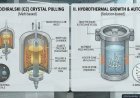
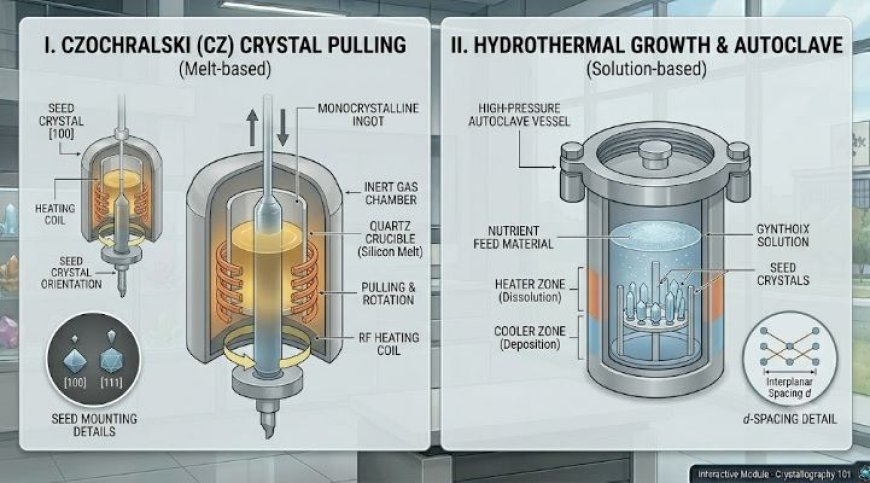
- A Hydrothermal Growth System creates conditions similar to those found deep inside the Earth.
- Materials dissolve in hot fluids and later deposit on a seed crystal.
- This method is commonly used for growing quartz and synthetic gemstones.
Autoclave
- An Autoclave is a strong metal vessel capable of withstanding high pressure and temperature.
- It is one of the most important tools used in hydrothermal crystal growth.
- The instrument allows minerals to dissolve and recrystallize under controlled conditions.
- Large and high-quality crystals can be produced using an autoclave.
Crystal Pulling Equipment
Czochralski Crystal Puller
- The Czochralski Method is widely used for producing large single crystals.
- A seed crystal is dipped into molten material and slowly pulled upward.
- As the seed rises, crystal material solidifies onto it.
- This method produces highly pure crystals used in electronics.
- Most silicon crystals used in computer chips are produced by this technique.
Furnaces Used in Crystal Growth
Bridgman Furnace
- A Bridgman Furnace is used to grow crystals from molten materials.
- The material is melted and then cooled slowly.
- Controlled cooling allows atoms to arrange themselves into a crystal structure.
- This method is often used to grow semiconductor and optical crystals.
Floating Zone Furnace
- The Floating Zone Furnace allows crystal growth without using a container.
- A small region of the material is melted while the rest remains solid.
- The molten zone moves slowly through the material, producing a crystal as it cools.
- Since no container is used, contamination is greatly reduced.
- This technique is useful for producing extremely pure crystals.
Vapor Growth Instruments
Vapor Deposition System
- Some crystals are grown directly from gases rather than liquids or melts.
- In a Vapor Deposition System, the material is converted into vapor.
- The vapor moves to a cooler area where it condenses and forms crystals.
- This technique is widely used in electronics and nanotechnology.
- Thin crystal layers used in modern devices are often produced in this way.
Gel Growth Equipment
Gel Growth Apparatus
- Certain delicate crystals are difficult to grow in liquids.
- A Gel Growth Apparatus uses a gel medium instead of a liquid solution.
- The gel slows down crystal growth and reduces disturbances.
- This produces well-shaped crystals with fewer defects.
- The method is commonly used in research laboratories.
Supporting Instruments in Crystal Growth
Temperature Controllers
- Temperature is one of the most important factors affecting crystal growth.
- Temperature controllers maintain stable heating conditions.
- They prevent sudden changes that may damage growing crystals.
Pressure Measuring Devices
- Pressure gauges monitor pressure inside crystal growth systems.
- They are especially important in hydrothermal methods.
Thermocouples
- Thermocouples measure temperature accurately.
- They help scientists maintain ideal growth conditions.
Microscopes
- Microscopes allow researchers to observe crystal growth directly.
- Small defects and structural changes can be detected during growth.
Digital Monitoring Systems
- Modern crystal growth instruments use sensors and computer systems.
- These systems continuously record temperature, pressure, and growth rates.
- Automatic monitoring improves crystal quality and consistency.
Applications of Crystal Growth Instruments
- Production of semiconductor materials.
- Manufacturing computer chips.
- Solar panel technology.
- Optical crystal production.
- Synthetic gemstone manufacturing.
- Medical and pharmaceutical research.
- Mineralogical investigations.
- Geological research.
- Nanotechnology development.
- Advanced materials engineering.
Importance of Crystal Growth Instruments
- Crystal growth instruments have become essential tools in modern science and technology.
- They allow researchers to create crystals that are difficult or impossible to obtain naturally.
- High-quality crystals produced in laboratories are used in computers, mobile phones, lasers, medical devices, and communication systems.
- These instruments also help scientists study crystal structures, growth mechanisms, and material properties in detail.
- In geology and mineralogy, crystal growth instruments provide valuable information about how minerals form in nature and how their structures develop over time.
- Because of their importance in research, industry, and technology, crystal growth instruments remain a key part of crystallography and material science.
What's Your Reaction?