













CALCULATION OF CRYSTAL ELEMENTS
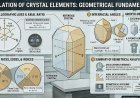
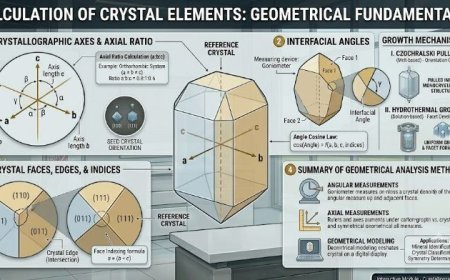
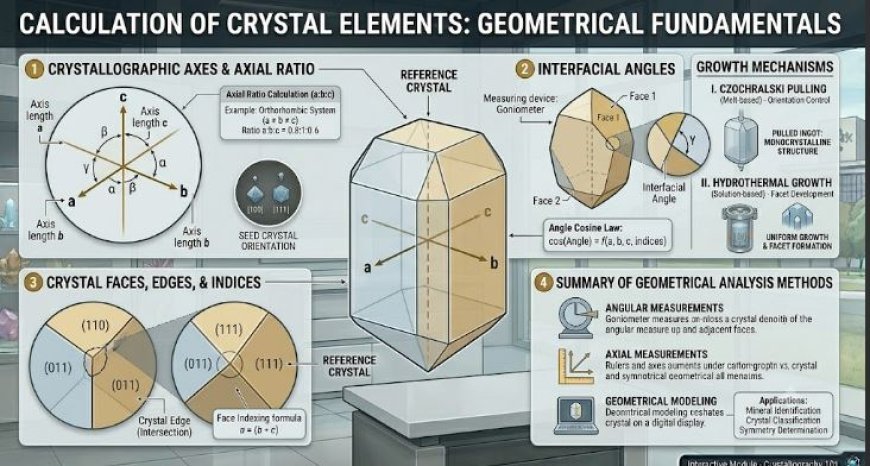
Calculation of Crystal Elements involves determining the geometrical relationships of crystallographic axes, crystal faces, edges, axial ratios, and interfacial angles. These calculations are essential for describing crystal geometry, identifying minerals, classifying crystal systems, understanding crystal symmetry, and conducting advanced crystallographic studies.
Calculation of Crystal Elements
Introduction
- The study of crystals involves not only identifying their external shape but also understanding their geometrical relationships. These geometrical features are known as crystal elements. They provide important information about the position of crystal faces, edges, angles, and crystallographic axes. The calculation of crystal elements helps scientists accurately describe crystal forms and classify minerals according to their symmetry and structure.
What are Crystal Elements?
- Crystal elements are the basic geometrical components that define the shape and orientation of a crystal. They include crystallographic axes, interfacial angles, crystal faces, edges, and axial ratios. These elements serve as reference points for studying crystal geometry and determining the symmetry of a crystal. Accurate calculation of these elements is essential for understanding crystal structures and their physical properties.
Importance of Calculating Crystal Elements
- The calculation of crystal elements provides a scientific method for describing crystal forms. It helps determine the exact position of crystal faces and their relationships with crystallographic axes. These calculations are important in mineral identification, crystal classification, and crystallographic research. They also help in constructing crystal models and understanding crystal growth patterns.
Crystallographic Axes
- Crystallographic axes are imaginary reference lines that pass through the center of a crystal. They are used to describe the orientation of crystal faces and forms. Different crystal systems have different arrangements of axes. The lengths of the axes and the angles between them are important crystal elements that are carefully measured and calculated during crystallographic studies.
Axial Ratio
- The axial ratio expresses the relative lengths of crystallographic axes. Instead of using actual measurements, crystallographers compare the axes proportionally. This ratio helps identify the crystal system and determine the shape of the unit cell. Axial ratios are particularly useful when comparing crystals of the same mineral that differ in size but have identical geometry.
Interfacial Angles
- An interfacial angle is the angle formed between two adjacent crystal faces. These angles are constant for a particular mineral regardless of crystal size. Measuring and calculating interfacial angles is one of the most important methods used in crystal identification. Special instruments such as goniometers are commonly used for this purpose.
Crystal Faces
- Crystal faces are the flat surfaces that form the external boundaries of a crystal. Their orientation relative to the crystallographic axes is an important crystal element. Calculating the position of crystal faces helps determine crystal forms and classify crystals into different systems and classes.
Crystal Edges
- Crystal edges are formed by the intersection of two crystal faces. The position and direction of these edges provide valuable information about crystal geometry. Studying crystal edges helps crystallographers understand the relationships between different crystal faces and their arrangement within the crystal.
Methods Used in Calculation
Angular Measurements
- Angular measurements involve determining the angles between crystal faces. These measurements provide important data for calculating crystal elements and identifying crystal forms.
Axial Measurements
- Axial measurements focus on determining the relative lengths and orientations of crystallographic axes. These measurements help establish axial ratios and crystal geometry.
Geometrical Analysis
- Geometrical analysis uses mathematical relationships between crystal faces, edges, and axes. This method allows precise calculation of crystal elements and helps construct accurate crystal models.
Applications of Crystal Element Calculations
- Mineral identification.
- Crystal classification.
- Determination of crystal symmetry.
- Construction of crystal models.
- X-ray crystallographic studies.
- Geological and mineralogical research.
- Study of crystal growth and development.
Role in Crystallography
- The calculation of crystal elements forms the foundation of crystallographic studies. It allows scientists to describe crystal structures accurately and compare different minerals based on their geometry. These calculations are essential for understanding crystal systems, crystal classes, and the internal arrangement of atoms within crystals.
What's Your Reaction?








ARUL PRASANTH
Arul Prasanth - MSc Geology graduate offering comprehensive study materials in Geology, Physics, and English. With a focus on clarity and effectiveness, I aim to provide students with the tools necessary for academic success.