













POLYSYNTHETIC TWINS IN CRYSTALS
Polysynthetic Twinning is a special type of crystal twinning in which numerous twin lamellae are arranged parallel to one another according to the same twin law. This form of twinning is particularly common in feldspar minerals and serves as an important feature in mineral identification, petrographic analysis, and crystallographic studies.
Polysynthetic Twins in Crystals
Introduction
- Polysynthetic Twinning is one of the most important and commonly observed forms of crystal twinning in mineralogy. Unlike simple twins, which involve only two crystal individuals, polysynthetic twins consist of numerous thin twin layers arranged parallel to one another. These repeated twin layers are known as twin lamellae.
- Polysynthetic twinning is especially significant because it is widely developed in many minerals, particularly the plagioclase feldspar group. The presence of these twin lamellae often produces characteristic striations that can be observed with the naked eye or under a microscope.
- The study of polysynthetic twins is important because it helps geologists identify minerals, understand crystal growth processes, and interpret geological conditions during mineral formation.
What are Polysynthetic Twins?
- Polysynthetic Twins are crystals composed of a large number of parallel twin individuals arranged according to the same twin law.
- These twin individuals occur as thin layers or bands known as lamellae.
- Each lamella is related to the adjacent lamella by a twin operation.
- The repeated arrangement produces a striped or banded appearance within the crystal.
- Polysynthetic twinning is essentially a repeated form of contact twinning.
Definition of Polysynthetic Twinning
- Polysynthetic twinning may be defined as a type of repeated twinning in which numerous parallel twin lamellae develop according to a single twin law.
- The twin individuals are arranged in an orderly and repetitive manner.
- The resulting crystal contains alternating layers of differently oriented crystal segments.
Formation of Polysynthetic Twins
- Polysynthetic twins generally form during crystal growth or crystal transformation.
- During crystal growth, repeated changes in atomic arrangement may produce successive twin layers.
- Structural changes caused by cooling, pressure, or deformation may also generate polysynthetic twin lamellae.
- In many minerals, polysynthetic twinning develops naturally as part of the crystal growth process.
- Environmental factors such as temperature, pressure, and chemical composition influence the development of twin lamellae.
Characteristics of Polysynthetic Twins
- Consist of numerous parallel twin lamellae.
- All twin layers follow the same twin law.
- Twin individuals belong to the same mineral species.
- The crystal exhibits alternating crystal orientations.
- Polysynthetic twins often produce visible striations.
- Twin lamellae may be microscopic or visible to the naked eye.
- The twin structure is highly regular and repetitive.
- This type of twinning is extremely common in feldspar minerals.
Twin Lamellae
- The most important feature of polysynthetic twinning is the presence of twin lamellae.
- A lamella is a thin plate-like crystal layer.
- Each lamella is separated from adjacent lamellae by twin boundaries.
- The orientation of one lamella differs slightly from that of its neighboring lamella.
- The repeated arrangement of lamellae produces characteristic banding patterns.
- Under a microscope, twin lamellae appear as alternating light and dark bands.
Twin Law in Polysynthetic Twins
- Every polysynthetic twin follows a specific twin law.
- The twin law determines the crystallographic relationship between adjacent lamellae.
- All lamellae within a polysynthetic twin are related by the same twin operation.
- The repeated application of the twin law produces the characteristic layered structure.
- Understanding the twin law is essential for identifying and classifying polysynthetic twins.
Mechanism of Formation
Growth Twinning
- During crystal growth, repeated changes in crystal orientation may occur.
- These changes produce successive twin lamellae.
- Growth twinning is one of the most common mechanisms responsible for polysynthetic twinning.
Transformation Twinning
- Structural transformations caused by temperature changes may generate twin lamellae.
- During cooling, the crystal structure may rearrange itself repeatedly according to a twin law.
- This process often produces polysynthetic twin patterns.
Deformation Twinning
- Mechanical stress may also create repeated twin layers.
- Compression and tectonic forces can generate multiple twin lamellae within a crystal.
- Deformation twinning is especially important in geological studies.
Difference Between Simple Twins and Polysynthetic Twins
- Simple Twins consist of only two crystal individuals.
- Polysynthetic Twins contain numerous twin lamellae.
- Simple twins involve a single twin boundary.
- Polysynthetic twins involve multiple parallel twin boundaries.
- Simple twins are relatively easy to recognize.
- Polysynthetic twins often require microscopic examination.
- Polysynthetic twinning is considered a repeated form of twinning.
Examples of Polysynthetic Twins
Plagioclase Feldspar
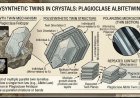
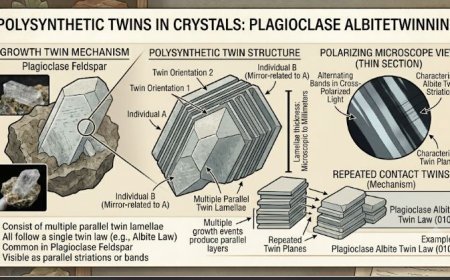
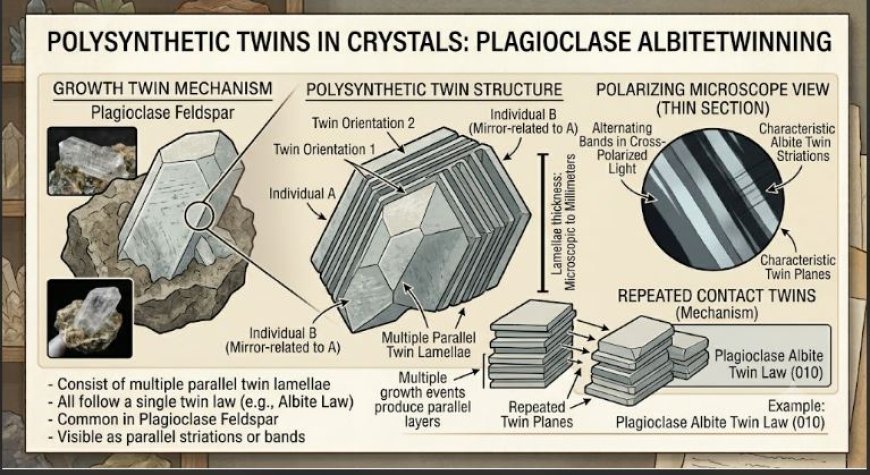
- Plagioclase Feldspar is the most famous example of polysynthetic twinning.
- The twin lamellae follow the Albite Twin Law.
- These twins produce characteristic parallel striations visible on crystal surfaces.
- Under a polarizing microscope, the lamellae appear as alternating bands.
- Polysynthetic twinning is one of the most important identifying features of plagioclase feldspar.
Calcite
- Certain varieties of calcite may develop polysynthetic deformation twins.
- These twins form in response to pressure and tectonic stress.
- They provide valuable information about geological deformation.
Pyroxenes
- Some pyroxene minerals display repeated twinning structures.
- These twins help mineralogists distinguish between different pyroxene species.
Recognition of Polysynthetic Twins
- Polysynthetic twins are commonly identified by their parallel twin lamellae.
- Visible striations on crystal surfaces often indicate twinning.
- Under a microscope, twin lamellae appear as alternating bands.
- Optical methods are widely used to study twin structures.
- Polarized light microscopy is particularly effective for identifying polysynthetic twins.
Importance in Mineral Identification
- Polysynthetic twinning is one of the most important diagnostic features in mineralogy.
- The presence of twin lamellae helps identify feldspar minerals.
- Geologists often use twinning patterns to distinguish plagioclase feldspars from other feldspar varieties.
- Microscopic twinning provides valuable information during petrographic analysis.
Geological Significance of Polysynthetic Twins
- Twin structures preserve evidence of crystal growth conditions.
- Deformation twins indicate tectonic stress and geological movement.
- Transformation twins record temperature-related structural changes.
- Polysynthetic twinning helps geologists reconstruct geological histories.
- Twin lamellae often provide clues about metamorphic and tectonic processes.
Applications of Polysynthetic Twin Studies
- Mineral identification
- Petrographic analysis
- Structural geology
- Metamorphic petrology
- Crystallographic research
- Geological mapping
- Material science
- Crystal growth investigations
Advantages of Studying Polysynthetic Twins
- Helps identify minerals accurately.
- Reveals crystal growth mechanisms.
- Provides evidence of geological deformation.
- Assists in crystallographic classification.
- Supports petrographic studies.
- Improves understanding of crystal symmetry.
Relationship Between Polysynthetic Twinning and Crystal Symmetry
- Polysynthetic twinning demonstrates how crystals can repeatedly reproduce a specific symmetry relationship.
- The repeated twin operation creates highly organized crystal structures.
- These structures provide important information about crystallographic symmetry and crystal behavior.
- The study of polysynthetic twins helps scientists understand how symmetry influences crystal development.
Importance of Polysynthetic Twins in Crystallography
- Polysynthetic twins are among the most significant twinning structures in crystallography because they occur in many common rock-forming minerals.
- Their study provides valuable information about crystal growth, crystal transformation, and geological deformation.
- Polysynthetic twinning is especially important in feldspar identification, making it a fundamental topic in mineralogy and petrology.
- The presence of twin lamellae often serves as a key feature used by geologists during microscopic analysis of rocks.
- Understanding polysynthetic twins helps students interpret crystal structures, identify minerals accurately, and appreciate the complexity of crystal growth processes.
- Because of their widespread occurrence, scientific importance, and practical applications, Polysynthetic Twins remain one of the most important topics in crystallography, mineralogy, and geological sciences.
- The study of polysynthetic twinning also provides a foundation for understanding the final topic in crystal twinning, namely Twin Laws, which explain the crystallographic principles governing all types of twin formation.
Explore Subject Categories
• StudySpot360 Home: https://studyspot360.com/
• Geology Study Materials: https://studyspot360.com/geology
• Physics Notes and Learning Resources: https://studyspot360.com/physics
• English Grammar and Study Materials: https://studyspot360.com/english
About StudySpot360
StudySpot360 is a trusted educational platform providing high-quality study materials, detailed notes, MCQs, quizzes, question papers, and academic resources across multiple subjects. Our mission is to make reliable educational content accessible to students, educators, researchers, and lifelong learners while supporting academic excellence, examination preparation, and continuous learning.
Explore more educational articles, tutorials, practice questions, quizzes, and subject-wise learning resources to strengthen your knowledge and continue your learning journey with StudySpot360.
What's Your Reaction?