














Forms of Crystals in the Monoclinic System
Learn about the forms of crystals in the Monoclinic Crystal System including prisms, pinacoids, domes, sphenoids, and pyramids. Detailed crystallography notes for geology and mineralogy students.
Forms of Crystals in the Monoclinic System
Introduction
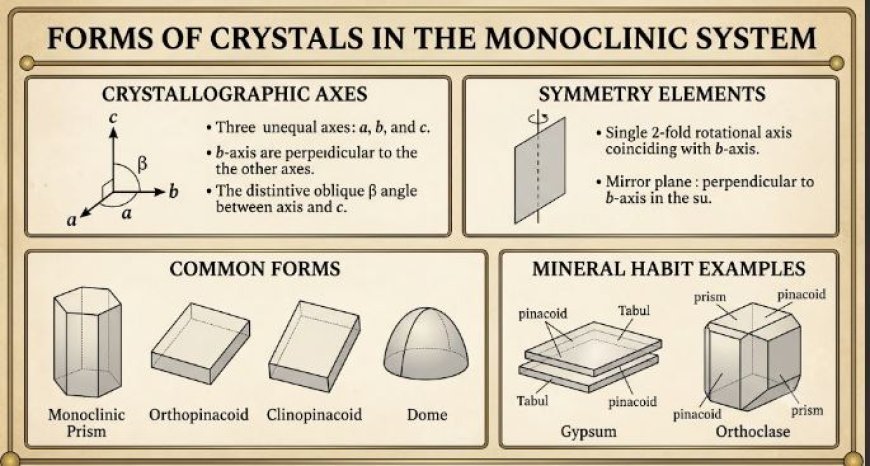
- The Monoclinic Crystal System is one of the most common crystal systems found in nature and contains many important rock-forming minerals. It is characterized by three crystallographic axes of unequal lengths, where two axes intersect at 90° and the third axis is inclined. This unique arrangement gives monoclinic crystals a distinctive appearance and produces a variety of crystal forms that differ significantly from those of higher-symmetry systems.
- The monoclinic system plays an important role in mineralogy because many common minerals such as gypsum, orthoclase feldspar, muscovite, biotite, hornblende, and augite belong to this system. Understanding monoclinic crystal forms helps students identify minerals, classify crystals, and understand the relationship between crystal symmetry and crystal growth.
- The crystal forms developed in the monoclinic system are generally less symmetrical than those found in the orthorhombic system. However, they display unique geometrical characteristics that make them important subjects in crystallographic studies.
Characteristics of Monoclinic Crystal Forms
- Crystal forms are based on three unequal crystallographic axes.
- Two axes intersect at 90°, while the third axis is inclined.
- The system commonly possesses a single two-fold axis of symmetry or a mirror plane.
- Crystal forms often appear elongated, tabular, or prismatic.
- Pinacoids and prisms are among the most common forms.
- Crystal faces are arranged according to monoclinic symmetry requirements.
- Several crystal forms frequently combine to produce complex crystal habits.
Monoclinic Prism
- The Monoclinic Prism is one of the most common crystal forms found in the monoclinic system. It consists of elongated crystal faces arranged parallel to one crystallographic axis.
- Unlike orthorhombic prisms, the prism faces in monoclinic crystals are influenced by the inclined crystallographic axis. This causes the crystal to appear slightly skewed or asymmetrical.
- Monoclinic prisms commonly form the main body of crystals and often combine with pinacoids, domes, and pyramidal forms.
- Minerals such as augite, hornblende, and gypsum frequently exhibit prismatic crystal habits.
- This crystal form is important because it clearly reflects the inclined symmetry characteristic of the monoclinic system.
Orthopinacoid
- The Orthopinacoid consists of two parallel crystal faces that are parallel to one crystallographic axis and intersect the other axes.
- These faces commonly develop as broad, flat surfaces on monoclinic crystals.
- Orthopinacoids often contribute to the tabular appearance of minerals such as gypsum and feldspar.
- Their development depends on crystal growth conditions and the relative growth rates of different crystal faces.
Clinopinacoid
- The Clinopinacoid is another important pinacoidal form found in the monoclinic system.
- It consists of two parallel faces oriented differently from the orthopinacoid.
- The clinopinacoid often forms prominent crystal surfaces and contributes to the characteristic shape of monoclinic crystals.
- This form is commonly observed in minerals that exhibit well-developed crystal faces.
Basal Pinacoid
- The Basal Pinacoid consists of two parallel faces that are perpendicular to the vertical crystallographic axis.
- These faces often form the upper and lower boundaries of a crystal.
- Basal pinacoids contribute significantly to the tabular habit of many monoclinic minerals.
- Their presence influences crystal proportions and overall crystal morphology.
Monoclinic Dome
- The Dome is one of the most distinctive crystal forms of the monoclinic system.
- It consists of two non-parallel crystal faces related by a mirror plane.
- The faces intersect along a common edge and produce a roof-like appearance.
- Domes commonly occur as terminal forms on monoclinic crystals and modify the ends of prisms.
- Their unique geometry makes them useful in identifying monoclinic minerals.
Positive Dome
- A Positive Dome is oriented in a particular crystallographic direction and develops according to the symmetry of the crystal class.
- Positive domes commonly occur in combination with prisms and pinacoids.
- They contribute to the formation of complex crystal habits and increase the diversity of monoclinic crystal forms.
Negative Dome
- A Negative Dome resembles a positive dome but differs in orientation.
- The distinction between positive and negative domes is important in crystallographic analysis and crystal classification.
- Both types may occur on the same crystal and contribute to its external appearance.
Sphenoid
- The Sphenoid is a characteristic crystal form found in certain monoclinic classes.
- It consists of two triangular faces related by a two-fold axis of symmetry.
- Unlike pyramids, the faces do not meet symmetrically around a central point.
- Sphenoids often produce wedge-shaped crystals and are important indicators of monoclinic symmetry.
- This form is particularly associated with the Sphenoidal Class (2).
Monoclinic Pyramid
- The Monoclinic Pyramid consists of crystal faces that converge toward a point at one end of the crystal.
- Because of the inclined crystallographic axis, the faces are not arranged as symmetrically as those in higher crystal systems.
- Monoclinic pyramids commonly occur as terminal modifications on prisms.
- They contribute to the development of pointed crystal terminations and increase the complexity of crystal morphology.
Combinations of Monoclinic Crystal Forms
- In nature, monoclinic crystals rarely develop as perfect examples of a single crystal form.
- Instead, multiple forms combine during crystal growth to produce a wide range of crystal habits.
- A crystal may consist of a monoclinic prism combined with pinacoids, producing a tabular or elongated appearance.
- Domes often occur at the ends of prisms and create characteristic roof-shaped terminations.
- Sphenoids and pyramids may also combine with other forms, resulting in complex crystal geometries.
- These combinations are important because they provide valuable clues about crystal growth conditions and mineral identity.
Minerals Showing Monoclinic Crystal Forms
- Several important minerals display crystal forms characteristic of the monoclinic system.
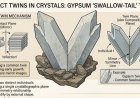
- Gypsum commonly forms tabular crystals dominated by pinacoids and prism faces.
- Orthoclase Feldspar often develops blocky crystals with well-defined monoclinic symmetry.
- Muscovite occurs as thin tabular crystals and sheets due to the dominance of pinacoidal forms.
- Biotite displays similar habits and is widely found in igneous and metamorphic rocks.
- Hornblende commonly develops elongated prismatic crystals.
- Augite frequently exhibits short prismatic forms with characteristic monoclinic symmetry.
- These minerals provide excellent examples for studying monoclinic crystal morphology and crystal growth.
Importance of Monoclinic Crystal Forms
- The crystal forms of the Monoclinic Crystal System are important because they illustrate how crystal symmetry decreases as crystallographic axes become more irregular.
- Understanding prisms, pinacoids, domes, sphenoids, and pyramids helps students recognize monoclinic minerals and classify crystals accurately.
- These crystal forms play a major role in mineral identification, petrology, crystallographic studies, and geological research.
- The study of monoclinic crystal forms also provides insight into crystal growth processes and the relationship between internal atomic arrangement and external crystal shape.
- Since many rock-forming minerals belong to this system, knowledge of monoclinic crystal morphology is essential for geologists, mineralogists, and earth science students.
- Monoclinic crystal forms serve as an important link between higher-symmetry crystal systems and the highly irregular triclinic system.
- Because of their scientific importance, widespread occurrence, and role in mineral classification, monoclinic crystal forms remain one of the most significant topics in crystallography and mineralogy.
- A detailed understanding of these forms helps students appreciate the diversity of crystal structures found in nature and provides a strong foundation for advanced studies in crystal morphology, crystal symmetry, and mineral sciences.
What's Your Reaction?








ARUL PRASANTH
Arul Prasanth - MSc Geology graduate offering comprehensive study materials in Geology, Physics, and English. With a focus on clarity and effectiveness, I aim to provide students with the tools necessary for academic success.