












Space Lattice
A space lattice is a three-dimensional arrangement of points representing the regular arrangement of atoms, ions, or molecules in a crystal. Learn about its definition, types, features, importance, and role in crystallography.
Space Lattice: Definition, Types and Features
Introduction
- Crystals are made up of atoms, ions, or molecules arranged in a highly organized pattern.
- This regular arrangement gives crystals their characteristic shapes and physical properties.
- To understand how particles are arranged inside crystals, crystallographers use the concept of a space lattice.
- A space lattice represents the repeating pattern of points in three-dimensional space and forms the basic framework of crystal structures.
- It is one of the most important concepts in crystallography and mineralogy.
Definition of Space Lattice
- A space lattice is a three-dimensional arrangement of points that are repeated regularly in all directions.
- Each point in the lattice represents the position of an atom, ion, molecule, or group of atoms within a crystal.
- The arrangement of these points follows a fixed geometric pattern throughout the crystal.
- A space lattice shows the orderly internal structure of crystalline materials.
- It is also known as a crystal lattice.
What is a Lattice Point?
- A lattice point is a specific position within a space lattice.
- Every lattice point has an identical environment surrounding it.
- The repeated arrangement of lattice points produces the overall crystal structure.
- These points help scientists understand how atoms are distributed inside a crystal.
Characteristics of a Space Lattice
- It is a three-dimensional arrangement of points.
- The pattern repeats regularly in all directions.
- Each lattice point has the same surroundings.
- It represents the internal structure of crystals.
- It forms the basis for the study of crystal systems and crystal classes.
- It helps explain the symmetry and properties of crystals.
Types of Space Lattice
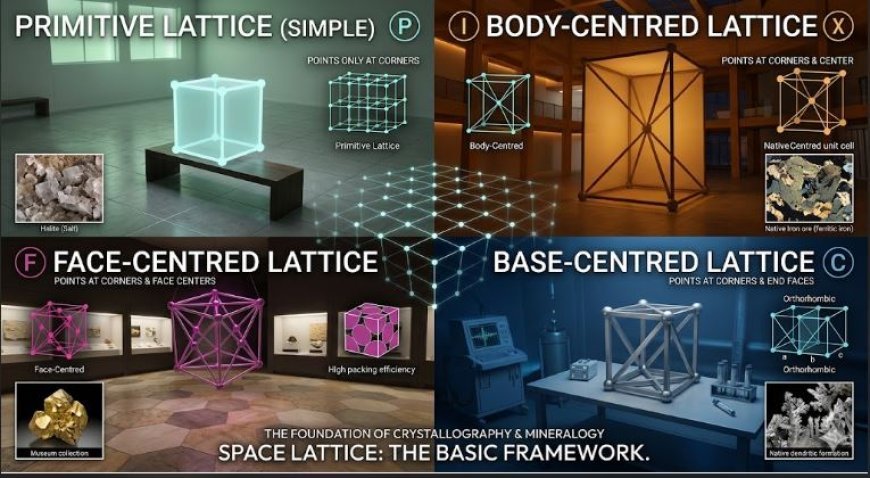
Based on the arrangement of lattice points within a unit cell, space lattices are classified into different types.
Primitive Lattice (Simple Lattice)
- In a primitive lattice, lattice points are present only at the corners of the unit cell.
- No additional lattice points occur inside the cell or on its faces.
- It is the simplest type of space lattice.
- Primitive lattices are represented by the symbol P.
Body-Centred Lattice
- In this type, lattice points occur at the corners and one additional point is present at the center of the unit cell.
- The central point is equally distant from all corner points.
- It is represented by the symbol I.
Face-Centred Lattice
- Lattice points are present at the corners and at the center of each face of the unit cell.
- This arrangement increases the packing efficiency of atoms.
- It is represented by the symbol F.
Base-Centred Lattice (End-Centred Lattice)
- Lattice points occur at the corners and at the centers of two opposite faces.
- These faces are usually the top and bottom faces of the unit cell.
- It is represented by the symbol C.
Unit Cell and Space Lattice
- A unit cell is the smallest repeating portion of a crystal lattice.
- Repetition of the unit cell in all directions produces the complete space lattice.
- The shape and dimensions of the unit cell determine the crystal system.
- Every crystal structure can be described using its unit cell and lattice arrangement.
Features of Space Lattice
Regular Arrangement
- Lattice points are arranged in a highly ordered pattern.
- This regularity gives crystals their geometric shapes.
Repetition in Three Dimensions
- The arrangement repeats along length, width, and height.
- This creates a continuous crystal structure.
Uniform Environment
- Every lattice point has identical surroundings.
- This ensures consistency throughout the crystal.
Symmetrical Structure
- Space lattices possess symmetry that helps classify crystals.
- The symmetry determines many crystal properties.
Foundation of Crystal Structures
- Space lattices provide the framework on which crystal structures are built.
- They help explain how atoms are organized within minerals.
Mathematical Representation
- Space lattices allow scientists to describe crystal structures using geometry and mathematics.
- This makes crystal classification more accurate and systematic.
Importance of Space Lattice
- Helps understand the internal structure of crystals.
- Forms the basis of crystallography.
- Assists in mineral identification.
- Explains crystal symmetry and crystal growth.
- Helps classify crystals into different crystal systems.
- Useful in geology, mineralogy, chemistry, and material science.
- Plays a major role in X-ray crystallographic studies.
Applications of Space Lattice
- Mineral identification.
- Crystal structure determination.
- Material science research.
- Semiconductor technology.
- Nanotechnology studies.
- Metallurgical investigations.
- Pharmaceutical crystal analysis.
What's Your Reaction?