











Symmetry Elements in Crystals
Learn about symmetry elements in crystals, their types, importance, and examples. Understand axis of symmetry, plane of symmetry, centre of symmetry, and rotation-inversion axis in simple terms.
Symmetry Elements in Crystals
Introduction
- Symmetry is one of the most important characteristics of crystals.
- It refers to the balanced arrangement of crystal faces, edges, and corners around a point, line, or plane.
- A crystal is said to possess symmetry when it appears unchanged after certain movements such as rotation or reflection.
- The study of symmetry helps scientists understand crystal shapes, classify minerals, and determine crystal structures.
- Symmetry forms the foundation of crystallography, the scientific study of crystals.
What are Symmetry Elements?
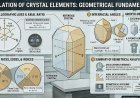
- Symmetry elements are imaginary geometric features such as points, lines, or planes around which symmetry operations are performed.
- These elements help determine how a crystal maintains its shape after specific movements.
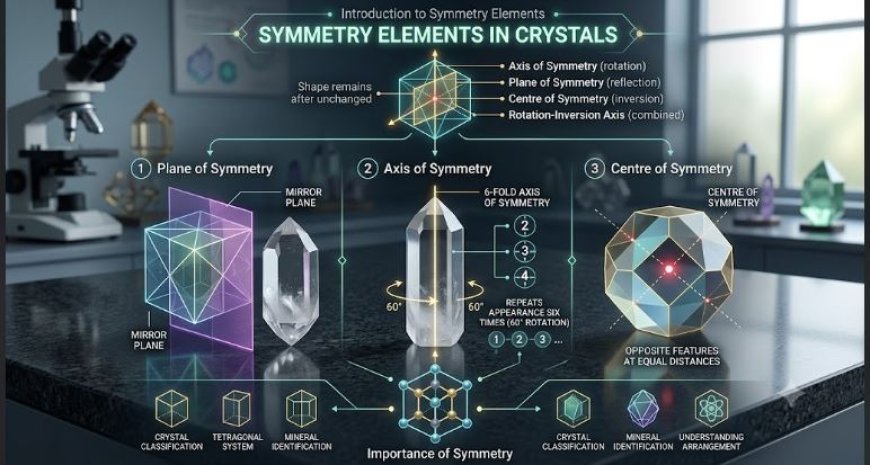
- The major symmetry elements found in crystals are:
-
- Axis of Symmetry
- Plane of Symmetry
- Centre of Symmetry
- Rotation-Inversion Axis
Axis of Symmetry
- An axis of symmetry is an imaginary line passing through the center of a crystal.
- When the crystal is rotated around this line through a specific angle, it appears exactly the same as before.
- The number of times the crystal repeats its appearance during one complete rotation determines the order of the axis.
Two-Fold Axis (2)
- The crystal repeats its appearance two times during a complete 360° rotation.
- It appears identical after every 180° rotation.
- This is one of the most common symmetry axes found in crystals.
Three-Fold Axis (3)
- The crystal repeats its appearance three times during a full rotation.
- It appears identical after every 120° rotation.
- This type of symmetry is found in some hexagonal minerals.
Four-Fold Axis (4)
- The crystal repeats its appearance four times during a complete rotation.
- It appears unchanged after every 90° rotation.
- This symmetry is common in tetragonal crystal forms.
Six-Fold Axis (6)
- The crystal repeats its appearance six times during a complete rotation.
- It appears identical after every 60° rotation.
- This type is characteristic of the hexagonal crystal system.
Plane of Symmetry
- A plane of symmetry is an imaginary plane that divides a crystal into two equal mirror-image halves.
- One side of the crystal becomes the exact reflection of the other side.
- Such a plane is also called a mirror plane.
Characteristics of a Plane of Symmetry
- Divides a crystal into two equal parts.
- Produces mirror-image halves.
- May occur in different orientations within a crystal.
- Helps in crystal identification and classification.
Centre of Symmetry
- A centre of symmetry is an imaginary point located at the center of a crystal.
- Any line drawn through this point intersects similar crystal faces, edges, or corners at equal distances on opposite sides.
- It provides balance and uniformity to the crystal structure.
Characteristics of Centre of Symmetry
- It is represented by a single point.
- Opposite crystal features occur at equal distances from the center.
- Many crystals possess a center of symmetry, while some do not.
Rotation-Inversion Axis
- A rotation-inversion axis combines two symmetry operations.
- The crystal is first rotated through a specific angle and then inverted through its center.
- If the crystal appears unchanged after both operations, it possesses a rotation-inversion axis.
- This symmetry element is important in advanced crystallographic studies.
Importance of Symmetry Elements
- Help classify crystals into different crystal systems.
- Assist in mineral identification.
- Provide information about the internal arrangement of atoms.
- Help determine crystal classes.
- Play a major role in crystallography, mineralogy, and materials science.
- Improve understanding of crystal growth and crystal properties.
Examples of Crystal Symmetry
- Diamond crystals show several symmetry elements.
- Quartz crystals display rotational symmetry.
- Cubic crystals possess multiple axes and planes of symmetry.
- Calcite crystals exhibit characteristic symmetry features useful in mineral identification.
What's Your Reaction?








ARUL PRASANTH
Arul Prasanth - MSc Geology graduate offering comprehensive study materials in Geology, Physics, and English. With a focus on clarity and effectiveness, I aim to provide students with the tools necessary for academic success.