











Stereographic Projection in Crystallography
Stereographic projection is a graphical method used to project points from a sphere onto a flat plane while preserving angular relationships. It is an essential tool for studying crystal symmetry, crystal faces, crystal classes, and crystallographic orientations.
Stereographic Projection
Introduction
- Stereographic projection is one of the most widely used projection methods in crystallography.
- It converts points from a spherical surface onto a flat plane without losing important angular relationships.
- The method provides a clear and convenient way to study crystal symmetry, crystal forms, and crystallographic directions.
- Because of its simplicity and accuracy, stereographic projection is extensively used in mineralogy, structural geology, and crystallography.
Definition of Stereographic Projection
- A stereographic projection is a method of projecting points from the surface of a sphere onto a flat plane.
- The projection is made from one pole of the sphere onto the equatorial plane.
- Each point on the sphere is represented by a corresponding point on the projection plane.
- This method helps represent three-dimensional crystal features on a two-dimensional surface.
Principle of Stereographic Projection
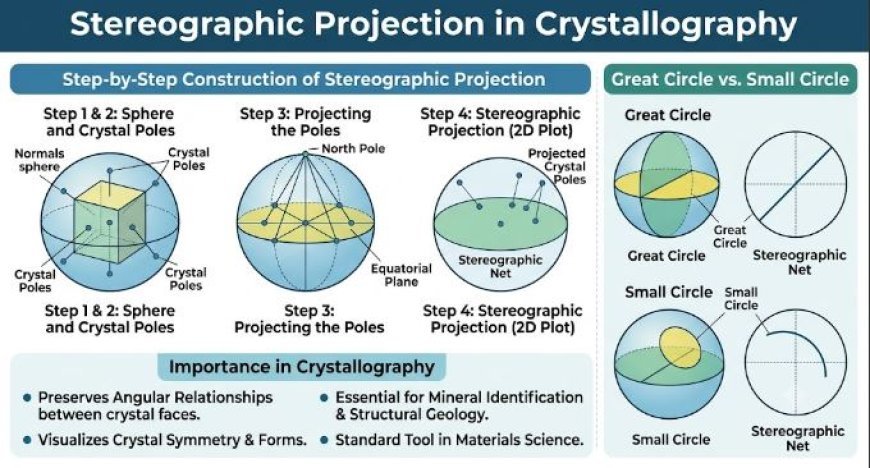
- An imaginary sphere is placed around the crystal.
- Crystal faces are represented by poles on the sphere.
- Lines are drawn from the North Pole of the sphere through these poles.
- The points where these lines intersect the equatorial plane form the stereographic projection.
- The resulting diagram preserves angular relationships between crystal faces.
Construction of Stereographic Projection
Step 1: Draw the Sphere
- An imaginary sphere is considered around the crystal.
- The center of the crystal coincides with the center of the sphere.
Step 2: Mark the Crystal Poles
- Normals drawn to crystal faces intersect the sphere at points called poles.
- These poles represent the orientation of crystal faces.
Step 3: Project the Poles
- Straight lines are drawn from the North Pole through each crystal pole.
- These lines meet the equatorial plane at specific points.
Step 4: Plot the Projection
- The intersection points are plotted on a circular diagram.
- The diagram represents the stereographic projection of the crystal.
Features of Stereographic Projection
- Represents three-dimensional crystal features on a flat surface.
- Preserves angular relationships accurately.
- Makes crystal symmetry easier to study.
- Provides a compact and convenient diagram.
- Useful for plotting crystal faces and symmetry elements.
Great Circle and Small Circle
Great Circle
- A great circle is formed when a plane passes through the center of the sphere.
- It divides the sphere into two equal halves.
- The equator is the best example of a great circle.
Small Circle
- A small circle is formed when a plane cuts the sphere without passing through the center.
- It produces two unequal portions of the sphere.
- Small circles are commonly used in crystallographic analysis.
Advantages of Stereographic Projection
- Easy to construct and interpret.
- Preserves angular relationships between crystal faces.
- Helps visualize crystal symmetry clearly.
- Suitable for studying crystal classes and crystal systems.
- Widely accepted in crystallographic research.
Applications of Stereographic Projection
- Analysis of crystal symmetry.
- Study of crystal forms.
- Determination of crystal classes.
- Mineral identification.
- Structural geology investigations.
- Interpretation of crystallographic data.
- Representation of crystal faces and directions.
Importance in Crystallography
- Stereographic projection is considered one of the most important graphical tools in crystallography.
- It simplifies the study of complex crystal structures.
- The method allows scientists to analyze symmetry elements quickly and accurately.
- Many crystallographic calculations and symmetry studies are based on stereographic projections.
- It remains an essential technique in geology, mineralogy, and materials science.
What's Your Reaction?








ARUL PRASANTH
Arul Prasanth - MSc Geology graduate offering comprehensive study materials in Geology, Physics, and English. With a focus on clarity and effectiveness, I aim to provide students with the tools necessary for academic success.