













Crystals Belonging to Normal Classes
Normal classes are the crystal classes that possess the maximum symmetry elements within each crystal system. Learn about the normal classes of the seven crystal systems, their symmetry characteristics, crystal forms, and importance in crystallography. crystals-belonging-to-normal-classes
Crystals Belonging to Normal Classes
Introduction
- Crystals are classified into different groups based on the symmetry elements they possess. Within each crystal system, one class contains the highest possible number of symmetry elements. Such a class is known as the normal class. These classes are considered the most symmetrical representatives of their respective crystal systems and are important in the study of crystallography. Since they exhibit maximum symmetry, they are often used as reference classes for understanding crystal forms, crystal growth, and crystal classification.
What are Normal Classes?
- A normal class is the crystal class that contains the greatest number of symmetry elements allowed within a particular crystal system. These symmetry elements may include rotational axes, mirror planes, centres of symmetry, and rotoinversion axes. Crystals belonging to normal classes generally display well-developed and highly symmetrical crystal forms. Because of their balanced geometry and regular appearance, they are widely studied in mineralogy and crystallography.
Characteristics of Normal Classes
- Normal classes possess the maximum symmetry possible within a crystal system. They contain more symmetry elements than any other class of the same system. Crystals belonging to these classes often develop regular geometric shapes and show balanced crystal growth. These classes are considered the standard representatives of their crystal systems and are useful for studying crystal morphology, symmetry, and classification.
Normal Class of the Isometric (Cubic) System
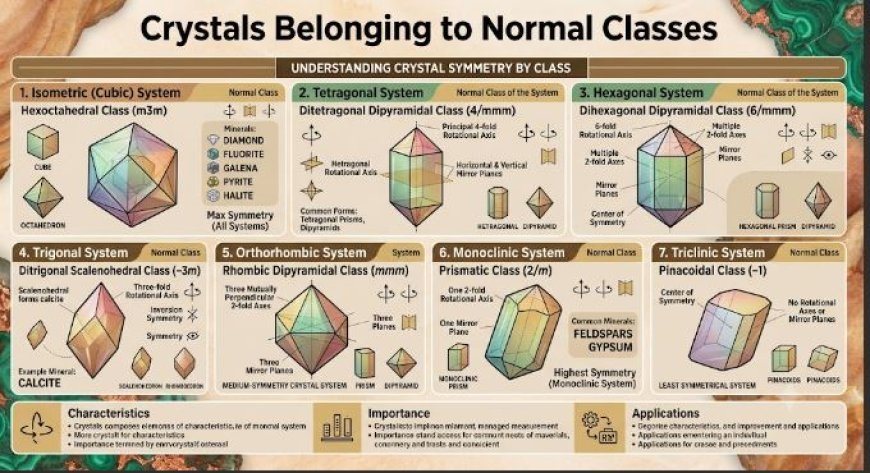
- The Hexoctahedral Class (m3m) is the normal class of the cubic system. It possesses the highest degree of symmetry among all crystal classes. This class contains several three-fold, four-fold, and two-fold rotational axes, numerous mirror planes, and a centre of symmetry. Because of this exceptionally high symmetry, crystals belonging to this class often form highly regular shapes such as cubes, octahedrons, and dodecahedrons. Minerals like diamond, fluorite, galena, pyrite, and halite commonly belong to this class. The cubic system is considered the most symmetrical crystal system in crystallography.
Normal Class of the Tetragonal System
- The Ditetragonal Dipyramidal Class (4/mmm) is the normal class of the tetragonal crystal system. This class possesses a principal four-fold rotational axis together with horizontal and vertical mirror planes and several secondary symmetry axes. The combination of these symmetry elements produces highly symmetrical crystal forms. Crystals in this class commonly develop tetragonal prisms and dipyramids. The symmetry of this class makes it an important example for understanding the tetragonal system and its crystal structures.
Normal Class of the Hexagonal System
- The Dihexagonal Dipyramidal Class (6/mmm) is the normal class of the hexagonal crystal system. It contains a six-fold rotational axis, multiple two-fold axes, several mirror planes, and a centre of symmetry. These symmetry elements produce highly symmetrical six-sided crystal forms. Crystals belonging to this class frequently develop hexagonal prisms and dipyramids. The high degree of symmetry found in this class makes it one of the most important groups within the hexagonal system.
Normal Class of the Trigonal System
- The Ditrigonal Scalenohedral Class (−3m) represents the normal class of the trigonal crystal system. It possesses a three-fold rotational axis along with mirror planes and inversion symmetry. The crystal forms produced by this class are highly symmetrical and often display scalenohedral and rhombohedral shapes. Minerals such as calcite are excellent examples of crystals belonging to this class. The symmetry characteristics of this class help distinguish the trigonal system from the hexagonal system.
Normal Class of the Orthorhombic System
- The Rhombic Dipyramidal Class (mmm) is the normal class of the orthorhombic crystal system. It contains three mutually perpendicular two-fold rotational axes and three mirror planes. These symmetry elements create highly balanced crystal forms and regular geometric shapes. Minerals belonging to this class often develop prism and dipyramid combinations. The orthorhombic normal class serves as an important example for studying medium-symmetry crystal systems.
Normal Class of the Monoclinic System
- The Prismatic Class (2/m) is the normal class of the monoclinic crystal system. It possesses one two-fold rotational axis and one mirror plane. Although the monoclinic system has lower symmetry than the orthorhombic, tetragonal, and cubic systems, this class represents the highest symmetry possible within the monoclinic system. Many common minerals, including some feldspars and gypsum, belong to this class. Its symmetry elements play an important role in determining crystal morphology and crystal growth patterns.
Normal Class of the Triclinic System
- The Pinacoidal Class (−1) is the normal class of the triclinic crystal system. This class contains only a centre of symmetry and lacks rotational axes and mirror planes. The triclinic system is the least symmetrical of all crystal systems. Despite its low symmetry, the pinacoidal class represents the maximum symmetry possible within this system. Minerals belonging to this class often exhibit irregular and less symmetrical crystal forms compared to crystals of higher-symmetry systems.
Importance of Normal Classes
- Normal classes are important because they provide a clear understanding of the highest symmetry possible within each crystal system. They serve as reference models for studying crystal morphology, crystal symmetry, and crystal classification. Knowledge of normal classes helps mineralogists identify minerals and understand the relationship between crystal structure and crystal form. These classes are also widely used in advanced crystallography, X-ray studies, and mineralogical research.
Applications of Normal Classes
- Identification and classification of minerals.
- Study of crystal symmetry and crystal morphology.
- Understanding crystal growth patterns.
- Crystallographic research and education.
- X-ray crystallography and structural analysis.
- Mineralogical and geological investigations.
- Study of crystal systems and crystal classes
What's Your Reaction?








ARUL PRASANTH
Arul Prasanth - MSc Geology graduate offering comprehensive study materials in Geology, Physics, and English. With a focus on clarity and effectiveness, I aim to provide students with the tools necessary for academic success.