













Inharmonic Ratio in Crystallography
Inharmonic ratio is a mathematical relationship used in crystallography to determine the relative positions of crystal faces, edges, and points. It plays an important role in crystal geometry, crystallographic calculations, projections, and the study of crystal elements.
Inharmonic Ratio
Introduction
- In crystallography, the accurate determination of crystal faces and their geometrical relationships is very important. Various mathematical methods are used to study these relationships, and one of them is the Inharmonic Ratio. This concept helps crystallographers analyze the positions of points, lines, and crystal faces in relation to one another. It is widely used in crystal calculations and provides valuable information about crystal geometry.
What is Inharmonic Ratio?
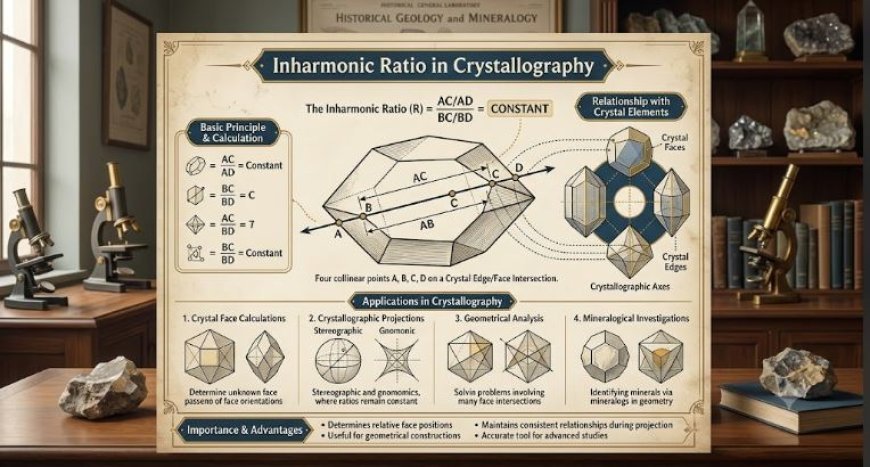
- The Inharmonic Ratio is a mathematical relationship between four points that lie on the same straight line. It is used to compare the distances between these points and establish a geometrical relationship among them. In crystallography, this ratio helps determine the relative positions of crystal faces and assists in calculating important crystal elements.
- Since crystals possess a highly ordered structure, mathematical relationships such as the inharmonic ratio are useful for describing their geometry accurately.
Basic Principle of Inharmonic Ratio
- The concept of inharmonic ratio is based on four points arranged on a straight line. These points are usually represented by the letters A, B, C, and D. The distances between these points are compared using a specific mathematical relationship.
- One important feature of the inharmonic ratio is that its value remains constant even when the figure is projected or transformed geometrically. Because of this property, it is extremely useful in crystallographic calculations and graphical methods.
Role of Inharmonic Ratio in Crystallography
- Inharmonic ratio is used to establish the positional relationship between crystal faces and crystallographic directions. It provides a mathematical method for analyzing crystal geometry and assists in determining unknown crystal elements from known measurements.
- Crystallographers use this concept while studying crystal projections, crystal forms, and geometrical constructions. It helps improve the accuracy of crystallographic investigations.
Importance of Inharmonic Ratio
- Helps determine the relative positions of crystal faces.
- Useful in geometrical and graphical crystal calculations.
- Assists in the study of crystal projections.
- Provides accurate mathematical relationships within crystals.
- Helps solve crystallographic problems involving crystal geometry.
- Supports advanced studies in crystal morphology and symmetry.
Relationship with Crystal Elements
- Crystal elements such as crystal faces, edges, and crystallographic axes are closely related to geometrical measurements. The inharmonic ratio helps establish relationships among these elements and allows crystallographers to calculate unknown parameters using known geometrical data.
- By applying the concept of inharmonic ratio, scientists can study crystal structures more accurately and understand the spatial arrangement of crystal components.
Applications of Inharmonic Ratio
Crystal Face Calculations
- Inharmonic ratio helps determine the position and orientation of crystal faces. It provides a mathematical approach for studying the geometrical arrangement of faces within a crystal.
Crystallographic Projections
- The concept is used in projection methods where crystal features are represented graphically. It assists in maintaining accurate geometrical relationships during projection.
Geometrical Analysis
- Inharmonic ratio is valuable in geometrical studies of crystals. It helps analyze lines, points, and intersections within crystal structures.
Mineralogical Investigations
- Mineralogists use inharmonic ratio when studying crystal morphology and identifying minerals based on their geometrical characteristics.
Advantages of Using Inharmonic Ratio
- Provides precise geometrical relationships.
- Useful in both theoretical and practical crystallography.
- Helps improve the accuracy of crystal calculations.
- Supports the study of crystal symmetry and morphology.
- Assists in understanding complex crystal structures.
Significance in Advanced Crystallography
- In advanced crystallographic studies, accurate geometrical calculations are essential. The inharmonic ratio provides a reliable mathematical tool for solving problems related to crystal geometry and crystal projections. Its ability to maintain consistent relationships during geometrical transformations makes it highly valuable in crystallographic analysis and research.
Use in Crystal Geometry
- Crystal geometry involves studying the shape, dimensions, and orientation of crystal forms. The inharmonic ratio contributes to this study by providing a method for analyzing geometrical relationships between different crystal components. It helps scientists understand how crystal faces and edges are arranged within a crystal structure and supports the development of accurate crystallographic models
What's Your Reaction?








ARUL PRASANTH
Arul Prasanth - MSc Geology graduate offering comprehensive study materials in Geology, Physics, and English. With a focus on clarity and effectiveness, I aim to provide students with the tools necessary for academic success.