












Gnomonic Projection in Crystallography
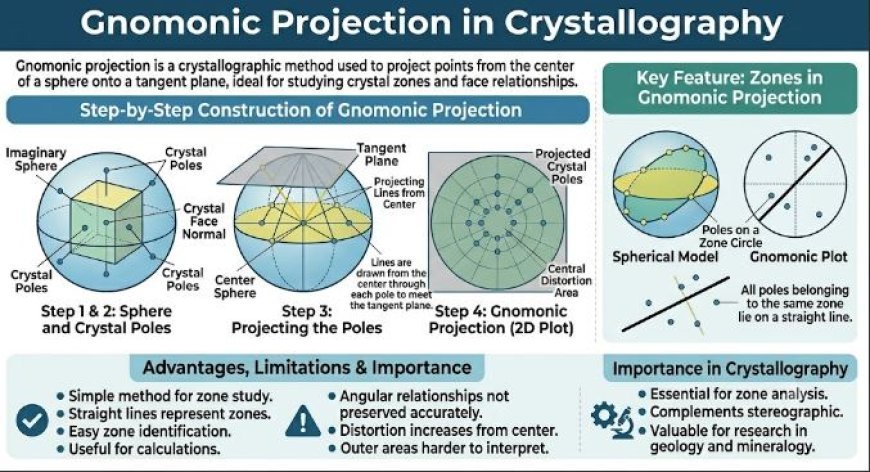
Gnomonic projection is a crystallographic method in which points on a sphere are projected from the center onto a tangent plane. It is widely used for studying crystal faces, crystal zones, crystallographic directions, and geometric relationships in crystals.
Gnomonic Projection
Introduction
- Gnomonic projection is an important graphical method used in crystallography to represent crystal faces and crystallographic directions on a flat plane.
- It is derived from spherical projection and helps in studying the geometric relationships between crystal faces.
- One of the special features of gnomonic projection is that all points belonging to the same crystal zone lie on a straight line.
- This property makes it useful for identifying zones and analyzing crystal structures.
Definition of Gnomonic Projection
- A gnomonic projection is a method in which points located on the surface of a sphere are projected from the center of the sphere onto a plane that touches the sphere.
- The plane is usually tangent to the sphere at a selected point.
- Crystal faces are represented by poles, and these poles are projected onto the tangent plane to obtain the gnomonic projection.
Principle of Gnomonic Projection
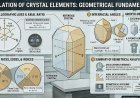
- An imaginary sphere is considered around the crystal.
- The crystal faces are represented by poles on the sphere.
- Straight lines are drawn from the center of the sphere through these poles.
- These lines intersect the tangent plane and form the projected points.
- The resulting projection shows the positions of crystal faces on a flat surface.
Construction of Gnomonic Projection
Step 1: Draw an Imaginary Sphere
- A sphere is imagined around the crystal.
- The center of the sphere coincides with the center of the crystal.
Step 2: Locate the Poles
- Crystal faces are represented by poles on the sphere.
- Each pole corresponds to a particular crystal face.
Step 3: Draw Projection Lines
- Lines are drawn from the center of the sphere through each pole.
- These lines continue until they meet the tangent plane.
Step 4: Mark the Projection Points
- The points where the lines intersect the tangent plane are plotted.
- These plotted points form the gnomonic projection.
Features of Gnomonic Projection
- Crystal faces are represented as points on a plane.
- All poles belonging to the same zone lie on a straight line.
- Useful for studying crystallographic zones.
- Provides a simple graphical representation of crystal geometry.
- Helps analyze relationships between crystal faces.
Zones in Gnomonic Projection
- A zone is a group of crystal faces whose edges are parallel to a common direction.
- In gnomonic projection, poles of faces belonging to the same zone fall on a straight line.
- This characteristic makes zone identification easier compared to other projection methods.
- The study of zones is important for crystal classification and crystal analysis.
Advantages of Gnomonic Projection
- Simple method for studying crystal zones.
- Straight-line representation of zones makes analysis easier.
- Useful for determining relationships between crystal faces.
- Helps in crystallographic calculations.
- Widely used in advanced crystal studies.
Limitations of Gnomonic Projection
- Angular relationships are not preserved accurately.
- Distortion increases away from the center of projection.
- Less suitable for studying crystal symmetry compared to stereographic projection.
- Outer portions of the projection may become difficult to interpret.
Applications of Gnomonic Projection
- Identification of crystal zones.
- Analysis of crystal faces.
- Crystallographic calculations.
- Study of crystal geometry.
- Mineralogical investigations.
- Advanced crystallographic research.
Importance in Crystallography
- Gnomonic projection is valuable because it simplifies the study of crystal zones and face relationships.
- It provides a practical method for analyzing crystallographic directions and crystal geometry.
- Although stereographic projection is more widely used for symmetry studies, gnomonic projection remains important for zone analysis and crystallographic calculations.
- It continues to be an essential tool in crystallography, mineralogy, and geological research.
What's Your Reaction?








ARUL PRASANTH
Arul Prasanth - MSc Geology graduate offering comprehensive study materials in Geology, Physics, and English. With a focus on clarity and effectiveness, I aim to provide students with the tools necessary for academic success.