













Spherical Projection in Crystallography
Spherical projection is a crystallographic method used to represent crystal faces, edges, and symmetry elements on an imaginary sphere. It helps study crystal geometry, angular relationships, and forms the basis of stereographic and gnomonic projections.
Spherical Projection
Introduction
- Spherical projection is one of the basic methods used in crystallography to study crystal symmetry and crystal faces.
- It provides a simple way to represent three-dimensional crystal features on the surface of an imaginary sphere.
- This method helps crystallographers understand the angular relationships between different crystal faces.
- Spherical projection forms the basis for advanced projection methods such as stereographic and gnomonic projections.
Definition of Spherical Projection
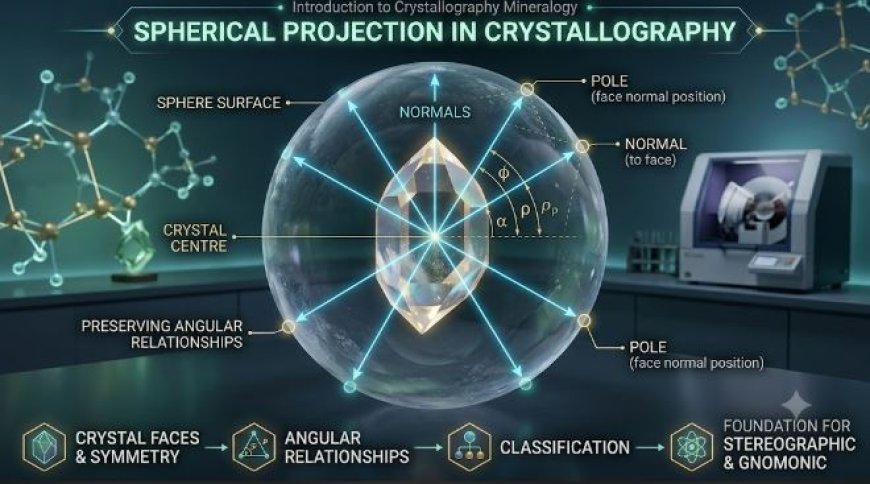
- A spherical projection is the representation of crystal faces, edges, and symmetry elements on the surface of an imaginary sphere surrounding the crystal.
- The center of the crystal is considered the center of the sphere.
- Lines drawn perpendicular to crystal faces intersect the sphere at specific points known as poles.
- These poles represent the orientation of crystal faces.
Principle of Spherical Projection
- An imaginary sphere is placed around the crystal with its center coinciding with the center of the crystal.
- Perpendicular lines called normals are drawn from the center to each crystal face.
- These lines meet the sphere at certain points.
- The points of intersection are plotted and used to study crystal symmetry and face relationships.

Components of Spherical Projection
Sphere
- The sphere acts as the reference surface for plotting crystal features.
- It completely surrounds the crystal and provides a uniform projection surface.
Pole
- A pole is the point where a normal to a crystal face intersects the sphere.
- Each crystal face has its own pole.
- Poles are used to represent the orientation of crystal faces.
Normal
- A normal is an imaginary line drawn perpendicular to a crystal face.
- It passes through the center of the crystal and reaches the sphere surface.
Features of Spherical Projection
- Represents crystal faces by poles rather than actual face shapes.
- Preserves angular relationships between crystal faces.
- Helps study symmetry elements easily.
- Provides a three-dimensional representation of crystal geometry.
- Serves as the foundation for other crystallographic projections.
Advantages of Spherical Projection
- Simple method for studying crystal symmetry.
- Helps visualize crystal faces and orientations.
- Useful in understanding angular relationships.
- Forms the basis for stereographic projection.
- Widely used in crystallographic analysis.
Limitations of Spherical Projection
- The complete sphere cannot be represented conveniently on flat paper.
- Interpretation becomes difficult when many crystal faces are present.
- Further projection methods are often required for practical use.
Applications of Spherical Projection
- Study of crystal symmetry.
- Analysis of crystal faces.
- Classification of crystal forms.
- Understanding crystallographic relationships.
- Basis for stereographic and gnomonic projections.
Importance in Crystallography
- Spherical projection provides a scientific method for representing crystal geometry.
- It allows crystallographers to analyze crystal symmetry in a systematic manner.
- The method is essential for understanding crystal classes and crystal systems.
- Many advanced crystallographic techniques are based on the principles of spherical projection.
What's Your Reaction?








ARUL PRASANTH
Arul Prasanth - MSc Geology graduate offering comprehensive study materials in Geology, Physics, and English. With a focus on clarity and effectiveness, I aim to provide students with the tools necessary for academic success.