













Trigonal Crystal System: Symmetry Elements and Classes
The Trigonal Crystal System is characterized by a principal three-fold axis of symmetry and distinct crystal classes. Learn about its symmetry elements, crystal forms, crystal classes, and important trigonal minerals in crystallography and mineralogy.
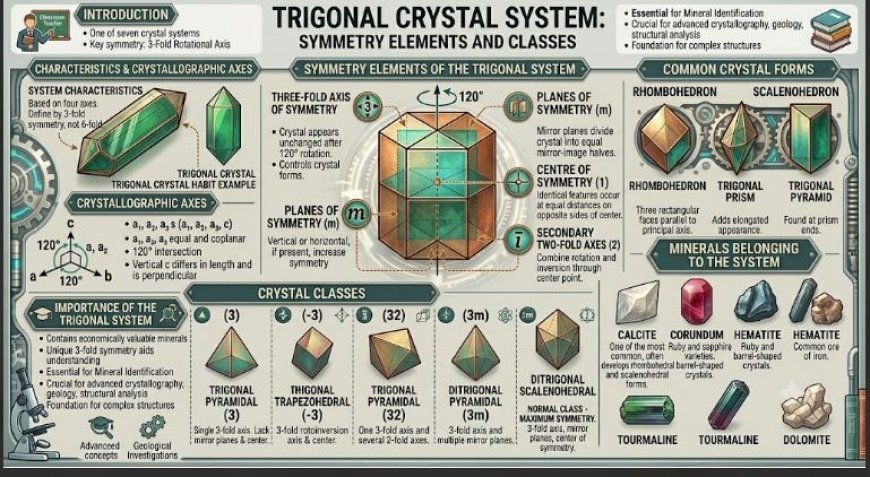
Trigonal Crystal System
Introduction
- The Trigonal Crystal System is one of the seven crystal systems in crystallography. It is characterized by the presence of a three-fold rotational axis, which is its most important symmetry element. Although the trigonal system is often grouped with the hexagonal system because both use similar crystallographic axes, it is treated as a separate crystal system due to its unique symmetry. Minerals belonging to this system commonly develop rhombohedral, scalenohedral, and trigonal prism forms.
Characteristics of the Trigonal Crystal System
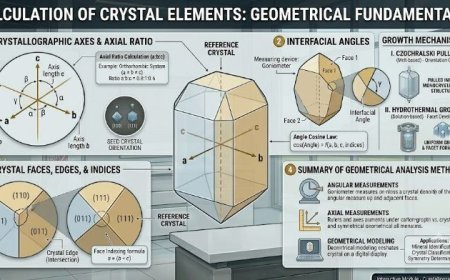
- The trigonal system is based on four crystallographic axes similar to those of the hexagonal system. Three horizontal axes are equal in length and lie in the same plane, intersecting at 120°, while the vertical axis is of different length and is perpendicular to the horizontal axes. The defining feature of this system is the presence of a three-fold axis of symmetry rather than a six-fold axis.
Crystallographic Axes
- The three horizontal axes are designated as a₁, a₂, and a₃, and are equal in length. The vertical axis, known as the c-axis, differs in length and passes through the center of the crystal. These axes provide the geometric framework for trigonal crystal forms and symmetry.
Symmetry Elements of the Trigonal System
Three-Fold Axis of Symmetry
- The most important symmetry element of the trigonal system is the three-fold rotational axis. A crystal possessing this axis appears unchanged after a rotation of 120°. This symmetry element distinguishes the trigonal system from all other crystal systems and controls the development of its crystal forms.
Planes of Symmetry
- Some trigonal crystal classes contain mirror planes. These planes divide the crystal into equal mirror-image halves and increase the overall symmetry of the crystal. The number and orientation of mirror planes vary among different trigonal classes.
Centre of Symmetry
- Certain trigonal classes possess a centre of symmetry. This means that identical crystal features occur at equal distances on opposite sides of the crystal center. The presence of a centre of symmetry contributes to more balanced crystal forms.
Rotation-Inversion Axes
- Some classes contain rotoinversion axes, which combine rotational movement with inversion through a center point. These symmetry elements help create complex crystal forms and are important in crystal classification.
Crystal Classes of the Trigonal System
Trigonal Pyramidal Class (3)
- The Trigonal Pyramidal Class possesses a single three-fold rotational axis and lacks mirror planes and a centre of symmetry. Crystals belonging to this class often develop simple trigonal pyramidal forms and represent one of the lowest symmetry classes of the trigonal system.
Rhombohedral Class (−3)
- The Rhombohedral Class contains a three-fold rotoinversion axis and a centre of symmetry. This class commonly produces rhombohedral crystal forms and is important in the study of trigonal minerals.
Trigonal Trapezohedral Class (32)
- This class possesses one three-fold axis together with several two-fold rotational axes. The combination of these symmetry elements results in characteristic trapezohedral crystal forms.
Ditrigonal Pyramidal Class (3m)
- The Ditrigonal Pyramidal Class contains a three-fold rotational axis and multiple mirror planes. These symmetry elements increase the regularity of crystal forms and produce more symmetrical crystal shapes.
Ditrigonal Scalenohedral Class (−3m)
- The Ditrigonal Scalenohedral Class is the normal class of the trigonal crystal system. It possesses the highest symmetry within the system and contains a three-fold axis, mirror planes, and a centre of symmetry. This class is responsible for the development of highly symmetrical trigonal crystal forms.
Common Crystal Forms in the Trigonal System
Rhombohedron
- The rhombohedron is one of the most characteristic crystal forms of the trigonal system. It resembles a distorted cube in which all faces are rhomb-shaped. This form is commonly observed in several trigonal minerals.
Scalenohedron
- A scalenohedron consists of multiple scalene triangular faces arranged symmetrically around the crystal. It is one of the most distinctive crystal forms found in the trigonal system.
Trigonal Prism
- The trigonal prism is composed of three rectangular faces parallel to the principal axis. This form frequently occurs in trigonal crystals and contributes to their elongated appearance.
Trigonal Pyramid
- The trigonal pyramid consists of three triangular faces meeting at a single point. It is commonly developed at the ends of trigonal prisms.
Minerals Belonging to the Trigonal System
- Several important minerals crystallize in the trigonal system and display characteristic trigonal symmetry.
- Calcite is one of the most common trigonal minerals and often develops rhombohedral and scalenohedral crystal forms.
- Corundum, which includes ruby and sapphire varieties, belongs to the trigonal system and frequently forms barrel-shaped crystals.
- Hematite commonly occurs in trigonal crystal forms and is an important ore of iron.
- Tourmaline and Dolomite are also important minerals that exhibit trigonal symmetry.
Importance of the Trigonal System
- The Trigonal Crystal System is important because it contains many economically valuable and scientifically significant minerals. Its unique three-fold symmetry helps students understand the relationship between crystal geometry and crystal classification. The study of trigonal crystal classes, symmetry elements, and crystal forms is essential for mineral identification, crystallography, and geological investigations. Understanding this system also provides a strong foundation for studying more advanced topics in crystal symmetry and crystal structure.
What's Your Reaction?