













Orthorhombic Crystal System: Symmetry Elements and Classes
The Orthorhombic Crystal System is characterized by three unequal crystallographic axes intersecting at right angles. Learn about its symmetry elements, crystal classes, crystal forms, and important orthorhombic minerals in crystallography and mineralogy
Orthorhombic Crystal System
Introduction
- The Orthorhombic Crystal System is one of the most important crystal systems in crystallography. It occupies an intermediate position between highly symmetrical crystal systems such as cubic and lower symmetry systems such as monoclinic and triclinic. The system is characterized by three crystallographic axes of unequal lengths that intersect at right angles. Because of this arrangement, orthorhombic crystals display a variety of crystal forms and symmetry combinations.
- Many important rock-forming and ore minerals crystallize in the orthorhombic system. The study of this system helps students understand how crystal symmetry influences crystal shape, growth, and classification.
Characteristics of the Orthorhombic Crystal System
- The orthorhombic system contains three crystallographic axes, namely a, b, and c.
- All three axes are unequal in length.
- The axes intersect each other at 90° angles.
- The crystal structure exhibits moderate symmetry compared to cubic and tetragonal systems.
- Crystal forms are generally elongated, tabular, or prismatic in appearance.
- The unequal axis lengths give rise to a wide range of crystal shapes and habits.
Crystallographic Axes
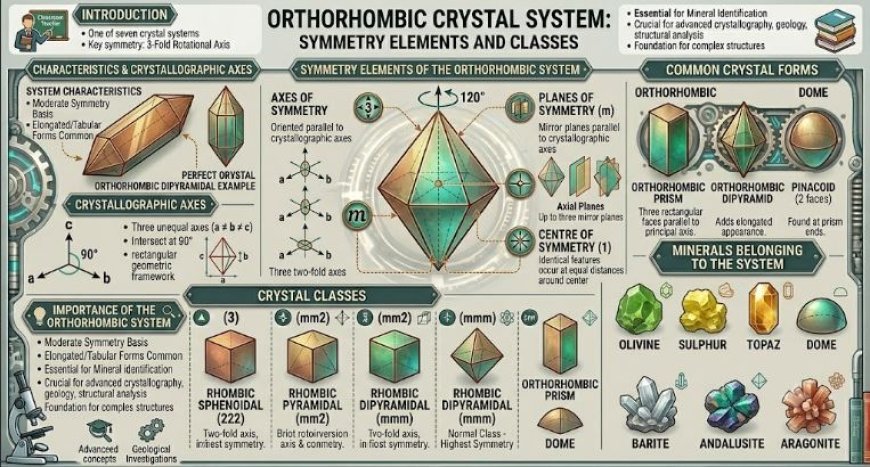
- In the orthorhombic system, the three crystallographic axes are all different in length but remain perpendicular to one another. This arrangement creates a rectangular geometric framework that controls the development of crystal forms.
- The relationship between the axes is expressed as:
a ≠ b ≠ c
α = β = γ = 90°
- This geometric arrangement distinguishes the orthorhombic system from tetragonal and cubic crystal systems.
Symmetry Elements of the Orthorhombic System
Axes of Symmetry
- The orthorhombic system commonly possesses three two-fold rotational axes. These axes are oriented parallel to the three crystallographic axes.
- When the crystal is rotated through 180°, it appears unchanged. This rotational symmetry contributes to the balanced appearance of orthorhombic crystals.
Planes of Symmetry
- Many orthorhombic crystals contain mirror planes that divide the crystal into equal mirror-image halves.
- These mirror planes may occur parallel to the crystallographic axes and contribute significantly to the overall symmetry of the crystal.
Centre of Symmetry
- Some orthorhombic crystal classes possess a centre of symmetry. In such crystals, identical crystal features occur at equal distances on opposite sides of the crystal center.
- The presence of a centre of symmetry increases the regularity and balance of crystal forms.
Crystal Classes of the Orthorhombic System
Rhombic Sphenoidal Class (222)
- The Rhombic Sphenoidal Class contains three mutually perpendicular two-fold rotational axes.
- It does not possess mirror planes or a centre of symmetry.
- Crystals belonging to this class often develop sphenoid-shaped forms and exhibit moderate symmetry.
Rhombic Pyramidal Class (mm2)
- The Rhombic Pyramidal Class contains one two-fold rotational axis and two mirror planes.
- These symmetry elements produce pyramidal crystal forms and contribute to the development of more symmetrical crystal shapes.
Rhombic Dipyramidal Class (mmm)
- The Rhombic Dipyramidal Class is the normal class of the orthorhombic system.
- It possesses three two-fold rotational axes, three mirror planes, and a centre of symmetry.
- This class contains the maximum symmetry elements possible within the orthorhombic system and serves as the standard representative of the system.
Common Crystal Forms in the Orthorhombic System
Orthorhombic Prism
- The orthorhombic prism is one of the most common crystal forms found in this system.
- It consists of rectangular faces parallel to the crystallographic axes and often produces elongated crystal shapes.
Orthorhombic Dipyramid
- The orthorhombic dipyramid consists of two pyramids joined base to base.
- This form is highly symmetrical and commonly occurs in minerals belonging to higher symmetry classes.
Pinacoid
- A pinacoid consists of two parallel crystal faces.
- Pinacoids commonly occur in orthorhombic crystals and often combine with prisms and dipyramids to form complex crystal shapes.
Dome
- A dome is formed by two non-parallel faces that intersect along a line.
- Domes are common accessory forms in many orthorhombic minerals.
Minerals Belonging to the Orthorhombic System
- Several economically and scientifically important minerals crystallize in the orthorhombic system.
- Olivine is one of the most important rock-forming minerals belonging to this system. It commonly occurs in igneous rocks and displays characteristic orthorhombic symmetry.
- Sulphur frequently forms well-developed orthorhombic crystals and is an excellent example of this crystal system.
- Topaz is another important orthorhombic mineral known for its beautiful crystal forms and gemstone varieties.
- Barite commonly develops tabular and prismatic crystals that reflect orthorhombic symmetry.
- Andalusite belongs to the orthorhombic system and is widely studied in metamorphic petrology.
- Aragonite is another important mineral that crystallizes in this system and often develops elongated crystal forms.
Importance of the Orthorhombic System
- The Orthorhombic Crystal System is important because it contains many significant minerals used in geological, industrial, and scientific studies.
- The system provides an excellent example of how crystal symmetry can exist even when all crystallographic axes are unequal.
- Understanding orthorhombic symmetry helps students identify minerals, interpret crystal forms, and classify crystals accurately.
- The study of orthorhombic crystal classes and symmetry elements also forms the foundation for understanding lower-symmetry crystal systems such as monoclinic and triclinic systems.
- Because of its wide mineral representation and moderate symmetry, the orthorhombic system remains one of the most important topics in crystallography, mineralogy, and geological sciences.
What's Your Reaction?