













Monoclinic Crystal System: Symmetry Elements and Classes
The Monoclinic Crystal System is characterized by three unequal crystallographic axes, with two axes intersecting at right angles and the third inclined. Learn about its symmetry elements, crystal classes, crystal forms, and important monoclinic minerals in crystallography and mineralogy.
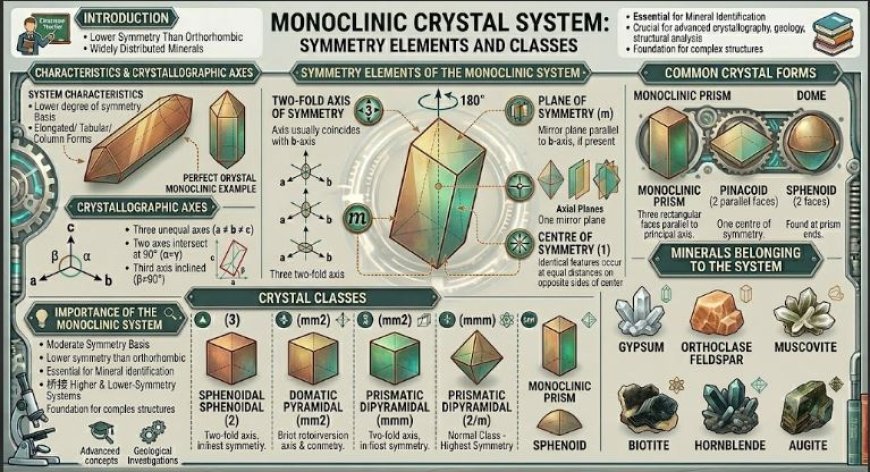
Monoclinic Crystal System
Introduction
- The Monoclinic Crystal System is one of the most common crystal systems found in nature. It is characterized by three crystallographic axes of unequal lengths and a lower degree of symmetry compared to the cubic, tetragonal, and orthorhombic systems. Many important rock-forming and ore minerals belong to this system, making it highly significant in mineralogy and geology.
- The name "monoclinic" means single inclination, referring to the fact that one crystallographic axis is inclined while the other two remain perpendicular. This unique arrangement produces crystal forms that are often elongated, tabular, or prismatic in appearance.
Characteristics of the Monoclinic Crystal System
- The monoclinic system contains three crystallographic axes, designated as a, b, and c.
- All three axes are unequal in length.
- Two axes intersect at 90°, while the third axis is inclined.
- The crystal structure exhibits moderate to low symmetry.
- Crystal forms are commonly prismatic, tabular, or columnar.
- Many minerals of economic and geological importance belong to this system.
Crystallographic Axes
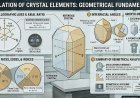
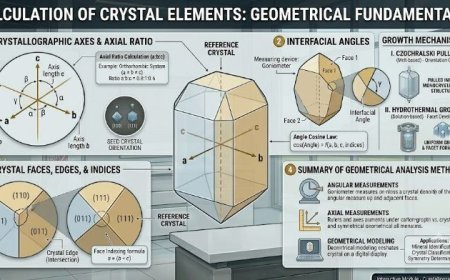
- In the monoclinic system, the crystallographic axes have unequal lengths and are arranged in a distinctive manner. The a-axis and c-axis are inclined to each other, while the b-axis remains perpendicular to both.
- The relationship between the axes is expressed as:
a ≠ b ≠ c
α = γ = 90°
β ≠ 90°
- This inclined arrangement is the key feature that distinguishes the monoclinic system from the orthorhombic system.
Symmetry Elements of the Monoclinic System
Two-Fold Axis of Symmetry
- The principal symmetry element of the monoclinic system is a two-fold rotational axis. When a crystal is rotated through 180° around this axis, it appears unchanged.
- This axis usually coincides with the b-axis and is responsible for the characteristic symmetry of monoclinic crystals.
Plane of Symmetry
- Many monoclinic crystals possess a mirror plane. This plane divides the crystal into two equal mirror-image halves.
- The presence of a mirror plane increases the symmetry of the crystal and contributes to the formation of more regular crystal forms.
Centre of Symmetry
- Some monoclinic crystal classes contain a centre of symmetry. This symmetry element ensures that identical crystal features occur on opposite sides of the crystal center.
- The centre of symmetry helps create balanced crystal structures and forms.
Crystal Classes of the Monoclinic System
Sphenoidal Class (2)
- The Sphenoidal Class contains only a two-fold rotational axis.
- It does not possess mirror planes or a centre of symmetry.
- Crystals belonging to this class often develop sphenoid-shaped forms and display relatively low symmetry.
Domatic Class (m)
- The Domatic Class contains a single mirror plane as its principal symmetry element.
- It lacks rotational symmetry and a centre of symmetry.
- Crystals in this class commonly develop dome-shaped crystal forms.
Prismatic Class (2/m)
- The Prismatic Class is the normal class of the monoclinic system.
- It contains a two-fold rotational axis, a mirror plane, and a centre of symmetry.
- This class possesses the highest symmetry possible within the monoclinic system and serves as its standard representative.
Common Crystal Forms in the Monoclinic System
Monoclinic Prism
- The monoclinic prism is one of the most common crystal forms in this system.
- It consists of elongated faces arranged parallel to the crystallographic axes and often produces columnar crystal shapes.
Pinacoid
- A pinacoid consists of two parallel crystal faces.
- Pinacoids are common in monoclinic crystals and often combine with prisms to create complex crystal habits.
Dome
- A dome is formed by two non-parallel faces that intersect along a common edge.
- Domes are characteristic forms in many monoclinic minerals and contribute to their distinctive appearance.
Sphenoid
- A sphenoid is composed of two non-parallel triangular faces related by a two-fold axis.
- This crystal form is commonly observed in minerals belonging to the sphenoidal class.
Minerals Belonging to the Monoclinic System
- The monoclinic system includes many important minerals that are widely distributed in igneous, metamorphic, and sedimentary rocks.
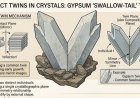
- Gypsum is one of the best-known monoclinic minerals and often forms transparent, tabular crystals.
- Orthoclase Feldspar belongs to the monoclinic system and is an important constituent of many igneous rocks.
- Muscovite is a common mica mineral that crystallizes in this system and displays perfect cleavage.
- Biotite is another important mica mineral that belongs to the monoclinic system.
- Hornblende commonly develops elongated prismatic crystals and is an important rock-forming mineral.
- Augite is a pyroxene mineral belonging to the monoclinic system and is widely found in igneous rocks.
Importance of the Monoclinic System
- The Monoclinic Crystal System is extremely important because it contains a large number of common rock-forming minerals. Understanding its symmetry elements and crystal classes helps geologists identify minerals and interpret rock formations.
- The system provides an excellent example of how crystal symmetry decreases as crystallographic axes become more irregular. It also serves as a bridge between higher-symmetry systems such as orthorhombic and lower-symmetry systems such as triclinic.
- The study of monoclinic crystals is essential in mineralogy, petrology, crystallography, and geological research. Knowledge of this system helps students understand crystal classification, mineral identification, and the relationship between internal atomic arrangement and external crystal form.
What's Your Reaction?