













Triclinic Crystal System: Symmetry Elements and Classes
The Triclinic Crystal System is the least symmetrical crystal system, characterized by three unequal crystallographic axes intersecting at unequal angles. Learn about its symmetry elements, crystal classes, crystal forms, and important triclinic minerals in crystallography and mineralogy.

Title: Triclinic Crystal System: Symmetry Elements and Classes
Slug: triclinic-crystal-system-symmetry-elements-and-classes
Summary: The Triclinic Crystal System is the simplest and least symmetrical of all crystal systems. It is characterized by three unequal crystallographic axes that intersect at unequal angles. Due to its low symmetry, only a few symmetry elements are present. Many important minerals belong to this crystal system and display distinctive crystal forms.
Meta Description: Learn about the Triclinic Crystal System, its symmetry elements, crystal classes, crystal forms, and minerals. Easy-to-understand crystallography notes for geology and mineralogy students.
Keywords (Meta Tag): triclinic crystal system, triclinic symmetry, crystal classes, crystallography, mineralogy notes, geology notes, triclinic crystals
Tags: Triclinic Crystal System, Crystal Symmetry, Crystal Classes, Crystallography, Mineralogy, Geology Notes
Triclinic Crystal System
Introduction
- The Triclinic Crystal System is the most basic and least symmetrical crystal system among the seven crystal systems. The word triclinic means three inclinations, which refers to the unequal inclination of all three crystallographic axes. Unlike other crystal systems, no axis is perpendicular to another, resulting in a highly irregular geometric arrangement.
- Because of its low symmetry, crystals belonging to this system often appear less regular than crystals of other systems. However, the triclinic system is very important in mineralogy because several common minerals crystallize in this system. Understanding triclinic symmetry helps students appreciate how crystal structures can vary from highly symmetrical to highly asymmetrical forms.
Characteristics of the Triclinic Crystal System
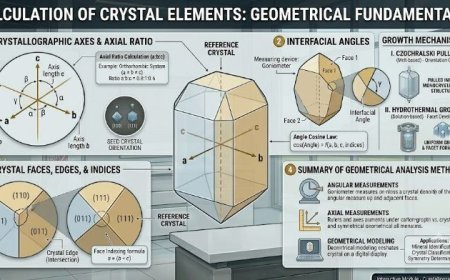
- The triclinic system contains three crystallographic axes, designated as a, b, and c.
- All three axes are unequal in length.
- All three axes intersect at unequal angles.
- None of the angles are equal to 90°.
- The system possesses the lowest degree of symmetry among all crystal systems.
- Crystal forms are often irregular and less symmetrical than those found in other systems.
Crystallographic Axes
- The arrangement of crystallographic axes in the triclinic system is unique because there are no right-angle intersections. All axes differ in length and inclination.
- The relationship between the axes is expressed as:
a ≠ b ≠ c
α ≠ β ≠ γ ≠ 90°
- This highly irregular arrangement creates a crystal framework that lacks the geometric simplicity seen in higher symmetry systems.
Symmetry Elements of the Triclinic System
Centre of Symmetry
- In some triclinic crystals, a centre of symmetry may be present. This means that every crystal face, edge, or corner on one side of the crystal has a corresponding feature on the opposite side at an equal distance from the center.
- The presence of a centre of symmetry slightly increases the symmetry of the crystal without changing its triclinic nature.
Absence of Rotational Axes
- The triclinic system generally lacks significant rotational axes of symmetry. Unlike cubic, tetragonal, or hexagonal systems, there are no two-fold, three-fold, four-fold, or six-fold rotational axes.
- This absence of rotational symmetry is one of the defining features of the triclinic system.
Absence of Mirror Planes
- Most triclinic crystals do not possess mirror planes. As a result, the crystal cannot be divided into two equal mirror-image halves.
- The lack of mirror symmetry contributes to the irregular appearance of triclinic crystal forms.
Crystal Classes of the Triclinic System
Pedial Class (1)
- The Pedial Class is the simplest crystal class in crystallography.
- It contains no symmetry elements other than identity.
- There are no rotational axes, mirror planes, or centres of symmetry.
- Crystals belonging to this class exhibit the lowest possible symmetry found in nature.
Pinacoidal Class (−1)
- The Pinacoidal Class contains a centre of symmetry.
- It does not possess mirror planes or rotational axes.
- This class represents the normal class of the triclinic system because it possesses the highest symmetry possible within the system.
- Many triclinic minerals belong to this class and display slightly more symmetrical forms than those of the pedial class.
Common Crystal Forms in the Triclinic System
Pinacoid
- The pinacoid is the most common crystal form in the triclinic system.
- It consists of two parallel crystal faces that are related by symmetry.
- Pinacoids often combine with other forms to produce complex crystal shapes.
Prismatic Forms
- Some triclinic minerals develop elongated prismatic crystal forms.
- These forms are generally less symmetrical than prisms found in higher crystal systems.
Tabular Forms
- Many triclinic minerals occur as tabular crystals, meaning they are flattened in one direction.
- This habit is commonly observed in several feldspar minerals.
Minerals Belonging to the Triclinic System
- Several important minerals crystallize in the triclinic system despite its low symmetry.
- Microcline Feldspar is one of the most common triclinic minerals and is widely found in igneous rocks.
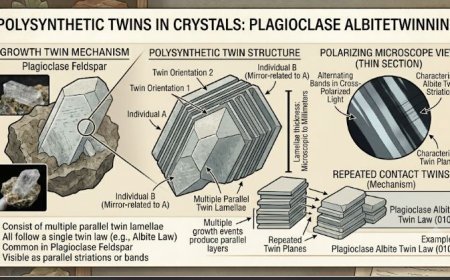
- Albite, a sodium-rich feldspar, belongs to the triclinic system and commonly occurs in granites and pegmatites.
- Kyanite is a metamorphic mineral that develops elongated triclinic crystals and is widely used as an indicator mineral.
- Rhodonite is another triclinic mineral known for its attractive pink color and ornamental value.
- Turquoise, a valuable gemstone mineral, also crystallizes in the triclinic system.
Crystal Forms and Appearance
- Triclinic crystals often appear less regular than crystals belonging to higher-symmetry systems. Their unequal axes and unequal angles result in distorted and asymmetrical shapes.
- Crystal faces may intersect at unusual angles, giving the crystals a distinctive appearance. These irregular forms are useful for identifying triclinic minerals in hand specimens and laboratory studies.
Importance of the Triclinic System
- The Triclinic Crystal System is important because it demonstrates the lowest level of symmetry possible in crystalline materials. It helps students understand how crystal structures can exist even when symmetry is greatly reduced.
- The study of triclinic crystals provides valuable information about crystal geometry, crystal classification, and mineral identification. Many important rock-forming and metamorphic minerals belong to this system, making it highly relevant to geology and mineralogy.
- Understanding triclinic symmetry also helps researchers compare crystal systems and appreciate the role of symmetry in determining crystal form, physical properties, and internal atomic arrangement.
- Although it is the least symmetrical crystal system, the triclinic system remains a fundamental part of crystallography and serves as an essential topic for students studying crystal structures and mineral sciences.
What's Your Reaction?