













Forms of Crystals in the Isometric (Cubic) System
The Isometric (Cubic) Crystal System contains highly symmetrical crystal forms such as the cube, octahedron, rhombic dodecahedron, tetrahedron, pyritohedron, tetrahexahedron, trisoctahedron, and hexoctahedron. Learn about their characteristics, symmetry, and mineral examples in crystallography.
Forms of Crystals in the Isometric (Cubic) System
Introduction
- The Isometric Crystal System is the most symmetrical crystal system and contains a wide variety of crystal forms. Since all three crystallographic axes are equal in length and intersect at 90°, crystals belonging to this system often develop highly regular geometric shapes. These crystal forms are important in crystallography because they help identify minerals and understand crystal symmetry. Many minerals such as diamond, pyrite, fluorite, garnet, galena, and halite exhibit crystal forms belonging to the cubic system.
What is a Crystal Form?
- A crystal form is a group of crystal faces that are related to each other by symmetry. All faces belonging to the same form have similar shapes and identical relationships with the crystallographic axes. Crystal forms may occur individually or combine with other forms to produce complex crystal shapes. In the cubic system, the high degree of symmetry allows the development of numerous crystal forms.
Cube
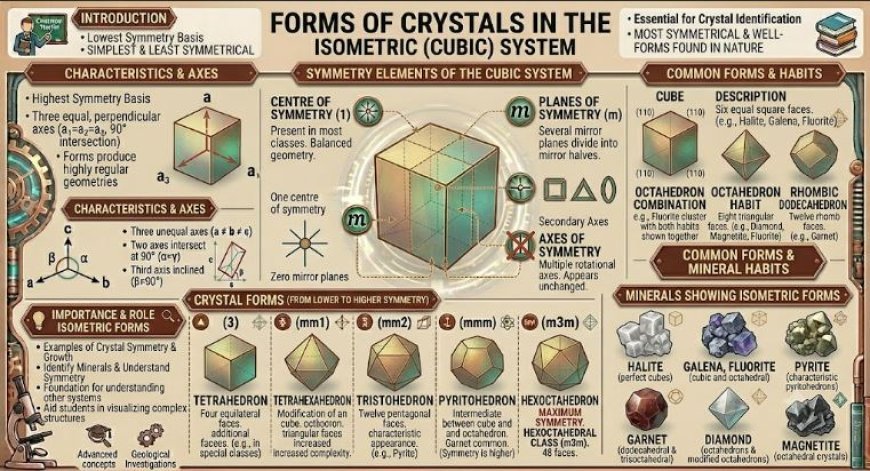
- The Cube is the simplest and most characteristic crystal form of the isometric system. It consists of six equal square faces, with each face perpendicular to one crystallographic axis. The cube possesses a very high degree of symmetry and is one of the easiest crystal forms to recognize.
- In a cube, all edges are equal in length and all angles between faces are 90°. Minerals such as halite, galena, and fluorite commonly develop cubic crystals. Because of its perfect symmetry, the cube is often used as the basic model for studying crystal geometry.
Octahedron
- The Octahedron is another important crystal form of the cubic system. It consists of eight equilateral triangular faces arranged symmetrically around the center of the crystal. Each face intersects all three crystallographic axes equally.
- The octahedron is one of the most attractive crystal forms and is commonly observed in minerals such as diamond, fluorite, and magnetite. Due to its balanced geometry and high symmetry, it is frequently used in crystallographic demonstrations and teaching.
Rhombic Dodecahedron
- The Rhombic Dodecahedron consists of twelve rhomb-shaped faces. This crystal form occupies an intermediate position between the cube and the octahedron in terms of crystal geometry.
- The faces are arranged symmetrically around the crystal center and produce a highly regular appearance. Minerals such as garnet often develop dodecahedral crystal forms. The rhombic dodecahedron is an important form because it demonstrates the influence of crystal symmetry on external shape.
Tetrahedron
- The Tetrahedron consists of four equilateral triangular faces. Although it belongs to the cubic system, its appearance differs significantly from the cube and octahedron.
- The tetrahedron represents a lower-symmetry form of the cubic system and commonly occurs in minerals that belong to special crystal classes. The crystal resembles a triangular pyramid and is important for understanding variations in cubic symmetry.
Pyritohedron
- The Pyritohedron is a distinctive crystal form consisting of twelve pentagonal faces. It is named after the mineral pyrite, in which this form commonly occurs.
- Although the faces resemble regular pentagons, they are actually irregular pentagonal shapes produced by crystal symmetry. The pyritohedron gives pyrite crystals their characteristic appearance and serves as an important identifying feature.
Tetrahexahedron
- The Tetrahexahedron is a more complex crystal form consisting of twenty-four faces. These faces are arranged symmetrically around the crystal and represent a modification of the simple cube.
- This form develops when additional crystal faces appear on the edges of a cube. The tetrahexahedron demonstrates how crystal growth conditions can modify basic crystal forms and produce more complex geometries.
Trisoctahedron
- The Trisoctahedron consists of twenty-four triangular faces and can be considered a modification of the octahedron. Each face of the octahedron is replaced by three smaller triangular faces, increasing the complexity of the crystal form.
- Minerals such as diamond and garnet may occasionally display trisoctahedral modifications. This form highlights the ability of cubic crystals to develop intricate geometric patterns while maintaining overall symmetry.
Hexoctahedron
- The Hexoctahedron is the most complex and most symmetrical crystal form of the cubic system. It consists of forty-eight faces arranged according to the highest symmetry possible in crystallography.
- This form belongs to the Hexoctahedral Class (m3m), which is the normal class of the cubic system. The hexoctahedron represents the maximum development of crystal symmetry and serves as an important model for advanced crystallographic studies.
Relationship Between Crystal Forms
- The crystal forms of the cubic system are closely related to one another. Simple forms such as the cube and octahedron often combine during crystal growth to produce more complex shapes. Modifications may occur through the addition of new crystal faces, resulting in forms such as the tetrahexahedron and trisoctahedron.
- These relationships help crystallographers understand how crystal morphology changes under different growth conditions and environmental influences.
Minerals Showing Isometric Crystal Forms
- Several important minerals exhibit crystal forms belonging to the cubic system.
- Halite commonly develops perfect cubic crystals.
- Diamond often occurs as octahedrons and modified octahedrons.
- Fluorite frequently displays both cubic and octahedral forms.
- Pyrite is well known for its pyritohedral crystals.
- Garnet commonly develops dodecahedral and trisoctahedral forms.
- Galena usually forms bright metallic cubes with excellent symmetry.
Importance of Isometric Crystal Forms
- The crystal forms of the Isometric Crystal System are important because they provide excellent examples of crystal symmetry and crystal growth. They help students understand the relationship between internal atomic arrangement and external crystal shape. These forms are widely used in mineral identification, crystallographic research, and geological investigations.
- The study of cubic crystal forms also forms the foundation for understanding crystal morphology in other crystal systems. Because of their perfect symmetry and geometric beauty, isometric crystal forms remain among the most important and widely studied topics in crystallography.
What's Your Reaction?








ARUL PRASANTH
Arul Prasanth - MSc Geology graduate offering comprehensive study materials in Geology, Physics, and English. With a focus on clarity and effectiveness, I aim to provide students with the tools necessary for academic success.