













14 Bravais Lattices and Their Derivation
The 14 Bravais lattices are the fundamental lattice arrangements derived from the seven crystal systems. Learn about their derivation, lattice types, crystal symmetry, unit cells, and importance in crystallography and mineralogy.
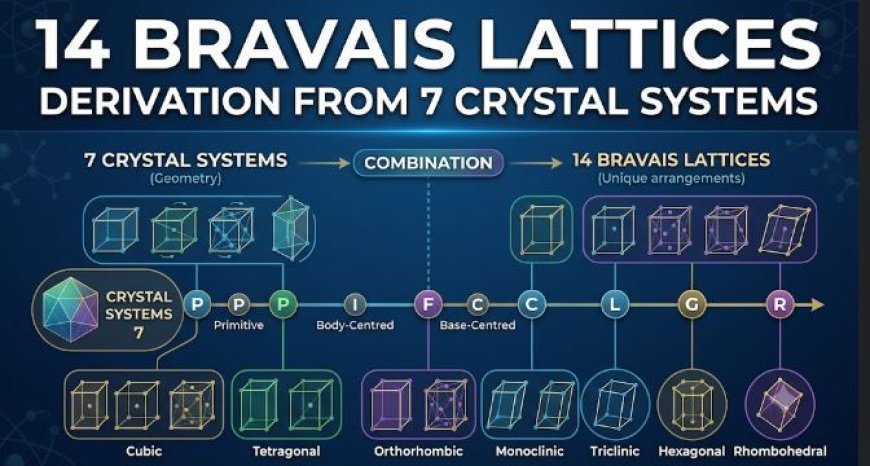
14 Bravais Lattices and Their Derivation
Introduction
- The internal structure of crystals is based on the regular arrangement of atoms, ions, or molecules.
- To represent this arrangement, scientists use a three-dimensional pattern called a space lattice.
- In 1848, the French scientist Auguste Bravais showed that only fourteen distinct types of lattices are possible in three-dimensional space.
- These arrangements are known as the 14 Bravais Lattices.
- They provide the basic framework for all known crystal structures and are widely used in crystallography and mineralogy.
What are Bravais Lattices?
- A Bravais lattice is a regular and repeating arrangement of lattice points in three-dimensional space.
- Every lattice point has an identical environment around it.
- The repetition of these lattice points forms the complete crystal structure.
- Bravais lattices help explain how atoms are arranged inside crystals.
Derivation of Bravais Lattices
- Crystals are grouped into seven crystal systems based on the lengths of their axes and the angles between them.
- Different arrangements of lattice points within these crystal systems produce different lattice types.
- By combining crystal geometry with lattice-point arrangements, only 14 unique lattices are possible.
- These fourteen lattices represent all possible periodic arrangements of points in crystalline materials.
The Seven Crystal Systems
The fourteen Bravais lattices are derived from the following seven crystal systems:
1. Cubic System
- All three axes are equal in length.
- All angles are 90°.
- This system possesses high symmetry.
The cubic system contains:
- Simple Cubic (P)
- Body-Centred Cubic (I)
- Face-Centred Cubic (F)
Total lattices = 3
2. Tetragonal System
- Two horizontal axes are equal.
- The vertical axis is different.
- All angles are 90°.
The tetragonal system contains:
- Simple Tetragonal (P)
- Body-Centred Tetragonal (I)
Total lattices = 2
3. Orthorhombic System
- All three axes are unequal.
- All angles are 90°.
The orthorhombic system contains:
- Simple Orthorhombic (P)
- Base-Centred Orthorhombic (C)
- Body-Centred Orthorhombic (I)
- Face-Centred Orthorhombic (F)
Total lattices = 4
4. Monoclinic System
- All axes are unequal.
- Two angles are 90° and one angle differs from 90°.
The monoclinic system contains:
- Simple Monoclinic (P)
- Base-Centred Monoclinic (C)
Total lattices = 2
5. Triclinic System
- All three axes are unequal.
- All angles are unequal and none are 90°.
The triclinic system contains:
- Simple Triclinic (P)
Total lattices = 1
6. Hexagonal System
- Three horizontal axes are equal.
- One vertical axis is different.
- Specific angular relationships exist between the axes.
The hexagonal system contains:
- Simple Hexagonal (P)
Total lattices = 1
7. Rhombohedral (Trigonal) System
- All axes are equal.
- All angles are equal but not 90°.
The rhombohedral system contains:
- Rhombohedral (R)
Total lattices = 1
List of the 14 Bravais Lattices
Cubic System
- Simple Cubic (P)
- Body-Centred Cubic (I)
- Face-Centred Cubic (F)
Tetragonal System
- Simple Tetragonal (P)
- Body-Centred Tetragonal (I)
Orthorhombic System
- Simple Orthorhombic (P)
- Base-Centred Orthorhombic (C)
- Body-Centred Orthorhombic (I)
- Face-Centred Orthorhombic (F)
Monoclinic System
- Simple Monoclinic (P)
- Base-Centred Monoclinic (C)
Triclinic System
- Simple Triclinic (P)
Hexagonal System
- Simple Hexagonal (P)
Rhombohedral System
- Rhombohedral (R)
Types of Lattice Centering
The fourteen lattices are formed using different centering arrangements.
Primitive Lattice (P)
- Lattice points are present only at the corners of the unit cell.
- It is the simplest lattice arrangement.
Body-Centred Lattice (I)
- Lattice points occur at the corners and one point at the center of the unit cell.
Face-Centred Lattice (F)
- Lattice points occur at the corners and at the center of each face.
Base-Centred Lattice (C)
- Lattice points occur at the corners and at the centers of two opposite faces.
Rhombohedral Lattice (R)
- A special lattice arrangement found only in the trigonal crystal system.
Importance of Bravais Lattices
- Provide the foundation for crystal structure studies.
- Help classify all crystalline materials.
- Explain the arrangement of atoms inside minerals.
- Assist in X-ray crystallographic analysis.
- Support mineral identification and crystal classification.
- Play a major role in geology, mineralogy, chemistry, and materials science.
- Help scientists understand crystal symmetry and crystal properties.
Applications of Bravais Lattices
- Crystal structure determination.
- Mineralogical investigations.
- X-ray diffraction studies.
- Material science research.
- Semiconductor technology.
- Metallurgical studies.
- Nanotechnology and advanced material development.
- The 14 Bravais lattices represent all possible three-dimensional arrangements of lattice points in crystalline materials. Derived from the seven crystal systems, they provide a systematic method for understanding crystal structures and symmetry. Their study forms a fundamental part of crystallography and serves as the basis for modern mineralogical and materials science research.
What's Your Reaction?