












Derivation of 32 Crystal Classes
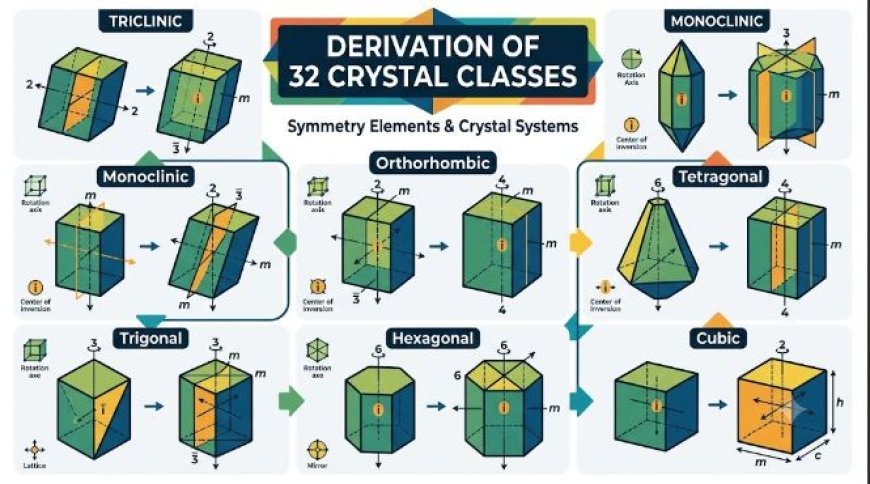
The 32 crystal classes are derived from different combinations of symmetry elements within the seven crystal systems. Learn about their derivation, distribution, point groups, and importance in crystal classification and crystallography.
Derivation of 32 Crystal Classes
Introduction
- Crystals occur in many different shapes and forms, but their external appearance is controlled by their internal symmetry. Scientists observed that crystals belonging to the same crystal system may possess different combinations of symmetry elements. To classify these variations, crystals are grouped into 32 crystal classes, also known as point groups. These classes are derived by combining symmetry elements such as rotational axes, mirror planes, centers of symmetry, and rotoinversion axes. The study of crystal classes is one of the most important topics in crystallography because it provides a systematic method for classifying all crystalline materials.
What are Crystal Classes?
- A crystal class is a group of crystals that possess the same combination of symmetry elements. Crystals belonging to a particular class may differ in size or shape, but they share identical symmetry characteristics. Crystal classes help scientists understand the geometric relationships within crystals and allow accurate classification of minerals. Each crystal class is represented by a unique set of symmetry elements and is associated with one of the seven crystal systems.
Basis for Derivation of Crystal Classes
- The derivation of crystal classes depends entirely on symmetry. Scientists begin with the symmetry elements allowed in a particular crystal system and then determine all possible combinations that can exist without violating the rules of crystallography. Each unique combination produces a separate crystal class. Through mathematical and geometrical analysis, it has been shown that only 32 unique combinations of symmetry elements are possible in crystals.
- The symmetry elements considered during derivation include:
- Axis of Symmetry
- Plane of Symmetry
- Centre of Symmetry
- Rotation-Inversion Axis

Role of Crystal Systems in Derivation
- The seven crystal systems provide the framework for deriving crystal classes. Each crystal system has specific symmetry restrictions based on its crystallographic axes. These restrictions determine which symmetry elements can occur and how they can be combined. As a result, each crystal system contains a fixed number of crystal classes.
Triclinic Crystal System
- The triclinic system possesses the lowest degree of symmetry. All axes are unequal in length, and all angles are unequal. Because of its low symmetry, only two crystal classes can exist within this system.
Crystal Classes in the Triclinic System
- Pedial Class (1)
- Contains no symmetry element except identity.
- Represents the simplest crystal symmetry.
- Pinacoidal Class (1‾\overline{1}1)
- Contains a centre of symmetry.
- More symmetrical than the pedial class.
Total Classes = 2
Monoclinic Crystal System
- The monoclinic system has three unequal axes, with two axes intersecting at right angles and one axis inclined. This system allows a greater number of symmetry combinations compared to the triclinic system.
Crystal Classes in the Monoclinic System
- Domatic Class (m)
- Contains one mirror plane.
- Sphenoidal Class (2)
- Contains one two-fold rotation axis.
- Prismatic Class (2/m)
- Contains both a two-fold axis and a mirror plane.
Total Classes = 3
Orthorhombic Crystal System
- The orthorhombic system consists of three unequal axes intersecting at right angles. Its higher symmetry allows more combinations of symmetry elements.
Crystal Classes in the Orthorhombic System
- Rhombic-Dipyramidal Class (mmm)
- Rhombic-Pyramidal Class (mm2)
- Rhombic-Bipyramidal Class (222)
- These classes differ in the number and arrangement of symmetry axes and mirror planes.
Total Classes = 3
Tetragonal Crystal System
- The tetragonal system contains two equal horizontal axes and one unequal vertical axis. The presence of a four-fold rotational axis is its defining feature.
Crystal Classes in the Tetragonal System
- 4
- 4‾\overline{4}4
- 4/m
- 422
- 4mm
- 4‾2m\overline{4}2m42m
- 4/mmm
- These classes are derived by combining four-fold axes with mirror planes and additional rotational symmetry elements.
Total Classes = 7
Trigonal Crystal System
- The trigonal system is characterized by a three-fold rotational axis. Crystals in this system possess moderate symmetry and unique geometric forms.
Crystal Classes in the Trigonal System
- 3
- 3‾\overline{3}3
- 32
- 3m
- 3‾m\overline{3}m3m
- Different combinations of three-fold axes, mirror planes, and inversion symmetry produce these classes.
Total Classes = 5
Hexagonal Crystal System
- The hexagonal system is distinguished by a six-fold rotational axis. Its symmetry is higher than that of the trigonal and tetragonal systems.
Crystal Classes in the Hexagonal System
- 6
- 6‾\overline{6}6
- 6/m
- 622
- 6mm
- 6‾m2\overline{6}m26m2
- 6/mmm
- These classes arise from different arrangements of six-fold rotational symmetry and mirror planes.
Total Classes = 7
Cubic Crystal System
- The cubic system possesses the highest degree of symmetry among all crystal systems. All three axes are equal and intersect at right angles. Because of this high symmetry, several crystal classes are possible.
Crystal Classes in the Cubic System
- 23
- m3
- 432
- 4‾3m\overline{4}3m43m
- m3m
- These classes contain multiple rotational axes, mirror planes, and inversion centers.
Total Classes = 5
Distribution of the 32 Crystal Classes
|
Crystal System |
Number of Classes |
|
Triclinic |
2 |
|
Monoclinic |
3 |
|
Orthorhombic |
3 |
|
Tetragonal |
7 |
|
Trigonal |
5 |
|
Hexagonal |
7 |
|
Cubic |
5 |
Total = 32 Crystal Classes
Importance of the 32 Crystal Classes
The 32 crystal classes provide the basic framework for crystal classification. They help scientists identify minerals, understand crystal symmetry, and predict physical properties. Crystal classes are also important in optical mineralogy, X-ray crystallography, materials science, and geological research. Every crystalline substance can be assigned to one of these 32 classes based on its symmetry elements, making them a fundamental part of crystallography and mineralogy.
What's Your Reaction?