












Hermann–Mauguin Notation in Crystallography
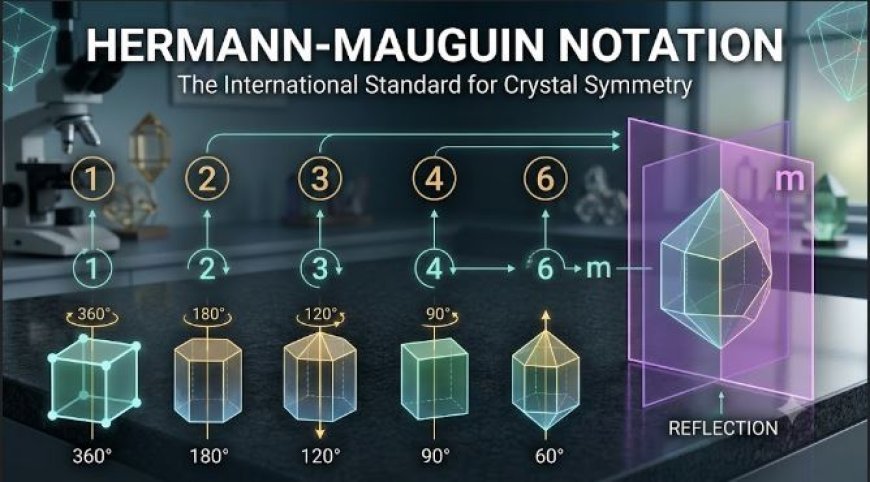
Hermann–Mauguin notation is the internationally accepted system for representing crystal symmetry using symbols for rotation axes, mirror planes, inversion centres, and rotoinversion axes. It is widely used to classify crystal classes and space groups in crystallography.
Schoenflies Notation
Introduction
- The study of crystals involves understanding their symmetry and classification. Since crystals may possess different combinations of symmetry elements, scientists developed notation systems to represent these symmetries in a simple and standardized manner. One of the most widely used systems is the Schoenflies notation, named after the German mathematician Arthur Moritz Schoenflies. This notation is commonly used in crystallography, chemistry, and physics to describe the symmetry of crystals and molecules. It helps scientists identify crystal classes and understand the arrangement of symmetry elements present within a structure.
What is Schoenflies Notation?
- Schoenflies notation is a symbolic system used to represent the symmetry of crystal point groups. Instead of listing all symmetry elements individually, a compact symbol is used to describe the overall symmetry of a crystal. Each symbol provides information about rotational axes, mirror planes, inversion centers, and other symmetry operations present in the crystal. This notation allows scientists to communicate complex symmetry information quickly and accurately.
- The Schoenflies system is particularly useful because it simplifies the classification of crystal structures. It provides a universal language that can be understood by crystallographers, mineralogists, chemists, and physicists around the world.
Purpose of Schoenflies Notation
- The primary purpose of Schoenflies notation is to provide a simple and systematic way to describe crystal symmetry. Crystals often possess multiple symmetry elements, making their description complicated. By using a single symbol, all essential symmetry information can be represented efficiently. This notation also helps in comparing crystal structures and understanding their physical and optical properties.
- Schoenflies notation is widely used in scientific research because it reduces confusion and ensures consistency in symmetry classification.

Basic Symbols Used in Schoenflies Notation
C Symbol
- The symbol C represents a rotational axis. It indicates that the crystal possesses rotational symmetry around a specific axis. The number written after the letter shows the order of rotation. For example, C₂ indicates a two-fold rotation axis, while C₄ represents a four-fold rotation axis. The crystal appears identical after rotation through specific angles around these axes.
D Symbol
- The symbol D represents a dihedral group. It indicates the presence of a principal rotational axis together with additional two-fold rotational axes that are perpendicular to the main axis. These symmetry combinations are commonly found in crystals with higher symmetry. Dihedral groups are more complex than simple rotational groups and play an important role in crystal classification.
S Symbol
- The symbol S represents a rotation-inversion axis. This symmetry operation combines rotation about an axis followed by inversion through a center point. Rotation-inversion symmetry is an important feature in many crystal structures and helps distinguish different point groups.
T Symbol
- The symbol T is used for tetrahedral symmetry. This type of symmetry occurs in crystals and molecules that possess the geometric arrangement of a tetrahedron. Tetrahedral symmetry is commonly observed in several minerals and chemical compounds.
O Symbol
- The symbol O represents octahedral symmetry. Crystals possessing octahedral symmetry contain multiple rotational axes and symmetry elements arranged in the form of an octahedron. This type of symmetry is often found in highly symmetrical crystal systems.
I Symbol
- The symbol I represents icosahedral symmetry. This is a highly complex symmetry arrangement involving numerous rotational axes. Although uncommon in natural crystals, it is important in theoretical crystallography and advanced symmetry studies.
Additional Symbols in Schoenflies Notation
h Symbol
- The letter h stands for a horizontal mirror plane. When attached to a Schoenflies symbol, it indicates the presence of a mirror plane perpendicular to the principal rotational axis. This additional symmetry element increases the overall symmetry of the crystal.
v Symbol
- The letter v represents vertical mirror planes. These mirror planes pass through the principal rotational axis. Crystals with vertical mirror planes exhibit greater symmetry and more balanced crystal forms.
d Symbol
- The letter d indicates diagonal mirror planes. These planes are positioned between the vertical mirror planes and add extra symmetry elements to the crystal structure.
Examples of Schoenflies Symbols
C₁
- The symbol C₁ represents the simplest possible symmetry group. It indicates that the crystal has no symmetry elements except identity. Such crystals possess very low symmetry.
C₂
- The symbol C₂ represents a crystal containing a single two-fold rotation axis. The crystal appears unchanged after a rotation of 180 degrees around the axis.
C₄v
- The symbol C₄v indicates a four-fold rotational axis combined with vertical mirror planes. This combination produces a higher degree of symmetry and is commonly observed in tetragonal crystal structures.
D₂
- The symbol D₂ represents one principal rotational axis along with two additional two-fold axes positioned perpendicular to it. This arrangement creates a more complex symmetry pattern.
Td
- The symbol Td represents tetrahedral symmetry with mirror planes. This notation is often used for minerals and molecules that exhibit tetrahedral geometry.
Relationship Between Schoenflies Notation and Crystal Classes
- The thirty-two crystal classes can be represented using Schoenflies notation. Each crystal class possesses a unique combination of symmetry elements and is assigned a specific Schoenflies symbol. These symbols make it easier to classify crystals according to their symmetry properties and compare different crystal structures.
- Crystallographers frequently use Schoenflies notation alongside other notation systems to accurately describe crystal symmetry and crystal classes.
Advantages of Schoenflies Notation
- Provides a compact and simple method for representing crystal symmetry.
- Makes the classification of crystals easier and more systematic.
- Helps scientists communicate symmetry information efficiently.
- Widely accepted in crystallography, chemistry, and physics.
- Useful for studying molecular structures and crystal classes.
- Simplifies the representation of complex symmetry operations.
Applications of Schoenflies Notation
- Crystal symmetry analysis.
- Mineral classification.
- Molecular structure studies.
- Spectroscopy and quantum chemistry.
- X-ray crystallography.
- Materials science research.
- Advanced crystallographic investigations.
- Schoenflies notation remains one of the most important systems for describing crystal symmetry. Its simple symbols provide a powerful tool for understanding crystal structures, classifying point groups, and studying the geometric arrangement of symmetry elements in both crystals and molecules.
What's Your Reaction?








ARUL PRASANTH
Arul Prasanth - MSc Geology graduate offering comprehensive study materials in Geology, Physics, and English. With a focus on clarity and effectiveness, I aim to provide students with the tools necessary for academic success.