













Forms of Crystals in the Triclinic System
Learn about the forms of crystals in the Triclinic Crystal System including pinacoids, prisms, pedions, and their significance in crystallography. Detailed geology and mineralogy notes for students.
Forms of Crystals in the Triclinic System
Introduction
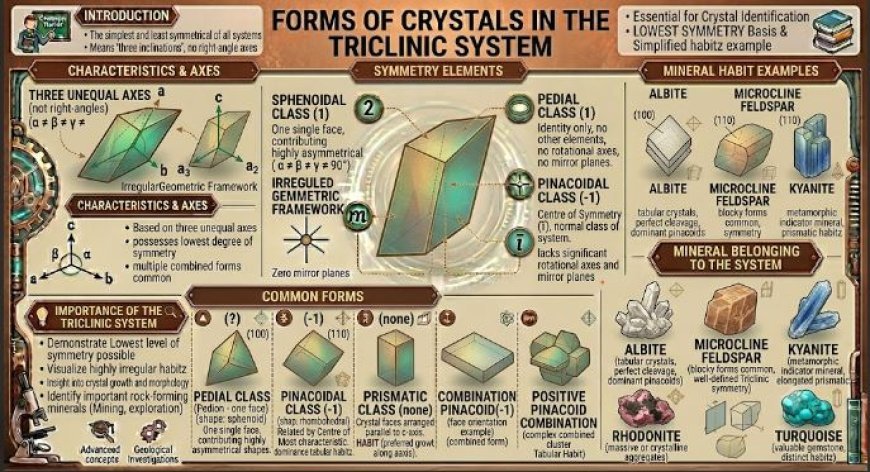
- The Triclinic Crystal System is the simplest and least symmetrical among the seven crystal systems recognized in crystallography. The word triclinic means three inclinations, referring to the fact that all three crystallographic axes are inclined to one another. Unlike the cubic, tetragonal, or orthorhombic systems, no axis in the triclinic system is perpendicular to another, and all axes differ in length.
- Because of this irregular arrangement, triclinic crystals display fewer symmetry elements and simpler crystal forms. However, these crystal forms are extremely important because they help scientists understand how crystals can exist even with very little symmetry.
- Many important minerals, including microcline, albite, kyanite, rhodonite, and turquoise, crystallize in the triclinic system. Their crystal forms provide valuable information about crystal growth, mineral identification, and crystal structure.
Characteristics of Triclinic Crystal Forms
- Crystal forms are based on three unequal crystallographic axes.
- All axes intersect at unequal angles.
- No angle is equal to 90°.
- The system possesses the lowest degree of symmetry among all crystal systems.
- Crystal forms are often irregular and asymmetrical.
- Crystal faces may intersect at unusual angles.
- Most triclinic crystals develop simple forms rather than highly symmetrical shapes.
- Multiple crystal forms may combine to produce complex crystal habits.
Crystallographic Axes and Their Influence on Crystal Forms
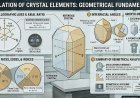
- In the triclinic system, the relationship between the axes is expressed as:
a ≠ b ≠ c
α ≠ β ≠ γ ≠ 90°
- This highly irregular arrangement strongly influences the appearance of crystal forms.
- Since there are no right-angle intersections, crystal faces develop at unusual orientations, producing asymmetrical shapes.
- The unequal axes and angles result in crystal forms that often appear distorted when compared with those of higher-symmetry systems.
- Despite their irregularity, triclinic crystal forms still follow definite geometric rules controlled by their internal atomic arrangement.
Pinacoid
- The Pinacoid is the most common and characteristic crystal form of the triclinic system.
- It consists of two parallel crystal faces that are related by symmetry.
- Because of the low symmetry of the triclinic system, pinacoids often dominate the external appearance of crystals.
- Pinacoids may occur in different orientations depending on which crystallographic axis they intersect.
- In many triclinic minerals, pinacoidal faces are broad and well developed, giving crystals a tabular appearance.
- The pinacoid is particularly important because it is associated with the Pinacoidal Class (-1), which is the normal class of the triclinic system.
- Many triclinic minerals develop crystals in which pinacoids are the most prominent crystal form.
Basal Pinacoid
- The Basal Pinacoid consists of two parallel crystal faces that are oriented perpendicular to the vertical crystallographic axis.
- These faces commonly form the upper and lower surfaces of the crystal.
- Basal pinacoids contribute significantly to the flattened or tabular appearance of many triclinic minerals.
- Their development depends on the relative growth rates of different crystal faces during crystal formation.
- In minerals such as albite and microcline, basal pinacoids often become dominant crystal surfaces.
Prism
- The Prism is another important crystal form found in the triclinic system.
- It consists of crystal faces arranged parallel to a crystallographic axis.
- Unlike prisms in higher symmetry systems, triclinic prisms are generally asymmetrical because of the unequal axes and angles.
- The prism often forms the elongated body of a crystal and may combine with pinacoids and pedions to produce more complex crystal habits.
- Many triclinic minerals exhibit prismatic growth due to preferred crystal growth along a particular axis.
Pedion
- The Pedion is one of the simplest crystal forms in crystallography.
- It consists of a single crystal face rather than a pair of related faces.
- Pedions are characteristic of crystals belonging to the Pedial Class (1), which possesses no symmetry elements except identity.
- Because there is no corresponding opposite face, pedions contribute to highly asymmetrical crystal shapes.
- Although pedions are relatively rare, they are important because they illustrate the extremely low symmetry possible in crystal systems.
Dome-Like Forms in Triclinic Crystals
- Some triclinic crystals develop forms that resemble domes, although true domes are more characteristic of the monoclinic system.
- These forms arise due to the irregular intersection of crystal faces and may create rounded or roof-like crystal terminations.
- Such forms contribute to the diversity of crystal habits observed in triclinic minerals.
- They often occur in combination with pinacoids and prisms.
Combinations of Triclinic Crystal Forms
- In nature, crystals rarely develop as perfect examples of a single crystal form.
- Instead, several crystal forms usually combine during crystal growth.
- A crystal may consist of a prism combined with one or more pinacoids, producing an elongated and flattened appearance.
- Pedions may modify crystal surfaces and create asymmetrical shapes.
- The combination of different forms results in the diverse crystal habits observed in triclinic minerals.
- These combinations provide valuable information about crystal growth conditions and the internal structure of minerals.
Crystal Habits of Triclinic Minerals
- Triclinic minerals commonly develop distinctive crystal habits due to their low symmetry.
- Tabular habits are very common because pinacoidal faces often dominate crystal growth.
- Prismatic habits occur when crystal growth is concentrated along one axis.
- Some minerals develop blocky or irregular crystal shapes due to the unequal development of crystal faces.
- The crystal habit often provides important clues for mineral identification in the field and laboratory.
Minerals Showing Triclinic Crystal Forms
- Several important minerals belong to the triclinic system and display characteristic crystal forms.
- Microcline Feldspar is one of the most common triclinic minerals and often develops blocky crystals dominated by pinacoidal forms.
- Albite commonly forms tabular crystals and is an important constituent of many igneous rocks.
- Kyanite develops elongated prismatic crystals and is widely used as an indicator mineral in metamorphic geology.
- Rhodonite often forms massive or crystalline aggregates with triclinic symmetry.
- Turquoise, a valuable gemstone mineral, also belongs to the triclinic system.
- These minerals provide excellent examples for studying triclinic crystal morphology and crystal growth.
Importance of Triclinic Crystal Forms
- The crystal forms of the Triclinic Crystal System are important because they represent the lowest level of crystal symmetry found in nature.
- Understanding pinacoids, prisms, and pedions helps students appreciate how crystals can develop even when symmetry is greatly reduced.
- These crystal forms play a significant role in mineral identification, crystallographic studies, petrology, and geological investigations.
- The study of triclinic crystal forms also helps explain the relationship between crystal symmetry and crystal morphology.
- Since several important rock-forming and metamorphic minerals belong to this system, knowledge of triclinic crystal forms is valuable for geology students and researchers.
- Triclinic crystal morphology provides a useful contrast to the highly symmetrical forms of cubic and tetragonal systems, helping students understand the full range of crystal symmetry found in nature.
- Because of their scientific significance and unique geometrical characteristics, triclinic crystal forms remain an essential topic in crystallography, mineralogy, and earth sciences.
- A detailed understanding of these forms provides a strong foundation for advanced studies in crystal structure, mineral classification, and crystallographic analysis, making them an important component of geology education and research.
What's Your Reaction?








ARUL PRASANTH
Arul Prasanth - MSc Geology graduate offering comprehensive study materials in Geology, Physics, and English. With a focus on clarity and effectiveness, I aim to provide students with the tools necessary for academic success.