













Crystal Growth
Learn about crystal growth, its process, conditions, mechanisms, factors affecting crystal growth, and importance in crystallography. Detailed notes for geology and mineralogy students.
Introduction
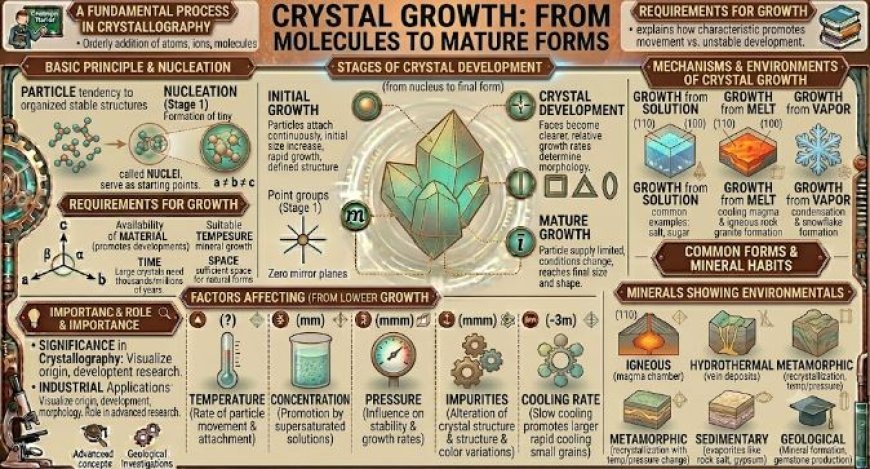
- Crystal Growth is the process by which a crystal increases in size through the addition of atoms, ions, or molecules in a definite and orderly pattern. It is a fundamental process in crystallography because every crystal found in nature or produced in laboratories develops through crystal growth.
- Crystals are not formed instantly. They grow gradually as particles from a surrounding medium such as a liquid, gas, or molten material attach themselves to the crystal surface. These particles arrange themselves according to the internal atomic structure of the crystal, resulting in the formation of well-defined crystal faces and shapes.
- Crystal growth is responsible for the formation of minerals in rocks, gemstones, snowflakes, salts, and many industrial materials. Understanding crystal growth helps geologists, mineralogists, and material scientists explain the origin and development of crystalline substances.
What is Crystal Growth?
- Crystal Growth refers to the enlargement of a crystal by the continuous addition of structural units such as atoms, ions, or molecules.
- During growth, these particles attach themselves to specific positions on the crystal surface. Because the internal arrangement of particles is highly ordered, the newly added particles follow the same pattern.
- As growth continues, the crystal maintains its characteristic symmetry and structure while increasing in size.
- The final shape of a crystal depends on factors such as temperature, pressure, concentration, available space, and growth rate.
Basic Principle of Crystal Growth
- The principle of crystal growth is based on the tendency of atoms and molecules to arrange themselves in a stable and organized structure.
- When particles in a solution, melt, or vapor become sufficiently concentrated, they begin to join together and form tiny crystal nuclei.
- These nuclei act as starting points for crystal development.
- Additional particles then attach to the nuclei, causing the crystal to grow larger.
- The arrangement of particles is controlled by the crystal lattice, ensuring that the crystal develops a regular geometric shape.
Stages of Crystal Growth
Nucleation
- Nucleation is the first stage of crystal growth.
- It involves the formation of tiny crystal embryos called nuclei.
- These nuclei are extremely small clusters of atoms or molecules that serve as the foundation for future crystal development.
- Nucleation may occur naturally or may be induced artificially in laboratory conditions.
- Without nucleation, crystal growth cannot begin.
Initial Growth
- After nucleation, particles continue to attach themselves to the crystal nucleus.
- The crystal begins to increase in size and develops its characteristic crystal structure.
- During this stage, growth is usually rapid because many available particles are present in the surrounding environment.
Crystal Development
- As growth continues, crystal faces become more clearly defined.
- Different crystal faces grow at different rates depending on environmental conditions.
- This stage determines the final shape and external appearance of the crystal.
Mature Growth
- Eventually, the supply of particles becomes limited or environmental conditions change.
- Crystal growth slows down and may eventually stop.
- The crystal reaches its final size and shape.
Requirements for Crystal Growth
Availability of Material
- A sufficient supply of atoms, ions, or molecules must be available for crystal growth.
- Without adequate material, crystals cannot increase in size.
Suitable Temperature
- Temperature plays a major role in crystal growth.
- High temperatures often increase particle movement and promote crystal formation.
- However, excessively high temperatures may prevent stable crystal development.
Proper Pressure
- Pressure influences crystal growth, particularly in deep geological environments.
- Many minerals form under high-pressure conditions within the Earth's crust and mantle.
Time
- Crystal growth requires time.
- Large crystals often develop over thousands or even millions of years.
- Rapid crystal growth usually produces smaller crystals.
Space for Growth
- Crystals need sufficient space to develop their natural forms.
- Limited space often results in irregular crystal shapes.
Mechanisms of Crystal Growth
Growth from Solution
- One of the most common methods of crystal growth occurs from a solution.
- When a solution becomes supersaturated, excess dissolved material begins to crystallize.
- Common examples include the formation of salt crystals and sugar crystals.
Growth from Melt
- Crystals can also grow from a molten material.
- As magma cools, minerals begin to crystallize from the melt.
- Igneous rocks such as granite form through this process.
Growth from Vapor
- Some crystals develop directly from a vapor phase.
- Atoms and molecules in the gas state condense onto a crystal surface and become part of the crystal structure.
- Snowflakes are a common example of crystals formed from vapor.
Factors Affecting Crystal Growth
Temperature
- Temperature affects the rate at which particles move and attach to the crystal surface.
- Different minerals require specific temperature conditions for growth.
Concentration
- Higher concentrations of dissolved material generally promote faster crystal growth.
- Supersaturated solutions are particularly favorable for crystal formation.
Pressure
- Pressure influences crystal stability and growth rates.
- Many deep-seated minerals form under high-pressure conditions.
Impurities
- Impurities can affect crystal growth by altering crystal structure and growth rates.
- In some cases, impurities produce color variations in minerals.
Cooling Rate
- Slow cooling allows crystals to grow larger.
- Rapid cooling produces small crystals because particles have less time to arrange themselves.
Types of Crystal Growth
Natural Crystal Growth
- Natural crystal growth occurs in geological environments such as magma chambers, hydrothermal veins, caves, and sedimentary basins.
- Most minerals found in nature are products of natural crystal growth.
Artificial Crystal Growth
- Artificial crystal growth is carried out in laboratories and industries.
- Scientists grow crystals for use in electronics, optics, medicine, and research.
- Examples include silicon crystals used in computer chips and quartz crystals used in watches.
Crystal Growth in Geological Environments
Igneous Environment
- Minerals crystallize from cooling magma.
- Slow cooling produces large crystals, while rapid cooling produces fine-grained textures.
Hydrothermal Environment
- Hot mineral-rich fluids deposit crystals in cracks and fractures.
- Many ore minerals form through hydrothermal crystal growth.
Metamorphic Environment
- Crystal growth occurs during metamorphism due to changes in temperature and pressure.
- Existing minerals recrystallize to form new minerals.
Sedimentary Environment
- Minerals may crystallize from evaporating water.
- Rock salt and gypsum commonly form through this process.
Importance of Crystal Growth
- Crystal Growth is essential for understanding the origin of minerals and rocks.
- It helps explain how crystal size, shape, and structure develop.
- Crystal growth studies are important in geology, mineralogy, chemistry, physics, and materials science.
- Knowledge of crystal growth assists in mineral exploration and gemstone formation studies.
- Industrial applications include semiconductor production, laser technology, pharmaceuticals, and optical devices.
- Crystal growth also plays a major role in manufacturing synthetic gemstones and advanced electronic materials.
Applications of Crystal Growth
- Mineral formation studies
- Gemstone production
- Semiconductor manufacturing
- Optical crystal production
- Medical and pharmaceutical research
- Materials engineering
- Nanotechnology development
- X-ray crystallography studies
Significance of Crystal Growth in Crystallography
- Crystal growth is one of the most important concepts in crystallography because it explains how crystals develop their internal and external structures.
- The study of crystal growth provides valuable information about crystal symmetry, crystal morphology, and mineral formation processes.
- By understanding crystal growth, scientists can explain the formation of natural minerals, improve industrial crystal production techniques, and develop advanced materials used in modern technology.
- Because every crystal begins and develops through this process, Crystal Growth serves as the foundation for the entire science of crystallography and remains a vital area of study in geology, mineralogy, and material sciences.
What's Your Reaction?