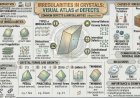














IRREGULARITIES IN CRYSTALS
Learn about irregularities in crystals, their causes, types, characteristics, and significance in crystallography. Detailed notes for geology and mineralogy students.
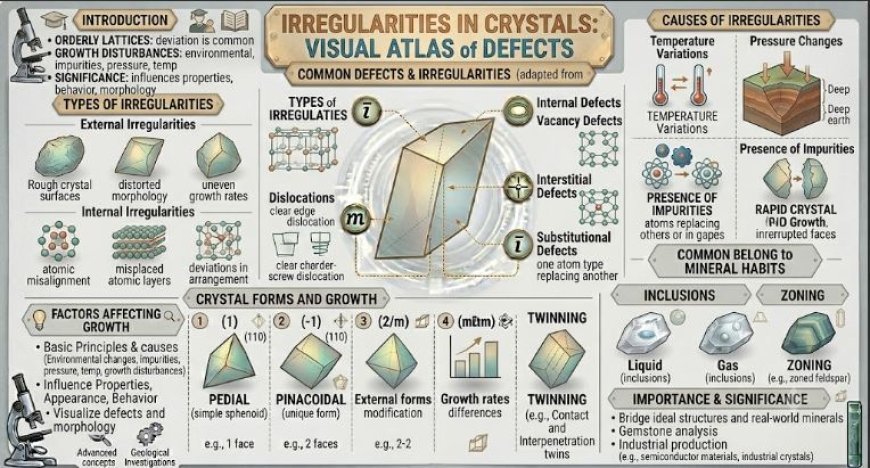
Irregularities in Crystals
Introduction
- Crystals are generally regarded as highly ordered solids with atoms, ions, or molecules arranged in a regular and repeating pattern. This orderly arrangement gives crystals their characteristic geometric shapes and symmetry. In theory, a perfect crystal should have a completely regular internal structure and smooth crystal faces. However, such perfect crystals are extremely rare in nature.
- During the process of crystal growth, various disturbances may affect the orderly arrangement of particles. Changes in temperature, pressure, chemical composition, impurities, and growth conditions often produce imperfections within the crystal structure. These imperfections are known as irregularities in crystals or crystal defects.
- Crystal irregularities are important because they influence the physical, chemical, optical, electrical, and mechanical properties of minerals. Understanding these defects helps geologists, mineralogists, and material scientists explain why natural crystals often differ from ideal crystal models.
What are Irregularities in Crystals?
- Irregularities in crystals are deviations from the perfect arrangement of atoms, ions, or molecules within a crystal structure.
- These irregularities may occur internally within the crystal lattice or externally on crystal surfaces.
- They can develop naturally during crystal growth or result from external forces acting on the crystal after formation.
- Although called defects, many crystal irregularities play an important role in determining the properties and behavior of minerals.
Formation of Crystal Irregularities
- Crystal irregularities develop because crystal growth rarely occurs under completely stable conditions.
- Variations in environmental factors can disturb the regular arrangement of particles within the crystal lattice.
- Growth interruptions, sudden temperature changes, pressure fluctuations, and the presence of foreign materials often contribute to defect formation.
- Mechanical stress and deformation after crystal formation can also create structural irregularities.
- These defects may be microscopic or visible to the naked eye depending on their size and nature.
Causes of Irregularities in Crystals
Temperature Variations
- Changes in temperature during crystal growth can affect the movement and arrangement of atoms.
- Sudden cooling or heating may prevent particles from occupying their correct positions.
- This often results in structural defects and growth irregularities.
Pressure Changes
- Variations in pressure influence crystal stability and growth patterns.
- Minerals forming deep within the Earth are especially affected by pressure fluctuations.
Presence of Impurities
- Foreign substances entering the crystal structure can disturb the regular arrangement of atoms.
- Impurities may replace original atoms or occupy spaces within the crystal lattice.
- These substitutions often produce color variations and structural irregularities.
Rapid Crystal Growth
- When crystals grow too quickly, atoms may not have sufficient time to arrange themselves properly.
- Rapid growth often produces imperfect crystal faces and internal defects.
Mechanical Stress
- External forces acting on a crystal may deform its structure.
- Compression, tension, and shearing can create fractures, dislocations, and other irregularities.
Types of Irregularities in Crystals
External Irregularities
- External irregularities affect the outer appearance of crystals.
- They are often visible without magnification and influence crystal morphology.
- These irregularities usually result from interrupted crystal growth or environmental disturbances.
Internal Irregularities
- Internal irregularities occur within the crystal lattice.
- They involve deviations in the arrangement of atoms, ions, or molecules.
- These defects often influence physical and optical properties.
Crystal Faces and Growth Irregularities
- Crystal faces may develop unevenly due to differences in growth rates.
- Some faces grow more rapidly than others, resulting in distorted crystal shapes.
- Growth interruptions may produce rough or irregular crystal surfaces.
- These features provide valuable information about the conditions under which the crystal formed.
Inclusions
- Inclusions are foreign materials trapped inside a crystal during growth.
- They may consist of liquids, gases, or solid particles.
- Inclusions are common in minerals and gemstones.
- They often provide important information about the environment in which the crystal formed.
- Gemologists frequently study inclusions to determine the origin and authenticity of gemstones.
Zoning
- Zoning refers to variations in chemical composition within different parts of a crystal.
- As growth conditions change, different layers of the crystal may contain varying concentrations of elements.
- This produces visible bands or zones within the crystal.
- Zoning is commonly observed in minerals such as feldspar, garnet, and tourmaline.
- It provides valuable evidence of changing growth conditions during crystal formation.
Dislocations
- Dislocations are defects involving the misalignment of atomic layers within a crystal.
- They are among the most important internal crystal defects.
- Dislocations allow crystals to deform without completely breaking.
- These defects play a major role in determining the mechanical strength of crystalline materials.
Edge Dislocation
- An edge dislocation occurs when an extra atomic plane is inserted into the crystal lattice.
- This disrupts the regular arrangement of surrounding atoms.
- Edge dislocations commonly develop during crystal growth and deformation.
Screw Dislocation
- A screw dislocation results from a spiral distortion within the crystal lattice.
- This type of defect often promotes crystal growth by providing favorable sites for atom attachment.
- Screw dislocations are important in understanding crystal growth mechanisms.
Vacancy Defects
- A vacancy defect occurs when an atom or ion is missing from its normal position within the crystal lattice.
- The absence of the particle creates an empty space.
- Vacancy defects influence diffusion, conductivity, and other physical properties.
- These defects commonly develop at high temperatures.
Interstitial Defects
- An interstitial defect occurs when an extra atom occupies a space between normal lattice positions.
- The additional particle distorts the crystal structure and affects its properties.
- Interstitial defects are common in minerals containing small ions capable of fitting into available spaces.
Substitutional Defects
- A substitutional defect occurs when one type of atom replaces another within the crystal lattice.
- The replacing atom may differ in size or charge from the original atom.
- This substitution often affects color, density, and chemical composition.
- Many mineral varieties result from substitutional defects.
Fractures and Cracks
- Crystals may develop fractures or cracks due to mechanical stress.
- These irregularities occur after crystal formation and can affect crystal strength.
- Fractures often serve as pathways for fluid movement and mineral deposition.
- In some cases, secondary minerals form within these cracks.
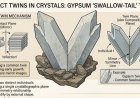
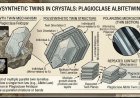
Twinning as a Crystal Irregularity
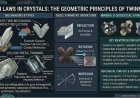
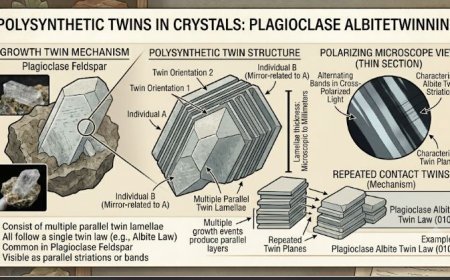
- Twinning is a special type of crystal irregularity in which two or more crystal parts grow together according to a definite symmetry relationship.
- Although twinning follows specific crystallographic rules, it represents a departure from normal crystal growth.
- Twinning is one of the most important irregularities studied in crystallography and mineralogy.
- Detailed study of twinning forms a separate topic within crystallography.
Effects of Irregularities on Crystal Properties
Physical Properties
- Irregularities may alter hardness, density, and cleavage.
- Defects often influence crystal strength and resistance to deformation.
Optical Properties
- Crystal defects may affect color, transparency, and optical behavior.
- Many gemstone colors result from structural irregularities and impurities.
Electrical Properties
- Certain defects influence electrical conductivity.
- Semiconductor materials rely on controlled crystal defects for their functionality.
Mechanical Properties
- Dislocations and structural defects affect crystal deformation and fracture behavior.
- These properties are important in engineering and material science.
Importance of Studying Crystal Irregularities
- Understanding crystal irregularities helps explain why natural crystals rarely exhibit perfect forms.
- The study of defects provides valuable information about crystal growth conditions and geological environments.
- Crystal irregularities assist mineralogists in identifying minerals and interpreting their formation history.
- Defects are also important in materials science because they influence the performance of industrial crystals.
- Many technological applications depend on controlling crystal defects to achieve desired properties.
Applications of Crystal Defect Studies
- Mineral identification
- Gemstone analysis
- Semiconductor manufacturing
- Materials engineering
- Nanotechnology research
- Metallurgical studies
- Geological investigations
- Crystal growth research
Significance of Irregularities in Crystallography
- Although crystals are known for their order and symmetry, irregularities are a natural part of crystal development.
- These defects provide valuable insights into crystal growth mechanisms and environmental conditions during formation.
- The study of crystal irregularities bridges the gap between ideal crystal structures and real-world minerals.
- Understanding these imperfections helps scientists improve industrial crystal production, identify minerals accurately, and develop advanced materials used in modern technology.
- Because defects influence nearly every aspect of crystal behavior, Irregularities in Crystals remain one of the most important topics in crystallography, mineralogy, geology, and material sciences.
What's Your Reaction?