













TWINNING IN CRYSTALS
Twinning is one of the most important crystal irregularities in crystallography. It occurs when two or more parts of a crystal grow together in a symmetrical manner according to definite crystallographic laws. Twinning affects the shape, appearance, and properties of crystals and plays a major role in mineral identification.
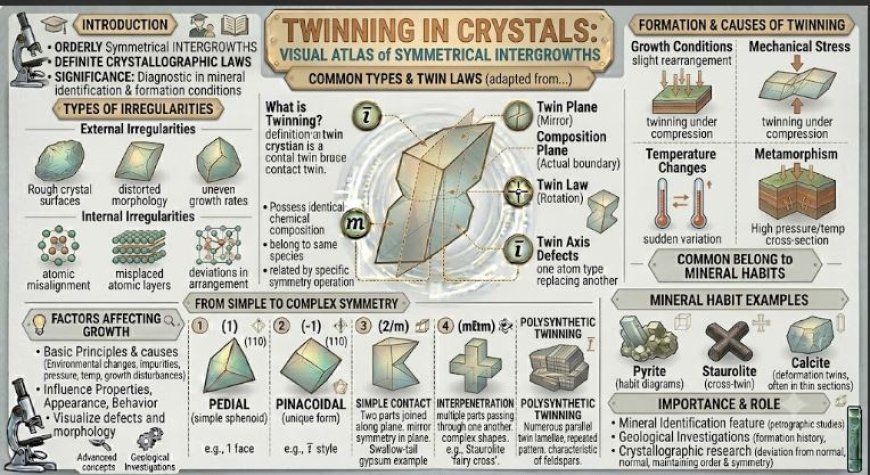
Twinning in Crystals
Introduction
- Twinning is one of the most common and important irregularities found in crystals. During normal crystal growth, atoms, ions, or molecules arrange themselves in a regular pattern according to the crystal lattice. However, under certain conditions, two or more parts of a crystal may grow together in a specific symmetrical relationship. This phenomenon is known as crystal twinning.
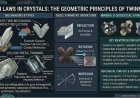
- Twinning is not a random defect. It follows definite geometric and crystallographic rules. The twinned parts are related to each other by a specific symmetry operation such as reflection, rotation, or inversion. Because of this orderly arrangement, twinned crystals often display beautiful and unusual crystal shapes.
- Twinning is commonly observed in many minerals and is extremely useful for mineral identification. Some minerals are so frequently twinned that their twin forms are considered characteristic features.
What is Twinning?
- Twinning is the symmetrical intergrowth of two or more crystal individuals of the same mineral species.
- These crystal individuals are related to each other by a specific crystallographic law known as a twin law.
- Although each individual crystal has the same internal structure, their orientations differ according to a definite symmetry relationship.
- The boundary separating the twin components is known as the twin plane or composition plane.
- Twinning may involve two crystals or several crystal individuals joined together.
Definition of a Twin Crystal
- A twin crystal is a crystal composed of two or more crystal parts that are symmetrically related but differ in orientation.
- The crystal individuals grow together in a manner that produces a repeated or mirrored crystal arrangement.
- Twin crystals often appear as a single crystal externally, even though they are composed of multiple crystal segments.
Formation of Twinning
- Twinning can develop during different stages of crystal formation.
- It may occur during the initial stages of crystal growth when atoms arrange themselves in slightly different orientations.
- Twinning may also form after crystal growth due to mechanical stress, pressure, or temperature changes.
- In some cases, twinning develops during recrystallization processes in metamorphic environments.
- The exact mechanism depends on the mineral species and environmental conditions.
Characteristics of Twinning
- Twinning involves two or more crystal individuals.
- The twin components belong to the same mineral species.
- The individuals possess identical chemical composition.
- The crystal parts are related by a specific symmetry operation.
- Twinning follows definite crystallographic laws.
- Twin crystals often display distinctive geometric patterns.
- Twinning is widely used as a diagnostic feature in mineral identification.
Elements of a Twin Crystal
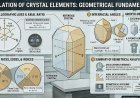
Twin Plane
- The Twin Plane is an imaginary plane that separates the twin individuals.
- The crystal parts are arranged as mirror images across this plane.
- Twin planes are important in classifying different types of twinning.
Twin Axis
- The Twin Axis is an imaginary line about which one crystal individual is rotated relative to another.
- Rotation around the twin axis creates the twinned arrangement.
Composition Surface
- The Composition Surface is the actual boundary where the twin individuals meet.
- It may be visible as a line or plane within the crystal.
Twin Law
- The Twin Law describes the specific crystallographic relationship between twin individuals.
- Every twin crystal follows a definite twin law that determines its geometry.
Causes of Twinning
Growth Conditions
- Twinning often develops during crystal growth when slight changes occur in the arrangement of atoms.
- Variations in temperature, pressure, and chemical composition may promote twin formation.
Mechanical Stress
- External forces acting on a crystal may produce twinning.
- Compression and deformation commonly generate mechanical twins.
Temperature Changes
- Sudden temperature variations may alter crystal structures and produce twin formations.
- Some minerals develop twins during cooling or heating processes.
Metamorphism
- During metamorphism, minerals are subjected to high pressure and temperature.
- These conditions frequently produce twinning in existing crystals.
Types of Twinning
- Twinning can be classified into several categories based on the relationship between twin individuals.
Simple Twinning
- Involves only two crystal individuals.
- The twin relationship is straightforward and easily recognized.
Repeated Twinning
- Involves multiple twin individuals arranged according to the same twin law.
- Produces more complex crystal patterns.
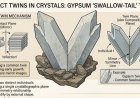
Contact Twinning
- Twin individuals are joined along a common plane.
- The boundary between the crystals is clearly visible.
Interpenetration Twinning
- Twin crystals penetrate each other during growth.
- The crystals appear to pass through one another.
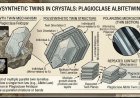
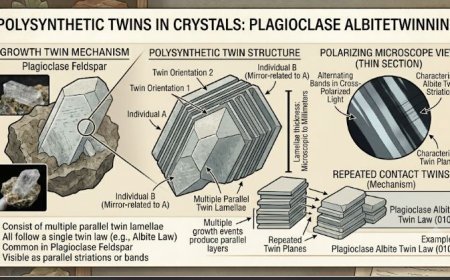
Polysynthetic Twinning
- Consists of numerous parallel twin lamellae.
- Common in feldspar minerals.
- This type produces repeated striped patterns.
Importance of Twinning in Mineral Identification
- Twinning is one of the most useful features in mineral identification.
- Many minerals possess characteristic twin forms that distinguish them from similar minerals.
- Mineralogists often use twinning patterns to identify feldspars, calcite, gypsum, pyrite, and other minerals.
- Microscopic twinning is particularly important in petrographic studies.
Common Minerals Showing Twinning
Feldspar
- Plagioclase feldspar commonly exhibits polysynthetic twinning.
- These twin lamellae produce characteristic striations visible under magnification.
Calcite
- Calcite frequently develops deformation twins.
- Twinning is often used to identify calcite in thin sections.
Gypsum
- Gypsum commonly forms contact twins known as swallow-tail twins.
- These twins are distinctive and easy to recognize.
Pyrite
- Pyrite often develops interpenetration twins.
- These twins create complex crystal shapes.
Staurolite
- Staurolite is famous for its cross-shaped penetration twins.
- These twins are commonly known as fairy crosses.
Twinning and Crystal Symmetry
- Twinning may produce apparent symmetry that does not exist in a single crystal.
- In some cases, twinning causes a low-symmetry crystal to resemble a higher-symmetry crystal.
- This phenomenon is known as pseudo-symmetry.
- Understanding the relationship between twinning and symmetry is important in crystallographic analysis.
Effects of Twinning on Crystal Properties
Physical Properties
- Twinning may influence cleavage, hardness, and fracture patterns.
- The presence of twin boundaries affects crystal behavior.
Optical Properties
- Twin structures influence optical characteristics observed under the microscope.
- Twinning is commonly used in optical mineralogy.
Mechanical Properties
- Twin boundaries may strengthen or weaken crystals depending on their arrangement.
- Twinning often affects crystal deformation mechanisms.
Applications of Twinning Studies
- Mineral identification
- Petrographic analysis
- Metamorphic studies
- Crystallographic research
- Materials science
- Structural geology
- Gemstone investigations
- Crystal growth studies
Significance of Twinning in Crystallography
- Twinning is one of the most important topics in crystallography because it demonstrates how crystal growth can deviate from normal patterns while still maintaining order and symmetry.
- The study of twinning provides valuable information about crystal growth conditions, geological history, and mineral formation processes.
- Twinned crystals often preserve evidence of temperature changes, pressure conditions, and deformation events that occurred during their formation.
- Understanding twinning also helps scientists interpret crystal structures and classify minerals more accurately.
- Because twinning is widespread in nature and plays a major role in crystal morphology, it remains a fundamental concept in crystallography, mineralogy, petrology, and geological sciences.
- The detailed study of twinning forms the basis for understanding more specialized topics such as Simple Twins, Contact Twins, Interpenetration Twins, Polysynthetic Twins, and Twin Laws, which are discussed separately in advanced crystallographic studies.
What's Your Reaction?