













SIMPLE TWINS IN CRYSTALS
Simple Twins are the most basic type of crystal twinning, consisting of only two crystal individuals related by a specific twin law. These twins develop through crystal growth, deformation, or transformation processes and are commonly observed in many minerals. The study of simple twins is important in crystallography because they provide valuable information about crystal symmetry, growth conditions, and mineral identification.
Simple Twins in Crystals
Introduction
- Twinning is one of the most important crystal irregularities found in nature. It occurs when two or more crystal individuals grow together according to a definite crystallographic relationship. Among the different types of twinning, Simple Twinning represents the most basic and easiest form to understand.
- A simple twin consists of only two crystal individuals joined together according to a specific twin law. Although the crystals share the same chemical composition and crystal structure, they differ in orientation. The twin relationship follows a definite geometrical rule and produces characteristic crystal shapes.
- Simple twins are common in many minerals and often serve as important diagnostic features in mineral identification. Their study provides valuable insights into crystal growth, crystal symmetry, and geological processes.
What are Simple Twins?
- Simple Twins are twin crystals composed of only two crystal individuals related by a single twin operation.
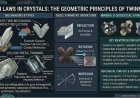
- The two crystal parts are arranged symmetrically with respect to a twin plane, twin axis, or twin center.
- The crystals appear as a single crystal externally but internally consist of two differently oriented crystal segments.
- The relationship between the individuals follows a definite twin law.
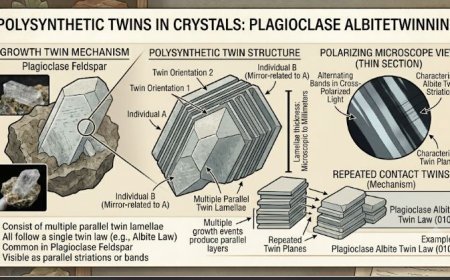
- Simple twins are the foundation for understanding more complex forms of twinning such as repeated and polysynthetic twins.
Definition of Simple Twinning
- Simple twinning may be defined as the symmetrical intergrowth of two crystal individuals of the same mineral species according to a definite crystallographic law.
- The two individuals are related by a specific symmetry operation that is not normally present in the crystal itself.
- This unique arrangement distinguishes twin crystals from ordinary crystal growth.
Formation of Simple Twins
- Simple twins may develop during various stages of crystal formation and geological processes.
- They commonly form during the initial stages of crystal growth when atoms arrange themselves in slightly different orientations.
- Some twins develop after crystal formation due to mechanical deformation.
- Others form during changes in temperature or pressure that alter the crystal structure.
- The formation mechanism depends on the mineral species and environmental conditions.
Characteristics of Simple Twins
- Consist of only two crystal individuals.
- Both individuals belong to the same mineral species.
- The crystals possess identical chemical composition.
- The twin relationship follows a definite twin law.
- The twin individuals differ only in orientation.
- The crystals may appear symmetrical externally.
- Twin boundaries are often visible and help identify the twin relationship.
Elements of a Simple Twin
Twin Plane
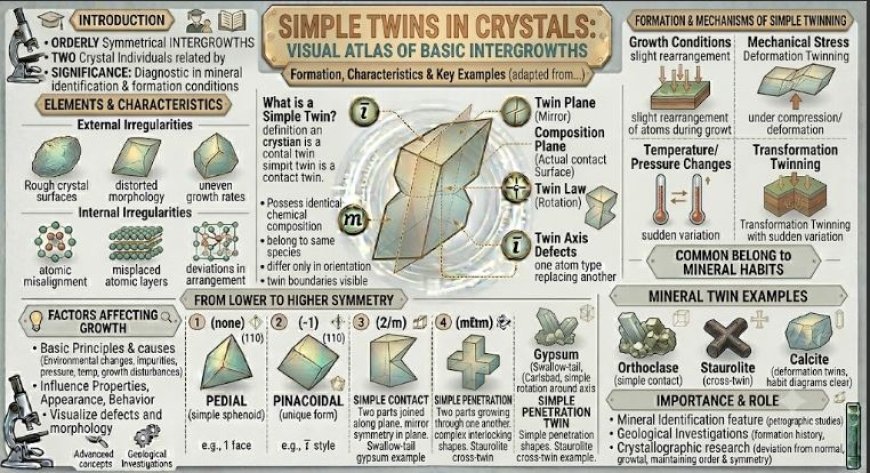
- The Twin Plane is an imaginary plane across which the two crystal individuals are related as mirror images.
- It is one of the most common symmetry elements involved in simple twinning.
- The twin plane often forms the boundary between the twin components.
Twin Axis
- The Twin Axis is an imaginary line around which one crystal individual is rotated relative to the other.
- Rotation through a specific angle creates the twin relationship.
- Some simple twins are best described using a twin axis rather than a twin plane.
Twin Center
- In certain twins, the crystal individuals are related by inversion through a point known as the Twin Center.
- This form of twinning is less common but still important in crystallography.
Composition Surface
- The Composition Surface is the actual contact surface between the twin individuals.
- It represents the physical boundary where the two crystals meet.
Mechanisms of Simple Twin Formation
Growth Twinning
- Growth Twinning develops during crystal growth.
- Small variations in atomic arrangement cause part of the crystal to grow in a different orientation.
- The resulting crystal exhibits a twin relationship from the beginning of its formation.
- Many naturally occurring twins belong to this category.
Transformation Twinning
- Transformation Twinning occurs when a crystal changes from one structural form to another due to temperature or pressure variations.
- The new crystal structure develops twin relationships during the transformation process.
Deformation Twinning
- Deformation Twinning results from mechanical stress.
- Compression or shearing forces cause part of the crystal lattice to shift and create a twin structure.
- This type of twinning is common in minerals subjected to tectonic forces.
Types of Simple Twins
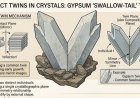
Contact Twins
- In Contact Twins, the two crystal individuals are joined along a single twin plane.
- The twin boundary is usually visible and clearly separates the crystal components.
- Contact twins are among the most common forms of simple twinning.
Penetration Twins
- In Penetration Twins, the crystal individuals grow into and through one another.
- The crystals appear interlocked and may seem to penetrate each other.
- Despite their complex appearance, penetration twins are still considered simple twins when only two individuals are involved.
Examples of Simple Twins in Minerals
Gypsum Twins
- Gypsum commonly develops simple contact twins.
- One of the best-known examples is the Swallow-Tail Twin, in which two crystal individuals meet at a distinct angle.
- These twins are frequently used as examples in crystallography textbooks.
Orthoclase Twins
- Orthoclase Feldspar commonly exhibits simple twins known as Carlsbad Twins.
- In this twin, two crystal individuals are related by rotation around a crystallographic axis.
- Carlsbad twinning is one of the most important diagnostic features of orthoclase.
Staurolite Twins
- Staurolite often forms simple penetration twins.
- These twins create cross-shaped crystals that are commonly known as fairy crosses.
- The characteristic shape makes staurolite easy to identify.
Calcite Twins
- Calcite frequently develops deformation twins.
- These twins form in response to pressure and are important indicators of geological deformation.
Recognition of Simple Twins
- Simple twins can often be identified by examining crystal shape and symmetry.
- Repeated crystal faces may indicate twin formation.
- Visible twin boundaries often reveal the relationship between crystal individuals.
- In thin sections, twinning may appear as distinct bands or changes in optical orientation.
- Mineralogists use hand specimens, microscopes, and crystallographic techniques to identify simple twins.
Importance of Simple Twins in Mineral Identification
- Simple twins are extremely useful for identifying minerals.
- Many minerals possess characteristic twin forms that serve as diagnostic features.
- The presence or absence of twinning helps distinguish similar minerals.
- Twinning patterns are commonly used in both field studies and laboratory investigations.
Geological Significance of Simple Twins
- Twin structures often preserve information about the environment in which a mineral formed.
- Growth twins provide evidence of crystal growth conditions.
- Deformation twins indicate the effects of pressure and tectonic stress.
- Transformation twins record changes in temperature and crystal structure.
- The study of twins helps geologists reconstruct geological history.
Applications of Simple Twin Studies
- Mineral identification
- Petrographic analysis
- Structural geology
- Metamorphic studies
- Crystallographic research
- Gemstone investigations
- Material science
- Crystal growth analysis
Difference Between Simple Twins and Other Twins
- Simple twins contain only two crystal individuals.
- Repeated twins contain multiple crystal individuals.
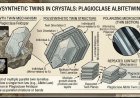
- Polysynthetic twins consist of numerous parallel twin lamellae.
- Contact and penetration twins may be simple twins when only two crystal segments are present.
- Simple twins provide the basis for understanding all other forms of crystal twinning.
Importance of Simple Twins in Crystallography
- Simple twins are among the most important topics in crystallography because they demonstrate how crystal growth can produce symmetrical intergrowths while maintaining crystallographic order.
- They help scientists understand crystal symmetry, crystal growth mechanisms, and structural changes within minerals.
- The study of simple twins provides valuable information about mineral formation, geological processes, and crystal classification.
- Because many common minerals exhibit simple twinning, knowledge of these structures is essential for geology, mineralogy, petrology, and crystallographic studies.
- Understanding simple twins also serves as the foundation for studying more advanced forms of twinning such as Contact Twins, Interpenetration Twins, Polysynthetic Twins, and Twin Laws, which are discussed separately in advanced crystallography.
- Due to their scientific importance, widespread occurrence, and usefulness in mineral identification, Simple Twins remain one of the most significant topics in crystallography and mineralogy.
What's Your Reaction?