













Napier's Theorem in Crystallography
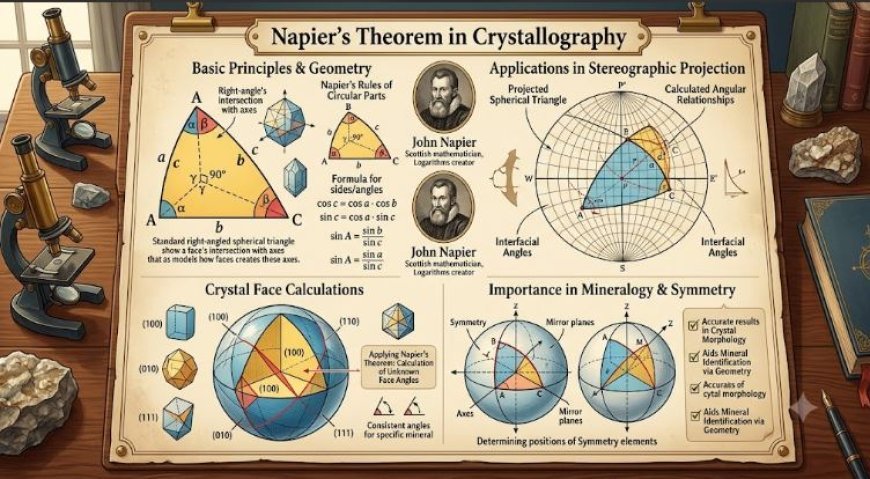
Napier's Theorem is a mathematical principle used in crystallography to solve right-angled spherical triangles and determine angular relationships between crystal faces. It is widely applied in crystal calculations, spherical projections, symmetry studies, and advanced crystallographic analysis.
Title: Napier's Theorem in Crystallography
Slug: napiers-theorem-in-crystallography
Summary: Napier's Theorem is an important mathematical principle used in crystallography for solving problems related to spherical triangles. It helps determine angular relationships between crystal faces and is widely used in crystallographic calculations and projections.
Meta Description: Learn about Napier's Theorem in crystallography, its principles, applications, and importance in crystal calculations. Easy notes for geology and mineralogy students.
Keywords (Meta Tag): Napier's theorem, crystallography, spherical triangles, crystal calculations, crystal geometry, mineralogy notes, geology notes, crystal elements
Tags: Napier's Theorem, Crystallography, Crystal Geometry, Mineralogy, Geology Notes, Advanced Crystallography
Napier's Theorem
Introduction
- Crystallography involves the study of crystal geometry, symmetry, and angular relationships between crystal faces. Since many crystallographic calculations involve spherical geometry, special mathematical principles are required to solve these problems. One of the most important principles is Napier's Theorem. This theorem is widely used in spherical trigonometry and helps crystallographers calculate unknown angles and relationships within crystal structures.
- Napier's Theorem is especially useful in crystallographic projections where spherical triangles are frequently encountered. It provides a simple method for solving complex geometrical problems and improves the accuracy of crystal calculations.
What is Napier's Theorem?
- Napier's Theorem is a mathematical rule used to solve right-angled spherical triangles. It establishes relationships between the sides and angles of a spherical triangle and helps determine unknown values when certain measurements are known.
- In crystallography, many angular relationships can be represented using spherical triangles. Napier's Theorem allows these relationships to be analyzed and calculated accurately.
Historical Background
- Napier's Theorem was developed by the Scottish mathematician John Napier, who is also known for introducing logarithms. His work in mathematics contributed greatly to trigonometry and geometrical calculations. The theorem became an important tool in navigation, astronomy, and later in crystallography, where spherical geometry plays a significant role.
Principle of Napier's Theorem
- The theorem is based on the properties of a right-angled spherical triangle. In such a triangle, the sides and angles are related through specific trigonometric relationships. By using these relationships, unknown sides or angles can be calculated from known values.
- The theorem simplifies calculations involving spherical surfaces and provides a systematic method for solving crystallographic problems.
Role of Spherical Triangles in Crystallography
- A spherical triangle is a triangle drawn on the surface of a sphere. In crystallography, crystal faces and symmetry elements are often represented on an imaginary sphere surrounding the crystal.
- The angular relationships between these features form spherical triangles. Napier's Theorem helps solve these triangles and determine important crystallographic measurements.
Importance of Napier's Theorem in Crystallography
- Helps calculate angular relationships between crystal faces.
- Useful in spherical projection studies.
- Assists in solving crystallographic geometrical problems.
- Provides accurate results in crystal calculations.
- Supports the study of crystal symmetry and crystal morphology.
- Forms an important part of advanced crystallographic mathematics.
Applications in Stereographic Projection
- In stereographic projection, crystal faces are represented as poles on a sphere and projected onto a plane. The angular relationships between these poles often involve spherical triangles.
- Napier's Theorem helps determine these angular relationships and ensures accurate representation of crystal features in projection diagrams.
Applications in Crystal Face Calculations
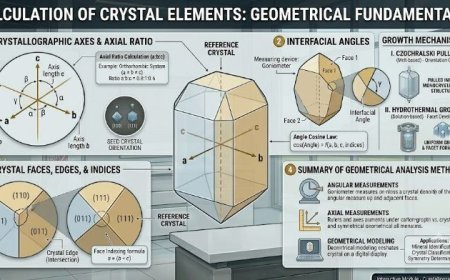
- Crystal faces meet at specific angles that remain constant for a given mineral. Napier's Theorem helps calculate these angles when direct measurements are not available.
- This method improves the accuracy of crystal face analysis and assists in crystal identification.
Applications in Crystal Symmetry Studies
- The theorem is useful for studying symmetry elements represented on spherical surfaces. It helps determine the angular positions of symmetry axes and mirror planes.
- By applying Napier's Theorem, crystallographers can better understand the symmetrical arrangement of crystal structures.
Advantages of Napier's Theorem
- Simplifies spherical trigonometric calculations.
- Provides accurate solutions for angular measurements.
- Useful in crystallographic projections.
- Supports crystal symmetry analysis.
- Widely accepted in advanced crystallographic studies.
Significance in Mineralogy
- Mineralogists use Napier's Theorem to study crystal forms and determine angular relationships between crystal faces. Since crystal geometry is important for mineral identification, accurate mathematical calculations help distinguish minerals with similar appearances.
- The theorem contributes to a deeper understanding of crystal morphology and mineral classification.
Use in Advanced Crystallography
- In advanced crystallography, Napier's Theorem is used alongside other trigonometric methods to solve complex geometrical problems. It is particularly valuable in projection techniques, crystal element calculations, and symmetry analysis.
- The theorem remains an essential mathematical tool for studying crystal structures and understanding the geometric principles that govern crystalline materials.
What's Your Reaction?