













Equation to Normal in Crystallography
The equation to normal is a mathematical method used in crystallography to describe the orientation and position of crystal faces through their perpendicular normals. It plays a key role in crystal geometry, crystallographic calculations, projections, and crystal structure analysis.

Equation to Normal
Introduction
- In crystallography, the position and orientation of crystal faces are very important for understanding crystal structures. To describe a crystal face accurately, crystallographers often use a line that is perpendicular to the face. This perpendicular line is known as the normal. The equation associated with this normal line is called the equation to normal. It provides a mathematical method for representing crystal faces and studying their geometrical relationships.
- The concept is widely used in crystal geometry, crystal face calculations, and crystallographic projections. It helps simplify the study of crystal structures by converting complex face orientations into mathematical expressions.
What is a Normal?
- A normal is an imaginary line drawn perpendicular to a crystal face. It passes through the center of the crystal and extends outward from the face. Every crystal face has its own normal, and the direction of the normal helps determine the orientation of that face.
- In crystallography, normals are often used instead of crystal faces because they provide a simpler and more accurate way to represent crystal geometry. Many projection methods are based on the positions of these normals.
What is the Equation to Normal?
- The equation to normal is a mathematical expression used to describe the position and direction of a normal line. Since the normal is always perpendicular to a crystal face, its equation provides important information about the orientation of that face.
- By calculating the equation to normal, crystallographers can determine the angular relationships between crystal faces and establish their positions within a crystal structure.
Principle of the Equation to Normal
- The basic principle involves drawing a perpendicular line from the center of the crystal to a crystal face. The direction and position of this line are then expressed mathematically. Since crystal faces are arranged in a regular geometric pattern, the normals also follow definite mathematical relationships.
- These relationships help crystallographers calculate face orientations and study crystal symmetry more effectively.
Role in Crystal Geometry
- Crystal geometry deals with the shape, dimensions, and arrangement of crystal faces. The equation to normal provides a precise mathematical method for describing these faces. Instead of studying the faces directly, scientists analyze their normals, which simplifies geometrical calculations.
- This approach is especially useful when dealing with complex crystal forms containing many faces and edges.
Importance in Crystallography
- Helps determine the orientation of crystal faces.
- Simplifies crystal geometry calculations.
- Assists in studying crystal symmetry.
- Useful in crystallographic projections.
- Supports the calculation of crystal elements.
- Provides accurate mathematical representation of crystal structures.
Relationship with Crystal Faces
- Every crystal face has a corresponding normal. The position of the normal depends on the orientation of the face. By studying the equation to normal, crystallographers can identify the exact location of a crystal face and compare it with other faces within the same crystal.
- This relationship is fundamental to the study of crystal morphology and crystal classification.
Applications in Crystal Calculations
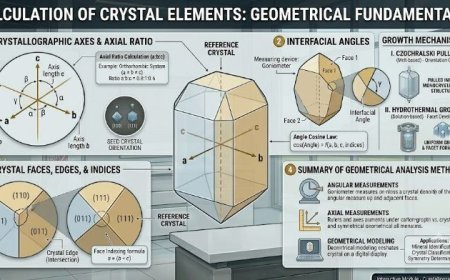
- The equation to normal is used to calculate interfacial angles, crystal face orientations, and crystallographic directions. It helps solve many geometrical problems encountered during crystal analysis.
- These calculations are essential for identifying minerals and understanding crystal growth patterns.
Applications in Crystallographic Projections
- Projection methods such as spherical, stereographic, and gnomonic projections often use normals instead of actual crystal faces. The equation to normal helps locate the positions of projected points accurately.
- This improves the precision of projection diagrams and facilitates the study of crystal symmetry.
Applications in Mineral Identification
- Different minerals possess characteristic crystal forms and face orientations. The equation to normal helps determine these orientations and supports accurate mineral identification.
- Mineralogists use this concept when studying crystal habits, symmetry, and morphological features.
Advantages of Using the Equation to Normal
- Provides accurate representation of crystal faces.
- Simplifies complex geometrical calculations.
- Useful for projection techniques.
- Supports crystal symmetry analysis.
- Helps in crystal classification and identification.
Significance in Advanced Crystallography
- In advanced crystallographic studies, the equation to normal is an essential mathematical tool. It allows scientists to analyze crystal structures with greater precision and establish relationships between crystal faces and symmetry elements.
- The concept is widely used in crystal morphology, mineralogy, X-ray crystallography, and structural analysis, making it an important part of modern crystallographic research.
What's Your Reaction?








ARUL PRASANTH
Arul Prasanth - MSc Geology graduate offering comprehensive study materials in Geology, Physics, and English. With a focus on clarity and effectiveness, I aim to provide students with the tools necessary for academic success.