












Isometric Crystal System (Cubic System)
The Isometric Crystal System, also known as the Cubic Crystal System, is the most symmetrical crystal system with three equal axes intersecting at right angles. Learn about its symmetry elements, crystal classes, crystal forms, and common minerals in crystallography.
Isometric Crystal System (Cubic System)
Introduction
- The Isometric Crystal System, also known as the Cubic Crystal System, is the most symmetrical crystal system in crystallography. It contains three crystallographic axes of equal length that intersect each other at right angles. Because of this perfect geometric arrangement, crystals belonging to this system often develop highly symmetrical and attractive forms. Many important minerals crystallize in the isometric system, making it one of the most widely studied crystal systems in geology and mineralogy.
Characteristics of the Isometric Crystal System
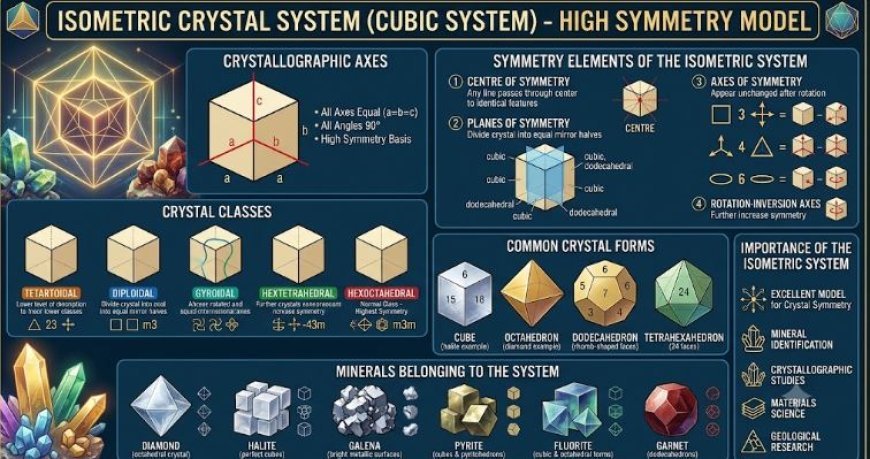
- The isometric system is characterized by three crystallographic axes designated as a, b, and c. All three axes are equal in length and intersect at angles of 90°. Since the axes are equal in length and arranged symmetrically, crystals belonging to this system display excellent symmetry and balanced crystal forms. The high degree of symmetry influences the physical and optical properties of minerals that crystallize in this system.
Crystallographic Axes
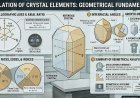
- In the isometric system, all three crystallographic axes are equal in length and perpendicular to each other. This arrangement produces a cube-like geometry and forms the basis for the crystal structure. The equality of the axes is one of the main reasons for the high symmetry found in this crystal system.
Symmetry Elements of the Isometric System
Centre of Symmetry
- Most crystals of the isometric system possess a centre of symmetry. This means that any line drawn through the center of the crystal intersects identical features at equal distances on opposite sides. The presence of a centre of symmetry contributes to the balanced appearance of cubic crystals.
Planes of Symmetry
- The isometric system contains several mirror planes. These planes divide the crystal into equal mirror-image halves. The large number of symmetry planes is responsible for the highly regular shape of isometric crystals.
Axes of Symmetry
- The cubic system possesses multiple rotational symmetry axes. These include three four-fold axes, four three-fold axes, and six two-fold axes. These rotational axes allow the crystal to appear unchanged after specific rotations and contribute significantly to its high symmetry.
Rotation-Inversion Axes
- In addition to rotational axes and mirror planes, isometric crystals may also contain rotation-inversion axes. These symmetry elements further increase the overall symmetry of the crystal and are important in crystal classification.
Crystal Classes of the Isometric System
Tetartoidal Class (23)
- The Tetartoidal Class possesses relatively low symmetry compared to other classes of the cubic system. It contains rotational axes but lacks mirror planes. This class is comparatively rare among naturally occurring minerals.
Diploidal Class (m3)
- The Diploidal Class contains rotational axes and a centre of symmetry. The addition of inversion symmetry increases its overall symmetry and produces more regular crystal forms.
Gyroidal Class (432)
- The Gyroidal Class contains several rotational axes but no mirror planes. The symmetry is higher than the diploidal class and gives rise to distinctive crystal forms.
Hextetrahedral Class (−43m)
- This class contains four-fold, three-fold, and two-fold rotational axes together with mirror planes. It possesses a high degree of symmetry and is represented by several minerals.
Hexoctahedral Class (m3m)
- The Hexoctahedral Class is the normal class of the cubic system and possesses the highest symmetry of all crystal classes. It contains the maximum number of symmetry elements possible in crystallography. Many common cubic minerals belong to this class.
Common Crystal Forms in the Isometric System
Cube
- The cube is the most characteristic form of the isometric system. It consists of six equal square faces and exhibits excellent symmetry. This form is commonly observed in minerals such as halite and galena.
Octahedron
- An octahedron is composed of eight triangular faces arranged symmetrically around the center of the crystal. This crystal form is frequently seen in minerals such as diamond and fluorite.
Dodecahedron
- The dodecahedron consists of twelve rhomb-shaped faces and is commonly observed in cubic minerals. Its symmetrical shape reflects the high degree of order present in the isometric system.
Tetrahexahedron
- The tetrahexahedron contains twenty-four faces and is derived from modifications of simpler cubic forms. It represents one of the more complex crystal forms found in highly symmetrical cubic crystals.
Minerals Belonging to the Isometric System
- Several important minerals crystallize in the isometric system because of its stable and symmetrical structure. These minerals often develop well-formed crystal shapes and are commonly studied in mineralogy and crystallography.
- Diamond is one of the most famous minerals belonging to this system and often occurs as octahedral crystals.
- Halite, commonly known as rock salt, typically forms perfect cubic crystals because of its highly symmetrical internal structure.
- Galena frequently develops cubic crystals with bright metallic surfaces and is an important ore of lead.
- Pyrite, often called fool’s gold, commonly forms cubes and pyritohedrons that reflect the symmetry of the cubic system.
- Fluorite is another common mineral that displays excellent cubic and octahedral crystal forms.
- Magnetite and Garnet also belong to the isometric system and are important minerals in geological studies.
Importance of the Isometric System
- The Isometric Crystal System serves as an excellent model for understanding crystal symmetry because it possesses the highest degree of symmetry among all crystal systems. It plays a major role in mineral identification, crystallographic studies, materials science, and geological research. The symmetry elements and crystal classes of this system provide a strong foundation for understanding more complex crystal structures found in nature. Because of its perfect geometric arrangement and high symmetry, the isometric system remains one of the most important topics in crystallography.
What's Your Reaction?