














DEVONIAN FISHES AND MESOZIC REPTILES
Learn about the evolution and diversity of Devonian fishes and Mesozoic reptiles.
Devonian Fishes and Mesozoic Reptiles
-
-
-
- The Devonian period, which is frequently referred to as the "Age of Fishes," and the Mesozoic era, which is commonly associated with the "Age of Reptiles."
-
-
The Devonian Period: The Age of the Fish
- The period of approximately 419 to 359 million years ago.
1. Diverse Fish Population
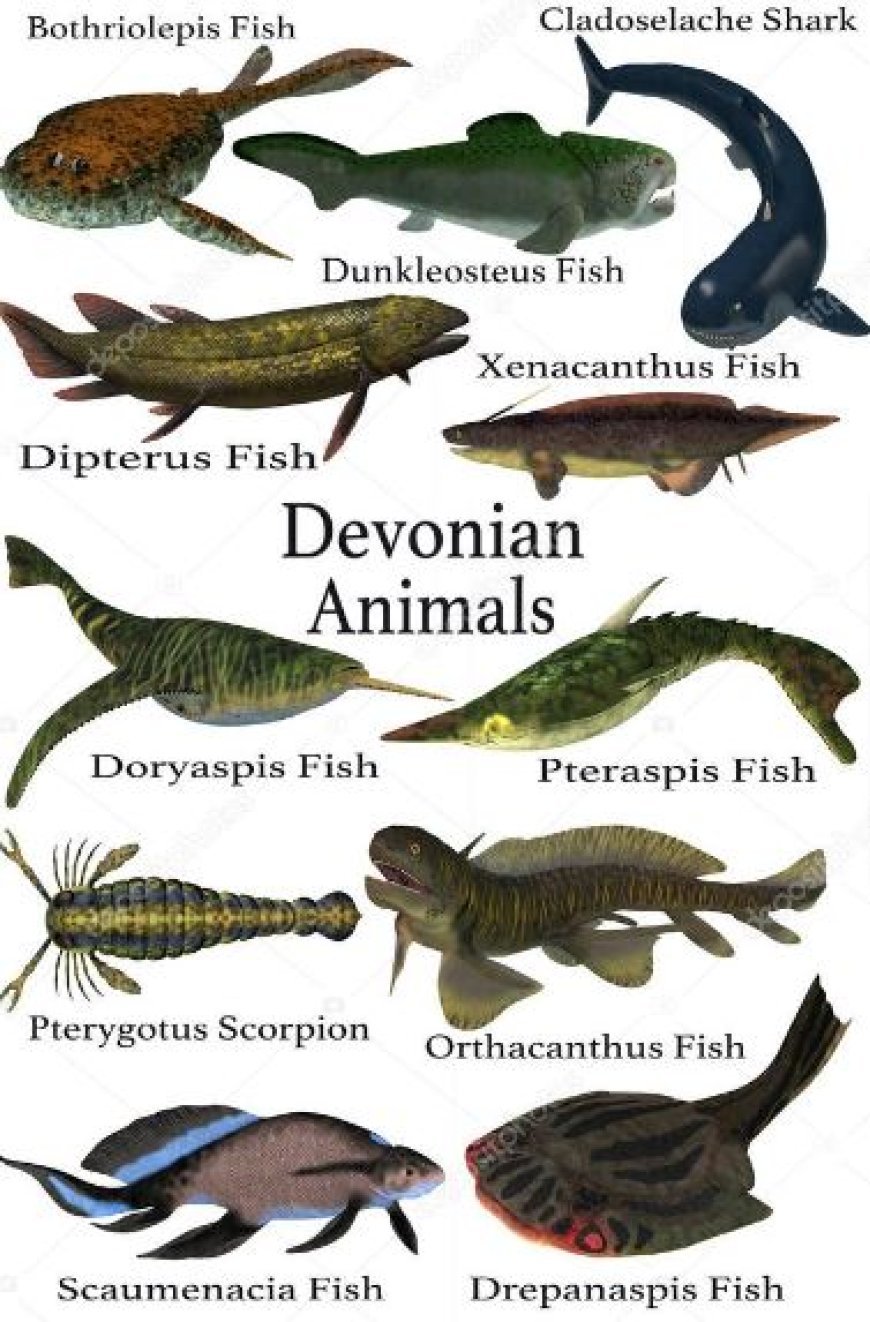
- During this period, a diverse array of fish was observed, including jawless fish like hagfish and lampreys. These are a few of the initial fish.
- The majority of fish today have swim bladders and bones to assist with flotation.
Sharks and rays have cartilage-based skeletons.
2. The Evolution of Fish
- Several fish, such as lobed-finned fish, evolved during this period and are considered the progenitors of amphibians.
- They have fleshy appendages that may one day enable them to move on land.
- The term "holy fish" denotes fish that possess unique characteristics that enable them to adjust to their environment.
3. Evolution of Fish Predators
- Predators evolved in tandem with the fish.
- A significant predator in Devonian waters was the Dunkleosteus, an enormous armoured fish.
4. Marine Ecosystems
- The Devonian waters were teeming with a variety of fish species, crustaceans, and coral reef.
5. Transition to Land
- Fish made significant progress in their evolution by exploring the land.
- They developed robust fins and lungs, which led to the development of the first amphibians after the Devonian.
The Mesozoic Era: The Age of Reptiles
- Time period: approximately 252 to 66 million years ago.Triassic, Jurassic, and Cretaceous comprise this epoch.
Mesozoic Era 
- Dinosaurs
- The Mesozoic period is renowned for its dinosaurs, which were both large and small.
- There were two primary groups.
- The saurischians group includes sauropods, including T. rex and Brontosaurus.
- The Ornithischians group includes crested dinosaurs like Triceratops and armoured dinosaurs like Stegosaurus.
- Flying Reptiles
- Pterosaurs, which possessed long appendages and skin-covered wings, dominated the skies.
- They varied in size from the scale of a crow to that of a tiny aeroplane.
3. Marine Reptiles
- Pleiosaurus, a species of reptile renowned for its large bodies and long necks, was prevalent in the ocean.
- Ichthyosaurs could swim at a swift pace, akin to dolphins.
- The Evolution of Birds and Mammals
- Mammals were first observed during the Mesozoic era.
- The animals were diminutive and covered in fur.
- The link between reptiles and birds is illustrated by the fact that birds were derived from diminutive theropod dinosaurs at the close of the period.
- Plant Life
- The era witnessed the emergence of flowering plants (angiosperms) and conifers, which altered the environment and enabled dinosaurs to access new food sources.
IMAGE SOURCE (THUMBNAIL)
What's Your Reaction?








ARUL PRASANTH
Arul Prasanth - MSc Geology graduate offering comprehensive study materials in Geology, Physics, and English. With a focus on clarity and effectiveness, I aim to provide students with the tools necessary for academic success.