














INTERPENETRATION TWINS IN CRYSTALS
Learn about interpenetration twins in crystals, their formation, characteristics, examples, and significance in crystallography. Detailed geology and mineralogy notes for students.
Interpenetration Twins in Crystals
Introduction
- Interpenetration Twinning is one of the most fascinating forms of crystal twinning observed in nature. In this type of twinning, two or more crystal individuals grow together in such a way that they appear to pass through one another. Unlike contact twins, where crystals meet along a common plane, interpenetration twins develop as interlocking crystal segments that share a definite crystallographic relationship.
- These twins often produce highly symmetrical and complex crystal shapes that attract the attention of mineralogists and crystallographers. Although the crystals appear to intersect each other, they are actually arranged according to specific crystallographic laws.
- Interpenetration twinning is important because it provides valuable information about crystal growth processes and symmetry relationships within minerals. Many common minerals display characteristic interpenetration twins that assist in mineral identification.
What are Interpenetration Twins?
- Interpenetration Twins are twin crystals in which two or more crystal individuals grow into and through each other while maintaining a definite crystallographic orientation.
- The twin individuals share the same chemical composition and crystal structure but differ in their spatial orientation.
- The crystals appear to penetrate one another without a distinct twin plane separating them.
- Their arrangement follows a specific twin law that determines the orientation of each crystal individual.
- The resulting crystal often appears highly symmetrical and geometrically complex.
Definition of Interpenetration Twinning
- Interpenetration twinning may be defined as the symmetrical intergrowth of two or more crystal individuals that penetrate one another according to a definite crystallographic law.
- The twin relationship is generally established through a rotational symmetry operation rather than reflection across a plane.
- The crystals maintain their individual crystal structures while sharing a common space.
Formation of Interpenetration Twins
- Interpenetration twins generally form during crystal growth.
- As crystals develop, two crystal nuclei may begin growing simultaneously in different but related orientations.
- Instead of growing separately, the crystals expand into each other while maintaining the twin relationship.
- The final structure appears as though one crystal passes through another.
- Growth conditions such as temperature, pressure, chemical composition, and available space influence the development of interpenetration twins.
Characteristics of Interpenetration Twins
- Consist of two or more crystal individuals.
- Crystal individuals belong to the same mineral species.
- The crystals possess identical chemical composition.
- The twin relationship follows a definite twin law.
- Twin individuals appear to grow through one another.
- No simple twin plane is visible as in contact twins.
- The crystal arrangement often exhibits striking symmetry.
- Interpenetration twins frequently form attractive and unusual crystal shapes.
Twin Law in Interpenetration Twins
- Every interpenetration twin follows a specific twin law.
- The twin law determines how the crystal individuals are oriented relative to one another.
- The relationship is usually described by a crystallographic axis or rotational operation.
- Understanding the twin law is essential for interpreting the geometry of interpenetration twins.
- Different minerals possess different twin laws, resulting in distinctive twin forms.
Mechanism of Formation
Growth Twinning
- Most interpenetration twins form during the process of crystal growth.
- Two crystal nuclei develop in orientations related by the twin law.
- As growth continues, the crystals expand into one another and form an interpenetrating structure.
- This is the most common mechanism responsible for interpenetration twinning.
Transformation Processes
- In some minerals, structural transformations caused by temperature changes may contribute to interpenetration twin formation.
- During the transformation, crystal segments may reorient according to twin relationships.
Pressure and Stress Effects
- Certain geological environments subject minerals to stress and pressure.
- These conditions may influence crystal growth and encourage twin formation.
- However, interpenetration twins are primarily considered growth twins.
Difference Between Contact Twins and Interpenetration Twins
- In Contact Twins, the crystal individuals are joined along a common twin plane.
- In Interpenetration Twins, the crystal individuals grow through one another.
- Contact twins possess a visible twin boundary.
- Interpenetration twins generally lack a simple twin plane.
- Contact twins resemble mirror images, whereas interpenetration twins often resemble interlocked crystals.
- Both forms follow definite twin laws but differ in their geometric arrangement.
Types of Interpenetration Twins
Simple Interpenetration Twins
- Consist of only two crystal individuals.
- The crystals intersect each other according to a single twin law.
- These twins are relatively easy to recognize.
Multiple Interpenetration Twins
- Consist of several crystal individuals arranged according to repeated twin relationships.
- These structures often produce highly complex crystal forms.
- Multiple twins may resemble star-shaped or cross-shaped crystals.
Examples of Interpenetration Twins
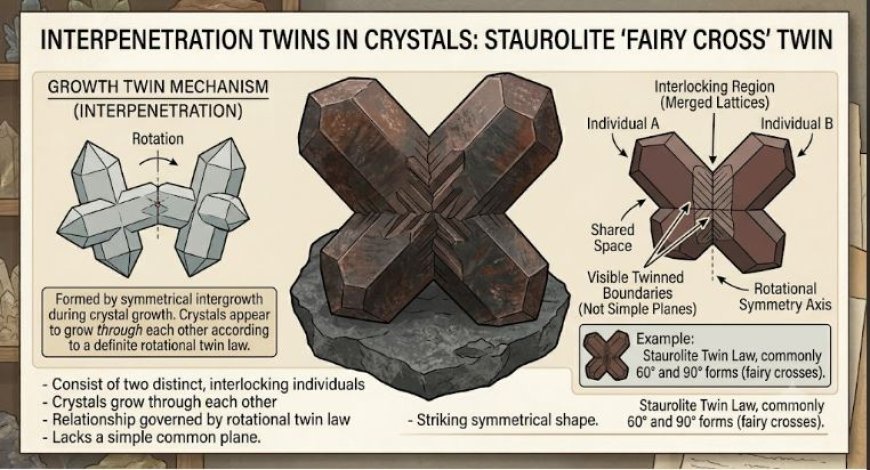
Staurolite Twins
- Staurolite is one of the most famous minerals exhibiting interpenetration twinning.
- The crystals often intersect at angles of approximately 60° or 90°.
- These cross-shaped crystals are popularly known as fairy crosses.
- Staurolite twins are widely used as textbook examples of interpenetration twinning.
Pyrite Twins
- Pyrite commonly develops interpenetration twins.
- These twins often involve pyritohedral crystal forms.
- The resulting crystal shapes are complex and highly symmetrical.
- Interpenetration twinning is an important identifying feature of some pyrite specimens.
Fluorite Twins
- Certain fluorite crystals display interpenetration twin relationships.
- These twins contribute to unusual crystal habits and geometrical patterns.
Spinel Twins
- Spinel frequently exhibits interpenetration twinning.
- Spinel twins are among the most studied examples in crystallography.
- The crystal individuals are related by a specific twin law characteristic of the mineral.
Recognition of Interpenetration Twins
- Interpenetration twins are recognized by their interlocking crystal appearance.
- Crystal faces may appear to pass through one another.
- Symmetrical repetition of crystal forms often indicates twinning.
- Mineralogists use crystallographic measurements to determine twin relationships.
- Optical and X-ray studies help confirm the presence of interpenetration twins.
Importance in Mineral Identification
- Interpenetration twins serve as important diagnostic features for several minerals.
- The presence of characteristic twin forms often helps identify minerals quickly.
- Minerals such as staurolite, spinel, and pyrite are commonly recognized through their twin structures.
- Twinning patterns provide valuable clues during field and laboratory investigations.
Geological Significance of Interpenetration Twins
- Interpenetration twins preserve information about crystal growth conditions.
- Their formation reflects the physical and chemical environment during mineral development.
- The study of these twins helps geologists understand crystallization processes.
- Twin structures may also provide evidence of geological events that influenced crystal growth.
Applications of Interpenetration Twin Studies
- Mineral identification
- Crystallographic analysis
- Petrographic investigations
- Crystal growth research
- Structural geology
- Gemstone studies
- Materials science
- Geological exploration
Advantages of Studying Interpenetration Twins
- Helps identify minerals accurately.
- Provides information about crystal growth mechanisms.
- Improves understanding of crystal symmetry.
- Assists in crystallographic classification.
- Supports geological and mineralogical research.
- Contributes to advanced materials science studies.
Relationship with Crystal Symmetry
- Interpenetration twins often create apparent symmetry higher than that of a single crystal.
- The combined twin structure may display geometric patterns not present in individual crystals.
- This phenomenon helps crystallographers understand the relationship between symmetry and crystal growth.
- Twin structures demonstrate how crystals can develop complex external forms while maintaining internal order.
Importance of Interpenetration Twins in Crystallography
- Interpenetration twins are among the most visually striking and scientifically important forms of crystal twinning.
- They provide excellent examples of crystallographic symmetry and crystal growth relationships.
- The study of interpenetration twins helps scientists understand how crystals develop under natural conditions and how twin laws influence crystal morphology.
- These twins are valuable tools in mineral identification, crystallographic research, and geological investigations.
- Because they occur in many important minerals and produce distinctive crystal shapes, interpenetration twins remain a fundamental topic in crystallography and mineralogy.
- Understanding interpenetration twins also provides a foundation for studying more advanced twinning phenomena such as Polysynthetic Twins and Twin Laws, which are essential for a complete understanding of crystal irregularities and crystal symmetry.
What's Your Reaction?