











MAGNETOSTRATIGRAPHY
Understand the science of magnetostriatgraphy, which reveals Earth's magnetic field reversals. Learn about its significance in reconstructing Earth's geological history.
- Introduction to Magnetostratigraphy
- Magnetostratigraphy is the study of magnetic characteristics in rock layers to determine their relative ages and correlation across locations.
- The goal is to create a timeline of rock formations based on the Earth's geomagnetic field reversals and to connect rock sequences with global magnetic polarity timeframes.
- Key Concepts
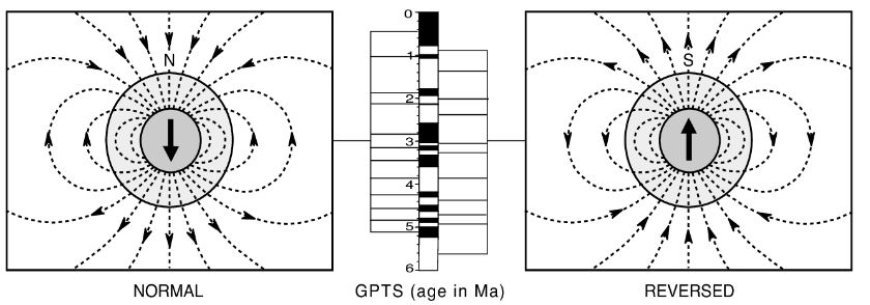
- Geomagnetic polarity reversals are changes in the Earth's magnetic field that occur when the north and south magnetic poles swap positions. These reversals are documented in volcanic rocks and sediments.
- The Magnetic Polarity Time Scale (MPTS) is a chronological framework that counts the timing of geomagnetic reversals and is used to date rock sequences.
- Magnetostratigraphic units
- Magnetic Chron: A time when the Earth's magnetic field was either normal or reversed.
- These serve as time units for dating rock sequences.
- Magnetic Subchron: A subset of magnetic chrons that represents shorter periods of steady magnetic polarity inside a chron.
- Magnetic anomalies are variations in the Earth's magnetic field observed in rocks and may be used to correlate and date stratigraphic sequences.
4. Magnetostratigraphy Techniques: Sampling and Measurement
- Core sampling involves collecting cylindrical samples from sedimentary or volcanic layers.
- Paleomagnetic analysis involves measuring the remanent magnetisation of rock samples with a magnetometer. This entails heating or demagnetising the samples to determine their magnetic characteristics.
Data analysis
- Magnetic inclination and declination are measurements of the angle of the Earth's magnetic field relative to a rock sample, which give information on its magnetic orientation.
- Magnetic Polarity: Whether the measured magnetic field is normal (north-seeking pole near the geographic north pole) or reversed (north-seeking pole near the geographical south pole).
5. Magnetostratigraphy applications include dating geological formations
- Chronostratigraphy is the process of dating rock formations using the Magnetic Polarity Time Scale.
- Absolute dating provides exact age limits for sedimentary and volcanic sequences by comparing them to known magnetic reversals.
Correlation of rock sequences
- Regional correlation is the process of linking rock units from various sites based on their magnetic polarity patterns.
- Global Correlation: Matching regional sequences to the global Magnetic Polarity Time Scale to get wider correlations.
Reconstructing Geological History
- Stratigraphic interpretation involves analysing the succession of magnetic reversals to better understand sedimentary and volcanic processes.
- Tectonic Activity: Investigating the impact of tectonic events on magnetic records and
- reconstructing previous plate movements.
6. Magnetic Polarity Time Scale: Construction
- Marine Magnetic Anomalies: magnetic anomalies detected in the oceanic crust and used to determine time scales.
- Continental Records: Magnetic data from continental rock sequences is linked with marine anomalies to further clarify the time scale.
Major Chrons and SubChrons
- Cenozoic: Includes chromosomes such as the Brunhes (normal polarity) and Matuyama (reversed polarity).
- Mesozoic: Jurassic and Cretaceous chronologies, including M0 and M1.
- Paleozoic: early chrones with less well-defined polarity patterns.
7. Challenges and limitations
- Incomplete records are gaps in the magnetic record caused by erosion, non-deposition, or local geological disturbances.
- Overprints: Magnetic overprints or changes can make it difficult to comprehend the original geomagnetic signal.
- Regional Variations: Magnetic signals vary according to local geological conditions or tectonic activity.
8. Case Studies and Examples
- Marine magnetic anomalies along mid-ocean ridges are being studied to better understand seafloor spreading rates and geomagnetic reversals.
- Volcanic Sequences: Analysis of volcanic materials to determine eruption dates and correlation with the geomagnetic polarity time scale.
- Sedimentary Basins: Combining sedimentary records with magnetic polarity data to better understand climatic and tectonic changes.
What's Your Reaction?








ARUL PRASANTH
Arul Prasanth - MSc Geology graduate offering comprehensive study materials in Geology, Physics, and English. With a focus on clarity and effectiveness, I aim to provide students with the tools necessary for academic success.